. 2023 Nov 2;13(1):18943.
doi: 10.1038/s41598-023-45787-9.

Angiogenic potential of skeletal muscle derived extracellular vesicles differs between oxidative and glycolytic muscle tissue in mice

Affiliations

Angiogenic potential of skeletal muscle derived extracellular vesicles differs between oxidative and glycolytic muscle tissue in mice

Christopher K Kargl et al. Sci Rep. .

Abstract

Skeletal muscle fibers regulate surrounding endothelial cells (EC) via secretion of numerous angiogenic factors, including extracellular vesicles (SkM-EV). Muscle fibers are broadly classified as oxidative (OXI) or glycolytic (GLY) depending on their metabolic characteristics. OXI fibers secrete more pro-angiogenic factors and have greater capillary densities than GLY fibers. OXI muscle secretes more EV than GLY, however it is unknown whether muscle metabolic characteristics regulate EV contents and signaling potential. EVs were isolated from primarily oxidative or glycolytic muscle tissue from mice. MicroRNA (miR) contents were determined and endothelial cells were treated with OXI- and GLY-EV to investigate angiogenic signaling potential. There were considerable differences in miR contents between OXI- and GLY-EV and pathway analysis identified that OXI-EV miR were predicted to positively regulate multiple endothelial-specific pathways, compared to GLY-EV. OXI-EV improved in vitro angiogenesis, which may have been mediated through nitric oxide synthase (NOS) related pathways, as treatment of endothelial cells with a non-selective NOS inhibitor abolished the angiogenic benefits of OXI-EV. This is the first report to show widespread differences in miR contents between SkM-EV isolated from metabolically different muscle tissue and the first to demonstrate that oxidative muscle tissue secretes EV with greater angiogenic signaling potential than glycolytic muscle tissue.


Conflict of interest statement

The authors declare no competing interests.

Figures
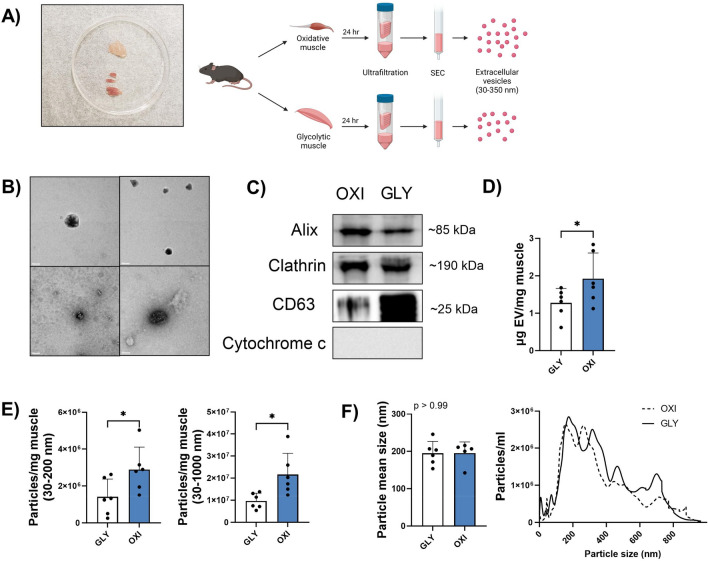
Figure 1
Figure 1
Oxidative muscle secretes more EVs than glycolytic. Representative image of oxidative (OXI) andglycolytic (GLY) muscle groups and schematic of EV isolation protocol (A). Transmission electron microscope (TEM) images of OXI- (top panels) and GLY- (bottom) (B). Representative western blotting images of EV markers ALIX, clathrin, and CD63 and the negative control cytochrome c; blot images have been cropped to display the bands of interest, full blot images are displayed in supplementary materials (C). EV release as measured by total protein concentration, normalized to muscle mass (D). EV concentration as measured by nanosight particle analysis at 30–200 nm and 30–1000 nm size ranges (E). Mean particle size and representative size distribution graph as measured by nanosight analysis (F). Statistical results are the output of paired Student’s t-tests. Mean + SD. n = 6 mice/group. Scale bar, 50 nm.
Figure 2
Figure 2
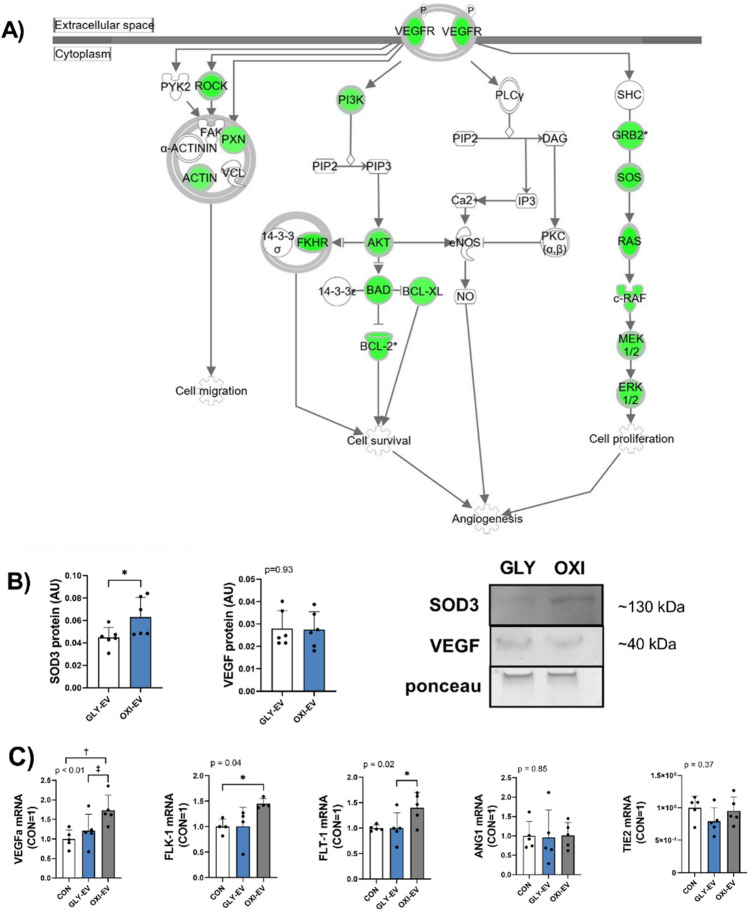
OXI- and GLY-EV miR differentially regulate angiogenic pathways. Ingenuity pathway analysis (IPA) generated vascular endothelial growth factor (VEGF) and angiogenesis pathway (A). Green denotes predicted gene downregulation by GLY-EV miR, compared to OXI-EV miR. EV protein contents of VEGF and superoxide dismutase 3 (SOD3), with representative blots, blot images have been cropped to display the bands of interest, full blot images are displayed in supplementary materials (B). HUVEC gene expression of angiogenesis-related factors (C). Gene expression statistical results are the output of repeated measures one-way ANOVA and are reported as a fold change, untreated control = 1. Mean + SD. *< 0.05; †< 0.01; ‡< 0.001. n = 6.
Figure 3
Figure 3
OXI-EV enhances EC migration and tube formation. Human umbilical vein endothelial cell (HUVEC) count, viability, and proliferation (% EdU + nuclei/total nuclei) following 48 h EV treatment (A). HUVEC tube formation with representative images (B). HUVEC migration with representative images (C). statistical results are the output of repeated measures one-way ANOVA with Tukey’s posthoc. Control represents HUVECs treated with vehicle only, no EVs. Scale bars = 200 μm. Mean + SD. *< 0.05; †< 0.01; n = 6.
Figure 4
Figure 4
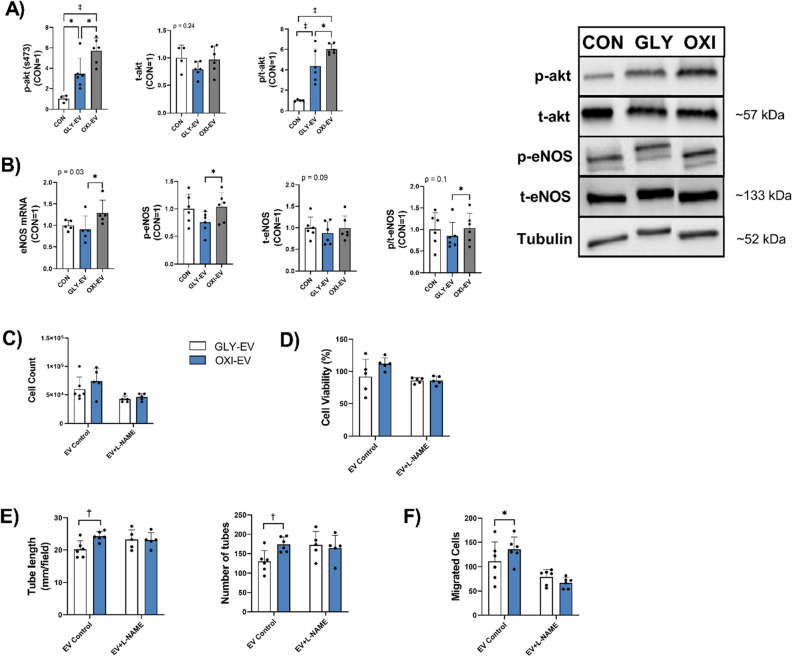
OXI-EV induced angiogenesis is mediated via NO signaling pathways. Protein expression of total and phosphorylated Akt, with representative blots (A). Gene and protein expression of total and phosphorylated endothelial nitric oxide synthase, with representative blots (B). Blot images have been cropped and arranged so that all bands of interest are displayed in the same order, full blot images are displayed in supplementary materials. HUVEC counts (C), viability (D), tube length and number of tubes (E), and migrated cells (F) under control and L-NAME conditions in the presence of EV treatments. Gene expression is reported as a fold change, with untreated controls = 1. Statistical results are the output of repeated measures one-way ANOVAs and student’s t-tests (EV + L-NAME comparisons). Mean + SD. *< 0.05; †< 0.01; ‡< 0.001. n = 6.

References

    1. Gavin TP. Basal and exercise-induced regulation of skeletal muscle capillarization. Exerc. Sport Sci. Rev. 2009;37:86–92. doi: 10.1097/JES.0b013e31819c2e9b. - DOI - PMC - PubMed
    1. Brodal P, Ingjer F, Hermansen L. Capillary supply of skeletal muscle fibers in untrained and endurance-trained men. Am. J. Physiol.-Heart Circ. Physiol. 1977;232:H705–H712. doi: 10.1152/ajpheart.1977.232.6.H705. - DOI - PubMed
    1. Gustafsson T, et al. VEGF-A splice variants and related receptor expression in human skeletal muscle following submaximal exercise. J. Appl. Physiol. Bethesda Md. 2005;1985(98):2137–2146. - PubMed
    1. Olfert IM, et al. Muscle-specific VEGF deficiency greatly reduces exercise endurance in mice. J. Physiol. 2009;587:1755–1767. doi: 10.1113/jphysiol.2008.164384. - DOI - PMC - PubMed
    1. Florczyk U, et al. Nrf2 regulates angiogenesis: Effect on endothelial cells, bone marrow-derived proangiogenic cells and hind limb ischemia. Antioxid. Redox Signal. 2014;20:1693–1708. doi: 10.1089/ars.2013.5219. - DOI - PMC - PubMed

Publication types