


Prevention of postoperative atrial fibrillation in cardiac surgery: a quality improvement project
- PMID: 37919634
- PMCID: PMC10709480
- DOI: 10.1007/s12630-023-02619-8
Prevention of postoperative atrial fibrillation in cardiac surgery: a quality improvement project
Abstract
Purpose: Postoperative atrial fibrillation (POAF) has an incidence of 20-60% in cardiac surgery. The Society of Cardiovascular Anesthesiologists and the European Association of Cardiothoracic Anaesthesiology Practice Advisory have recommended postoperative beta blockers and amiodarone for the prevention of POAF. By employing quality improvement (QI) strategies, we sought to increase the use of these agents and to reduce the incidence of POAF among our patients undergoing cardiac surgery.
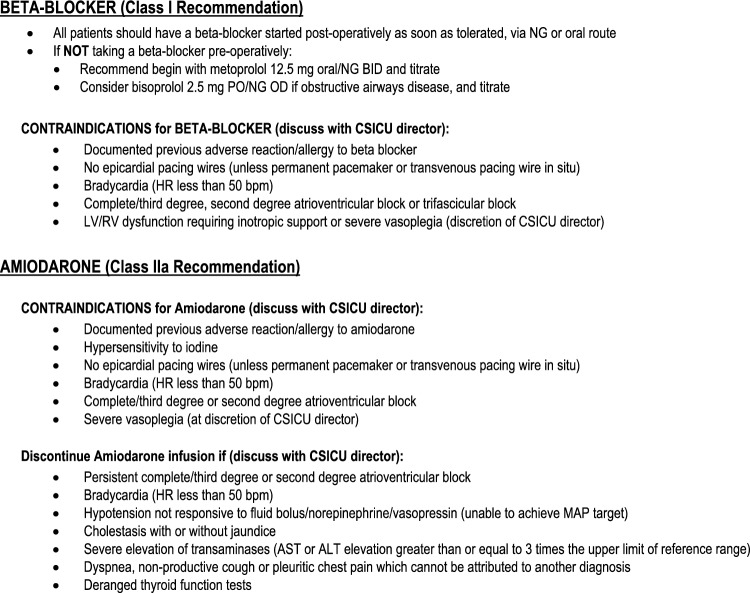
Methods: This single-centre QI initiative followed the traditional Plan, Do, Study, Act (PDSA) cycle scientific methodology. A POAF risk score was developed to categorize all patients undergoing cardiac surgery as either normal or elevated risk. Risk stratification was incorporated into a preprinted prescribing guide, which recommended postoperative beta blockade for all patients and a postoperative amiodarone protocol for patients with elevated risk starting on postoperative day one (POD1). A longitudinal audit of all patients undergoing cardiac surgery was conducted over 11 months to track the use of prophylactic medications and the incidence of POAF.
Results: Five hundred and sixty patients undergoing surgery were included in the QI initiative from 1 December 2020 to 1 November 2021. The baseline rate of POAF across all surgical subtypes was 39% (198/560). The use of prophylactic amiodarone in high-risk patients increased from 13% (1/8) at the start of the project to 41% (48/116) at the end of the audit period. The percentage of patients receiving a beta blocker on POD1 did fluctuate, but remained essentially unchanged throughout the audit (34.8% in December 2020 vs 46.7% in October 2021). After 11 months, the overall incidence of POAF was 29% (24.9% relative reduction). Notable reductions in the incidence of POAF were observed in more complex surgical subtypes by the end of the audit, including multiple valve replacement (89% vs 56%), aortic repair (50% vs 33%), and mitral valve surgery (45% vs 33%).
Conclusions: This single-centre QI intervention increased the use of prophylactic amiodarone by 28% for patients at elevated risk of POAF, with no change in the early postoperative initiation of beta blockers (46.7% of patients by POD1). There was a notable reduction in the incidence of POAF in patients at elevated risk undergoing surgery.
RéSUMé: OBJECTIF: Il y a une incidence de 20 à 60 % de fibrillation auriculaire postopératoire (FAPO) en chirurgie cardiaque. Dans un avis de pratique, la Society of Cardiovascular Anesthesiologists et l’European Association of Cardiothoracic Anaesthesiology ont recommandé l’utilisation de bêtabloquants et d’amiodarone en postopératoire pour la prévention du FAPO. En employant des stratégies d’amélioration de la qualité (AQ), nous avons cherché à augmenter l’utilisation de ces agents et à réduire l’incidence de FAPO chez nos patient·es bénéficiant d’une chirurgie cardiaque. MéTHODE: Cette initiative d’AQ monocentrique a suivi la méthodologie scientifique traditionnelle du cycle Plan, Do, Study, Act (PDSA), soit Planifier, Réaliser, Étudier, Agir. Un score de risque de FAPO a été mis au point pour catégoriser toute la patientèle bénéficiant d’une chirurgie cardiaque comme présentant un risque normal ou élevé. La stratification du risque a été intégrée dans un guide de prescription préimprimé, qui recommandait des bêtabloquants en période postopératoire pour tou·tes les patient·es et un protocole postopératoire d’amiodarone pour celles et ceux présentant un risque élevé et débutant à partir du premier jour postopératoire (JPO1). Une vérification longitudinale de toute la patientèle bénéficiant d’une chirurgie cardiaque a été menée sur une période de 11 mois afin de suivre l’utilisation de médicaments prophylactiques et l’incidence de FAPO. RéSULTATS: Cinq cent soixante personnes opérées ont été incluses dans l’initiative d’AQ entre le 1er décembre 2020 et le 1er novembre 2021. Le taux initial de FAPO pour tous les sous-types chirurgicaux était de 39 % (198/560). L’utilisation d’amiodarone prophylactique chez les patient·es à risque élevé est passée de 13 % (1/8) au début du projet à 41 % (48/116) à la fin de la période de vérification. Le pourcentage de patient·es recevant un bêtabloquant au JPO1 a fluctué, mais est resté fondamentalement inchangé tout au long de la période de vérification (34,8 % en décembre 2020 vs 46,7 % en octobre 2021). Après 11 mois, l’incidence globale de FAPO était de 29 % (réduction relative de 24,9 %). Des réductions notables de l’incidence de FAPO ont été observées dans des sous-types chirurgicaux plus complexes à la fin de la vérification, y compris le remplacement de plusieurs valves (89 % vs 56 %), la réparation aortique (50 % vs 33 %) et la chirurgie valvulaire mitrale (45 % vs 33 %). CONCLUSION: Cette intervention monocentrique d’amélioration de la qualité a augmenté l’utilisation de l’amiodarone prophylactique de 28 % chez les patient·es présentant un risque élevé de FAPO, sans changement dans l’amorce postopératoire précoce des bêtabloquants (46,7 % des patient·es au JPO1). Il y a eu une réduction notable de l’incidence de FAPO chez les patient·es à risque élevé bénéficiant d’une intervention chirurgicale.
Keywords: amiodarone; postoperative atrial fibrillation; prophylaxis; quality improvement.
© 2023. The Author(s).
Conflict of interest statement
None.
Figures



References
-
- Muehlschlegel JD, Burrage PS, Ngai JY, et al. Society of Cardiovascular Anesthesiologists/European Association of Cardiothoracic Anaesthetists practice advisory for the management of perioperative atrial fibrillation in patients undergoing cardiac surgery. Anesth Analg. 2019;128:33–42. doi: 10.1213/ane.0000000000003865. - DOI - PubMed
-
- Tseng YH, Ko HK, Tseng YC, Lin YH, Kou YR. Atrial fibrillation on intensive care unit admission independently increases the risk of weaning failure in nonheart failure mechanically ventilated patients in a medical intensive care unit: a retrospective case-control study. Medicine (Baltimore) 2016;95:e3744. doi: 10.1097/md.0000000000003744. - DOI - PMC - PubMed
MeSH terms
Substances
LinkOut - more resources
Full Text Sources
Medical
