. 2023 Dec;28(6):232.
doi: 10.3892/mmr.2023.13119. Epub 2023 Nov 3.

A novel nutraceutical formulation increases telomere length and activates telomerase activity in middle‑aged rats

Affiliations

A novel nutraceutical formulation increases telomere length and activates telomerase activity in middle‑aged rats

Aristidis Tsatsakis et al. Mol Med Rep. 2023 Dec.

Abstract

Telomeres are major contributors to cell fate and aging through their involvement in cell cycle arrest and senescence. The accelerated attrition of telomeres is associated with aging‑related diseases, and agents able to maintain telomere length (TL) through telomerase activation may serve as potential treatment strategies. The aim of the present study was to assess the potency of a novel telomerase activator on TL and telomerase activity in vivo. The administration of a nutraceutical formulation containing Centella asiatica extract, vitamin C, zinc and vitamin D3 in 18‑month‑old rats for a period of 3 months reduced the telomere shortening rate at the lower supplement dose and increased mean the TL at the higher dose, compared to pre‑treatment levels. TL was determined using the Q‑FISH method in peripheral blood mononuclear cells collected from the tail vein of the rats and cultured with RPMI‑1640 medium. In both cases, TLs were significantly longer compared to the untreated controls (P≤0.001). In addition, telomerase activity was increased in the peripheral blood mononuclear cells of both treatment groups. On the whole, the present study demonstrates that the nutraceutical formulation can maintain or even increase TL and telomerase activity in middle‑aged rats, indicating a potential role of this formula in the prevention and treatment of aging‑related diseases.

Keywords: Centella asiatica; dietary supplements; in vivo; telomerase activity; telomere length.


Conflict of interest statement

DAS is the Editor-in-Chief for the journal, but had no personal involvement in the reviewing process, or any influence in terms of adjudicating on the final decision, for this article. DT is a scientific advisor for Natural Doctor S.A. The other authors declare that they have no competing interests.

Figures
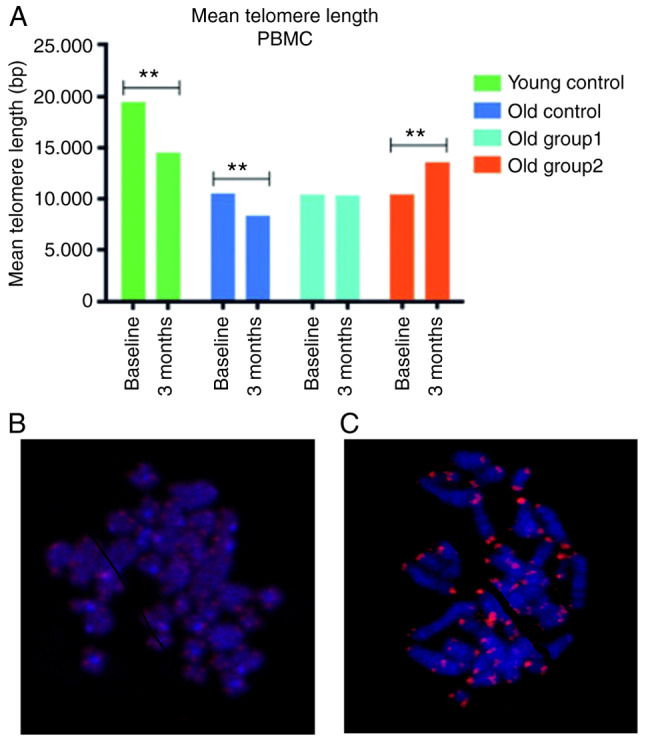
Figure 1.
Figure 1.
(A) PBMC mean telomere length values (bp), at baseline and post-treatment (3 months). Horizontal bars with two asterisks (**) indicate significant comparisons at P<0.01 in paired comparisons. (B) An indicative image from Q-FISH analysis is presented from the old group 2 pre-treatment. (C) An indicative image from Q-FISH analysis is presented from the old group 2 post-treatment. PBMC, peripheral blood mononuclear cell.
Figure 2.
Figure 2.
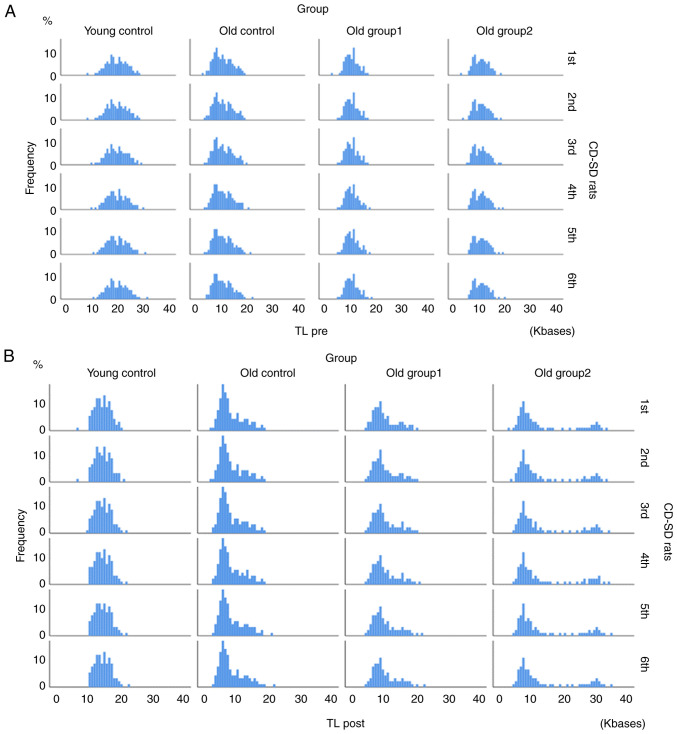
Histograms for the TL distribution per treatment group and per animal of Sprague-Dawley rats at (A) baseline (start of the experiment) and (B) 3 months following the onset of the experiments. TL, telomere length.
Figure 3.
Figure 3.
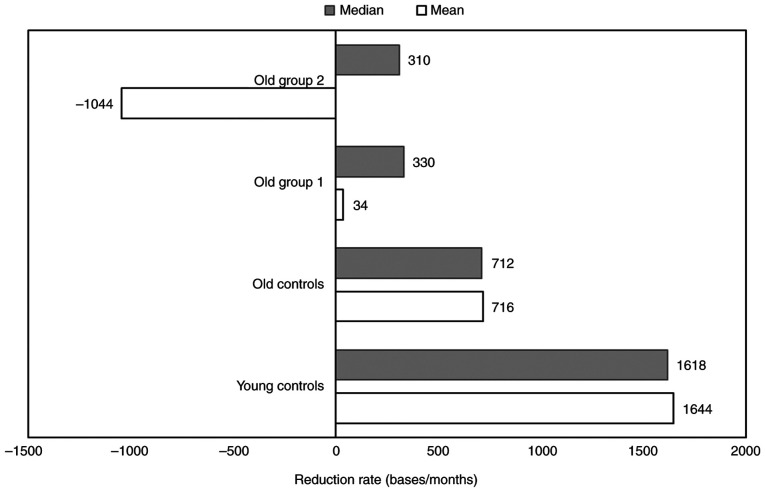
Mean and median reduction rate of TL (bases/month) during the 3-month experimental period, for each group separately (treated: old group 2 and old group 1; untreated: old controls, young controls). Negative values of mean reduction rate of TL of old group 2 (−1,044 bases/month) indicate telomere elongation, mean reduction rate of TL of old group 1 (34 bases/month), lower than both control groups (old controls, 716 bases/month; and young controls, 1,644 bases/month). TL, telomere length.
Figure 4.
Figure 4.
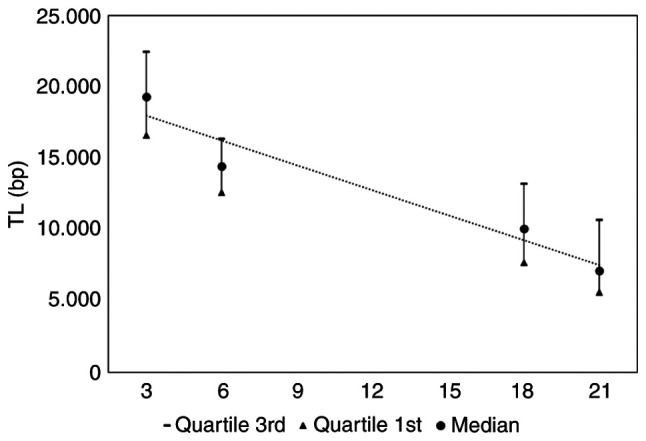
The TL scatterplot with error bars of the median TL (bp) (dots) and inter-quartile range (bars) at different time points (months) in the control groups representing the effects of aging on TL (young controls, 3 to 6 months; old controls, 18 to 21 months). TL, telomere length.
Figure 5.
Figure 5.
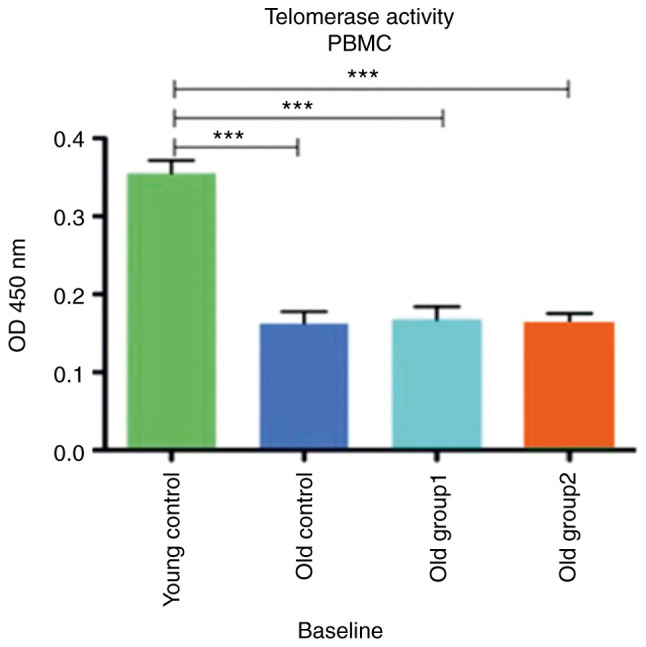
Mean PBMC telomerase activity at baseline expressed as OD450 fluorescence arbitrary units. Vertical bars represent the standard deviation of measurements. The three asterisks (***) resulting from Dunnett's post hoc tests indicate significant differences in comparisons between the young control vs. the other groups (P<0.001). PBMC, peripheral blood mononuclear cell.
Figure 6.
Figure 6.
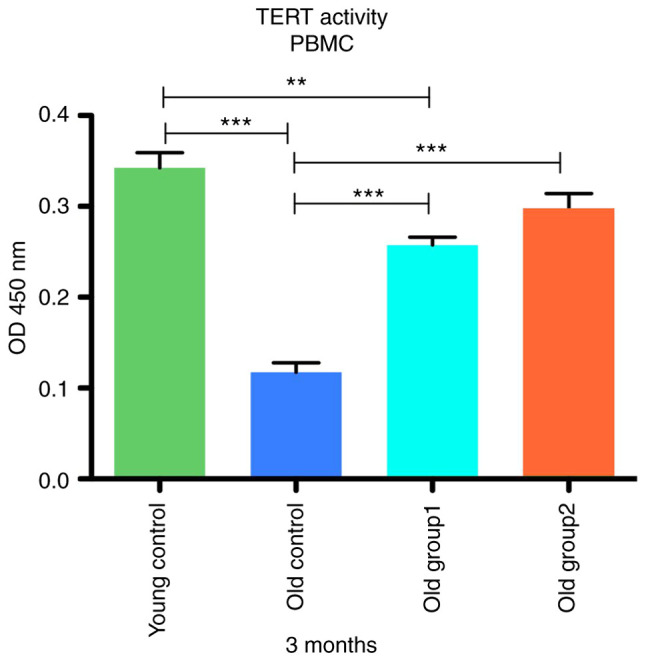
Mean PBMC telomerase activity after 3 months of exposure expressed as OD450 fluorescence presented as colored bars. Vertical thin bars represent the standard deviation of measurements. The horizontal bars indicate the significance of the two groups' comparisons using post hoc tests. The two (**) or three (***) asterisks refer to P<0.01 and P<0.001 significant differences, respectively between groups. PBMC, peripheral blood mononuclear cell.
Figure 7.
Figure 7.
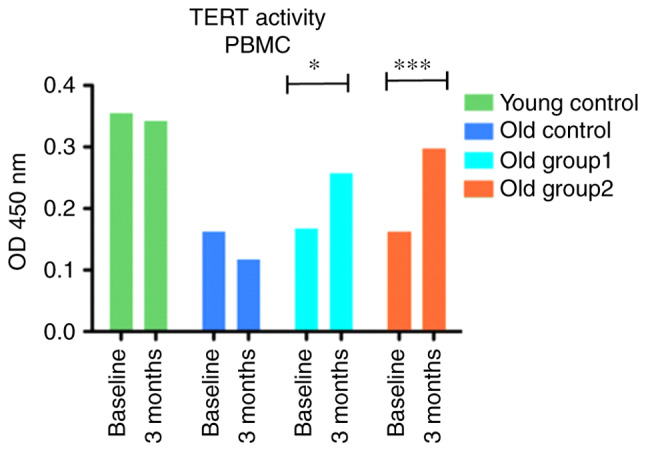
Mean PBMC telomerase activity expressed as OD450 fluorescence at baseline and post-treatment (3 months). Horizontal thin bars indicate significant differences within groups between baseline and post-treatment. Three (***) and one (*) asterisk indicate significant comparisons at the P<0.001 and P<0.05 levels, respectively. PBMC, peripheral blood mononuclear cell.

References

    1. Chakravarti D, LaBella KA, De Pinho RA. Telomeres: History, health, and hallmarks of aging. Cell. 2021;184:306–322. doi: 10.1016/j.cell.2020.12.028. - DOI - PMC - PubMed
    1. Poole JC, Andrews LG, Tollefsbol TO. Activity, function, and gene regulation of the catalytic subunit of telomerase (hTERT) Gene. 2001;269:1–12. doi: 10.1016/S0378-1119(01)00440-1. - DOI - PubMed
    1. Razgonova MP, Zakharenko AM, Golokhvast KS, Thanasoula M, Sarandi E, Nikolouzakis K, Fragkiadaki P, Tsoukalas D, Spandidos DA, Tsatsakis A. Telomerase and telomeres in aging theory and chronographic aging theory (Review) Mol Med Rep. 2020;22:1679–1694. doi: 10.3892/mmr.2020.11274. - DOI - PMC - PubMed
    1. Maciejowski J, de Lange T. Telomeres in cancer: Tumour suppression and genome instability. Nat Rev Mol Cell Biol. 2017;18:175–186. doi: 10.1038/nrm.2016.171. - DOI - PMC - PubMed
    1. Hao LY, Armanios M, Strong MA, Karim B, Feldser DM, Huso D, Greider CW. Short telomeres, even in the presence of telomerase, limit tissue renewal capacity. Cell. 2005;123:1121–1131. doi: 10.1016/j.cell.2005.11.020. - DOI - PubMed