Observational Study
. 2023 Nov 5;13(1):19119.
doi: 10.1038/s41598-023-46268-9.

Years of life lost and long-term outcomes due to glomerular disease in a Southeast Asian Cohort

Affiliations
Observational Study

Years of life lost and long-term outcomes due to glomerular disease in a Southeast Asian Cohort

Chitimaporn Janphram et al. Sci Rep. .

Abstract

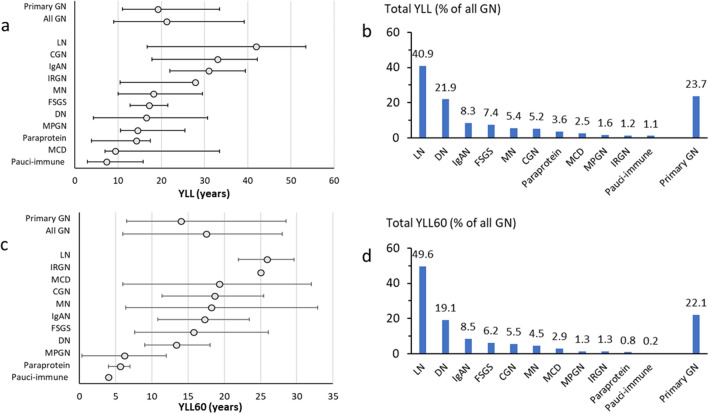
Death and end-stage kidney disease (ESKD) are major outcomes of glomerular disease. (GD) The years of potential life lost (YLL) may provide additional insight into the disease burden beyond death rates. There is limited data on premature mortality in GD. In this retrospective observational cohort study, we evaluated the mortality, ESKD rates, and YLL in Thais with biopsy-proven GD. The mortality and combined outcome rates were determined by log-rank test and ESKD by using a competing risk model. YLL and premature life lost before age 60 were calculated for different GD based on the life expectancy of the Thai population. Patients with GD (n = 949) were followed for 5237 patient years. The death rate and ESKD rates (95%CI) were 4.2 (3.7-4.9) and 3.3 (2.9-3.9) per 100 patient-years, respectively. Paraprotein-related kidney disease had the highest death rate, and diabetic nephropathy had the highest ESKD rate. Despite not having the highest death rate, lupus nephritis (LN) had the highest YLL (41% of all GD) and premature loss of life before age 60. In conclusion, YLL provided a different disease burden assessment compared to mortality rates and identified LN as the major cause of premature death due to GD in a Southeast Asian cohort.


Conflict of interest statement

The authors declare no competing interests.

Figures

Figure 1
Figure 1
Study flow.
Figure 2
Figure 2
The cumulative incidence of outcomes for different GD (n = 949). (a) Death. (b) End-stage kidney disease (ESKD). (c) Combined events (death or ESKD).
Figure 3
Figure 3
Years of life lost (YLL) by GD types (including diabetes). (a) All patients: Median YLL. Open circle denotes median with ends representing 25 and 75 percentile. (b) All patients: Proportion of total YLL. (c) Premature death before age 60: Median YLL60. Open circle denotes median with ends representing 25 and 75 percentile. (d) Premature death before age 60: Proportion of total YLL60.

References

    1. Kovesdy CP. Epidemiology of chronic kidney disease: An update 2022. Kidney Int. Suppl. 2022;12(1):7–11. doi: 10.1016/j.kisu.2021.11.003. - DOI - PMC - PubMed
    1. Xie Y, Bowe B, Mokdad AH, Xian H, Yan Y, Li T, et al. Analysis of the Global Burden of Disease study highlights the global, regional, and national trends of chronic kidney disease epidemiology from 1990 to 2016. Kidney Int. 2018;94(3):567–581. doi: 10.1016/j.kint.2018.04.011. - DOI - PubMed
    1. Liyanage T, Ninomiya T, Jha V, Neal B, Patrice HM, Okpechi I, et al. Worldwide access to treatment for end-stage kidney disease: A systematic review. The Lancet. 2015;385(9981):1975–1982. doi: 10.1016/S0140-6736(14)61601-9. - DOI - PubMed
    1. Wetmore JB, Guo H, Liu J, Collins AJ, Gilbertson DT. The incidence, prevalence, and outcomes of glomerulonephritis derived from a large retrospective analysis. Kidney Int. 2016;90(4):853–860. doi: 10.1016/j.kint.2016.04.026. - DOI - PubMed
    1. O'Shaughnessy MM, Montez-Rath ME, Lafayette RA, Winkelmayer WC. Patient characteristics and outcomes by GN subtype in ESRD. Clin. J. Am. Soc. Nephrol. 2015;10(7):1170–1178. doi: 10.2215/CJN.11261114. - DOI - PMC - PubMed

Publication types

MeSH terms