


Prevention strategies for sexually transmitted infections, HIV, and viral hepatitis in Europe
- PMID: 37927439
- PMCID: PMC10625023
- DOI: 10.1016/j.lanepe.2023.100738
Prevention strategies for sexually transmitted infections, HIV, and viral hepatitis in Europe
Abstract
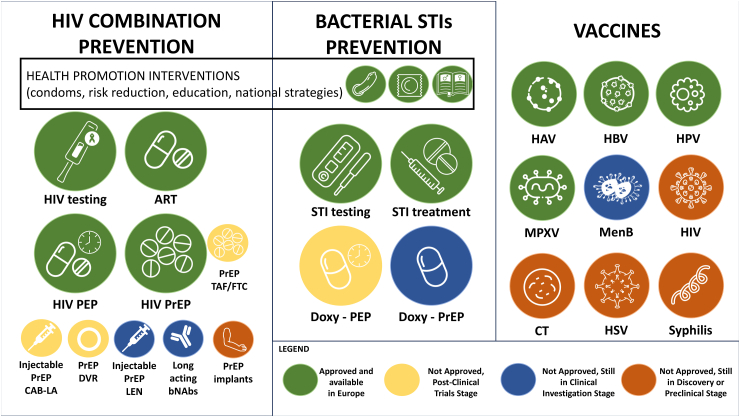
The current prevention efforts for STIs, HIV and viral hepatitis in the WHO European Region, especially in the Central and Eastern subregions, are hindered by healthcare disparities, data gaps, and limited resources. In this comprehensive narrative review, we aim to highlight both achievements and persisting challenges while also exploring new developments that could significantly impact the prevention of these infections in the near future. While pre-exposure prophylaxis (PrEP) for HIV has been broadly approved and implemented in 38 out of 53 countries in the region, challenges remain, including cost, limited licensing, and incomplete adherence. We explore innovative approaches like on-demand PrEP, long-acting injectable cabotegravir, and intravaginal rings that have shown promising results, alongside the use of six-monthly lenacapavir, the outcomes of which are pending. Additionally, the potential of doxycycline post-exposure prophylaxis has been discussed, revealing efficacy in reducing chlamydia and syphilis risk, but effectiveness against gonorrhoea being contingent on tetracycline resistance rates, and the need of further data to determine potential resistance development in other bacteria and its impact on the gut microbiome. We examine successful vaccination campaigns against HBV and HPV, the ongoing development of vaccines for chlamydia, syphilis, herpesvirus, and gonorrhoea, and challenges in HIV vaccine research, including lines of research with significant potential like sequential immunization, T-cell responses, and mRNA technology. This review underscores the research endeavors that pave the way for a more resilient and robust approach to combating STIs, HIV, and viral hepatitis in the region.
Keywords: Chlamydia; Gonorrhea; HIV; HPV; Hepatitis B or C; Post-exposure prophylaxis; Pre-exposure prophylaxis; Prevention vaccine; Syphilis; sexually transmitted infections.
© 2023 The Author(s).
Conflict of interest statement
Deniz Gökengin attends advisory board meetings for Gilead, GSK, and MSD, and receives grant from GSK. Jean Michel Molina reported receiving grants from Merck for a treatment trial funded by ANRS, payments for serving on advisory boards of ViiV, Gilead, and Merck, expert testimony payments from Merck and a payment from Aelix for participation on an advisory board. Geoffroy Liegeon has received drugs from Gilead Sciences and ViiV Healthcare for two academic-funded PrEP clinical trials. The remaining authors have nothing to declare.
Figures

References
-
- ECDC. WHO . 2022. HIV/AIDS surveillance in Europe 2022: 2021 data.https://www.ecdc.europa.eu/sites/default/files/documents/2022-Annual_HIV...
-
- Global health sector strategies on, respectively, HIV, viral hepatitis and sexually transmitted infections for the period 2022-2030. https://www.who.int/publications/i/item/9789240053779
-
- Continuum of HIV care - monitoring implementation of the Dublin Declaration on partnership to fight HIV/AIDS in Europe and central Asia. European Centre for Disease Prevention and Control; 2021. progress report. - DOI
-
- Geretti A.M., Mardh O., de Vries H.J.C., et al. Sexual transmission of infections across Europe: appraising the present, scoping the future. Sex Transm Infect. 2022 - PubMed
Publication types
LinkOut - more resources
Full Text Sources
Miscellaneous
