


Evolving community structure in the international pesticide trade networks
- PMID: 37928009
- PMCID: PMC10623292
- DOI: 10.1016/j.heliyon.2023.e21076
Evolving community structure in the international pesticide trade networks
Abstract
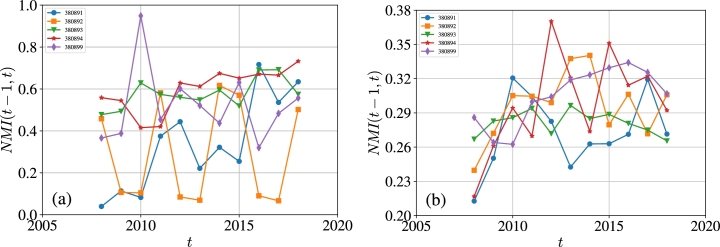
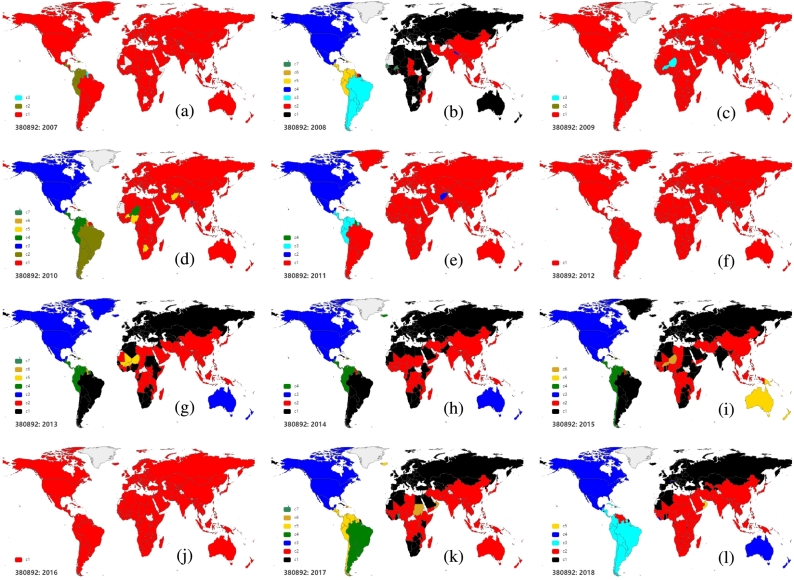
The statistical properties of the international trade networks of all commodities as a whole have been extensively studied. However, the international trade networks of individual commodities often behave differently. Due to the importance of pesticides in agricultural production and food security, we investigated the evolving community structure in the international pesticide trade networks (iPTNs) of five categories from 2007 to 2018. We reveal that the community structures in the undirected and directed iPTNs exhibit regional patterns. However, the regional patterns are very different for undirected and directed networks and for different categories of pesticides. Moreover, the community structure is more stable in the directed iPTNs than in the undirected iPTNs. We also extract the intrinsic community blocks for the directed international trade networks of each pesticide category. It is found that the largest intrinsic community block is the most stable, appears in every pesticide category, and contains important economies (Belgium, Germany, Spain, France, the United Kingdom, Italy, the Netherlands, and Portugal) in Europe. Other important and stable intrinsic community blocks are Canada and the United States in North America, Argentina and Brazil in South America, and Australia and New Zealand in Oceania. These results suggest that, in the international trade of pesticides, geographic distance and the complementarity of important and adjacent economies are significant factors.
Keywords: Community structure; Econophysics; International pesticide trade network; Intrinsic community block; Regional pattern; Temporal network.
© 2023 The Author(s).
Conflict of interest statement
The authors declare that they have no known competing financial interests or personal relationships that could have appeared to influence the work reported in this paper.
Figures





References
-
- Food Security Information Network . May 2021. https://www.wfp.org/publications/global-report-food-crises-2021 Global Report on Food Crises 2021.
-
- Garlaschelli D., Loffredo M.I. Structure and evolution of the world trade network. Physica A. 2005;355:138–144. doi: 10.1016/j.physa.2005.02.075. - DOI
-
- Garlaschelli D., Di Matteo T., Aste T., Caldarelli G., Loffredo M.I. Interplay between topology and dynamics in the world trade web. Eur. Phys. J. B. 2007;57:159–164. doi: 10.1140/epjb/e2007-00131-6. - DOI
LinkOut - more resources
Full Text Sources
