


A novel intervention for treating adults with ADHD using peripheral visual stimulation
- PMID: 37928920
- PMCID: PMC10623343
- DOI: 10.3389/fpsyt.2023.1280440
A novel intervention for treating adults with ADHD using peripheral visual stimulation
Abstract
Objective: Stimulation of the peripheral visual field has been previously reported as beneficial for cognitive performance in ADHD. This study assesses the safety and efficacy of a novel intervention involving peripheral visual stimuli in managing attention deficit hyperactivity disorder (ADHD).
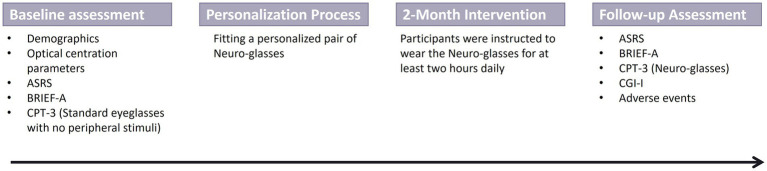
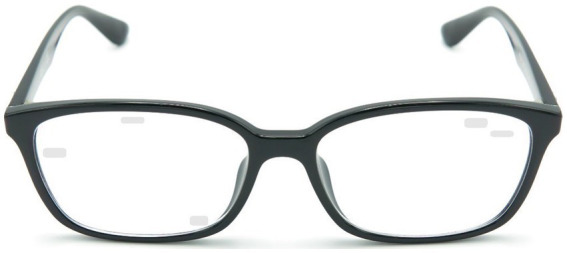
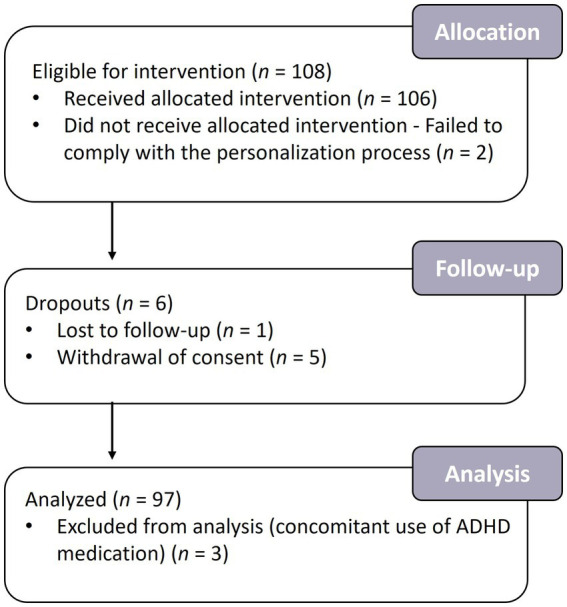
Methods: One hundred and eight adults, 18-40 years old, with ADHD, were enrolled in a two-month open-label study. The intervention (i.e., Neuro-glasses) consisted of standard eyeglasses with personalized peripheral visual stimuli embedded on the lenses. Participants were assessed at baseline and at the end of the study with self-report measures of ADHD symptoms (the Adult ADHD Self-Report Scale; ASRS), and executive functions (The Behavior Rating Inventory of Executive Function Adult Version; BRIEF-A). A computerized test of continuous performance (The Conners' Continuous Performance Test-3; CPT-3) was tested at baseline with standard eyeglasses and at the end of study using Neuro-glasses. The Clinical Global Impression-Improvement scale (CGI-I) was assessed at the intervention endpoint. Safety was monitored by documentation of adverse events.
Results: The efficacy analysis included 97 participants. Significant improvements were demonstrated in self-reported measures of inattentive symptoms (ASRS inattentive index; p = 0.037) and metacognitive functions concerning self-management and performance monitoring (BRIEF-A; p = 0.029). A continuous-performance test (CPT-3) indicated significant improvement in detectability (d'; p = 0.027) and reduced commission errors (p = 0.004), suggesting that the Neuro-glasses have positive effects on response inhibition. Sixty-two percent of the participants met the response criteria assessed by a clinician (CGI-I). No major adverse events were reported.
Conclusion: Neuro-glasses may offer a safe and effective approach to managing adult ADHD. Results encourage future controlled efficacy studies to confirm current findings in adults and possibly children with ADHD.Clinical trial registration: https://www.clinicaltrials.gov/, Identifier NCT05777785.
Keywords: ADHD; ADHD intervention; Adult ADHD; peripheral vision; peripheral visual stimulation.
Copyright © 2023 Richter, Gordon, Vainstein, Bublil-Mor, Geisinger, Meital-Kfir and Elyoseph.
Conflict of interest statement
YR, CG, DG, NM-K, and CB-M are employees of VIZO-Specs Ltd. ZE and GV are consultants for VIZO-Specs Ltd. The author(s) declare financial support was received for the research, authorship, and/or publication of this article. This study received funding from VIZO-Specs Ltd. The funder had the following involvement with the study: study design, data collection, analysis, interpretation of data, the writing of this article, and the decision to submit it for publication.
Figures
References
-
- Visser SN, Danielson ML, Bitsko RH, Holbrook JR, Kogan MD, Ghandour RM, et al. Trends in the parent-report of health care provider-diagnosed and medicated attention-deficit/hyperactivity disorder: United States, 2003–2011. J Am Acad Child Adolesc Psychiatry. (2014) 53:34–46.e2. doi: 10.1016/j.jaac.2013.09.001, PMID: - DOI - PMC - PubMed
Associated data
LinkOut - more resources
Full Text Sources
Medical
Miscellaneous
