Review
. 2023 Nov 6;7(11):e0297.
doi: 10.1097/HC9.0000000000000297. eCollection 2023 Nov 1.

The Impact and Burden of Dietary Sugars on the Liver

Affiliations
Review

The Impact and Burden of Dietary Sugars on the Liver

Helaina E Huneault et al. Hepatol Commun. .

Abstract

NAFLD, or metabolic dysfunction-associated steatotic liver disease, has increased in prevalence hand in hand with the rise in obesity and increased free sugars in the food supply. The causes of NAFLD are genetic in origin combined with environmental drivers of the disease phenotype. Dietary intake of added sugars has been shown to have a major role in the phenotypic onset and progression of the disease. Simple sugars are key drivers of steatosis, likely through fueling de novo lipogenesis, the conversion of excess carbohydrates into fatty acids, but also appear to upregulate lipogenic metabolism and trigger hyperinsulinemia, another driver. NAFLD carries a clinical burden as it is associated with obesity, type 2 diabetes, metabolic syndrome, and cardiovascular disease. Patient quality of life is also impacted, and there is an enormous economic burden due to healthcare use, which is likely to increase in the coming years. This review aims to discuss the role of dietary sugar in NAFLD pathogenesis, the health and economic burden, and the promising potential of sugar reduction to improve health outcomes for patients with this chronic liver disease.


Conflict of interest statement

Miriam B. Vos serves as a consultant to Boehringer Ingelheim, Novo Nordisk, Eli Lilly, Intercept, Takeda and Alberio. She has stock or stock options in Thiogenesis and Tern Pharmaceuticals. Her institution has received research grants (or in kind research services) from Target Real World Evidence, Quest, Labcorp, and Sonic Incytes Medical Corp. The remaining authors have no conflicts to report.

Figures
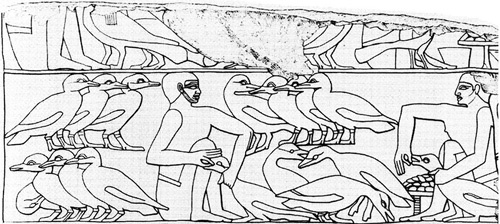
FIGURE 1
FIGURE 1
A bas relief depiction from the tomb of Mereruka, 2500 BC, illustrating the ancient Egyptian practice of overfeeding geese to produce foie gras.
FIGURE 2
FIGURE 2
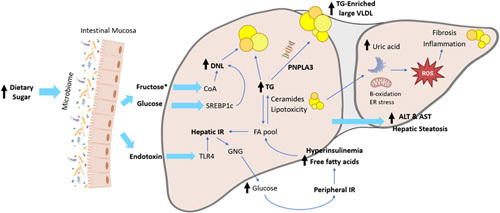
Biological mechanisms of NAFLD development by a high free sugar diet. Dietary sugars in the gut can alter the microbiome, increasing endotoxin that promotes hepatic IR. Monosaccharides enter the liver, and fructose is metabolized into fructose-1-P and further into acetyl-CoA, fueling DNL. Fructose, glucose, and insulin activate ChREBP & SREBP-1c, which transcriptionally activates genes in DNL. FA accumulation can exceed the liver’s capacity, which leads to ectopic lipid deposition and lipotoxicity. This promotes impaired mitochondrial beta-oxidation and ER stress, driving the production of ROS, hepatic IR, inflammation, and fibrosis through a complex set of mechanisms. Fructose metabolism also produces a drop in intracellular phosphate, resulting in increased uric acid formation, which is associated with oxidative stress and hepatic fat accumulation. Abbreviations: ALT, alanine aminotransferase; AST, aspartate aminotransferase; ChREBP, carbohydrate-responsive element–binding protein; DNL, de novo lipogenesis; ER, endoplasmic reticulum; FA, fatty acid; GNG, gluconeogenesis; IR, insulin resistance; PNPLA3, patatin-like phospholipase domain–containing protein 3; ROS, reactive oxygen species; SREBP-1c, sterol regulatory element–binding protein 1c; TG, triglycerides; TLR4, toll-like receptor 4. Figure adapted with permission from Welsh et al., 2023.
FIGURE 3
FIGURE 3
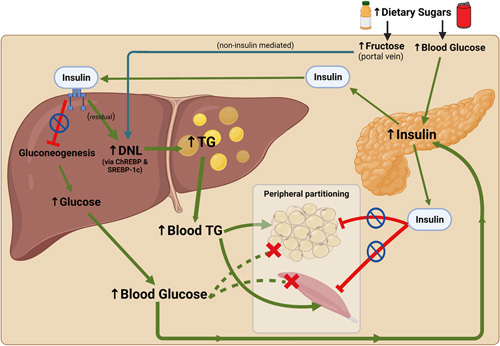
Mediators of hepatic de novo lipogenesis in obese individuals with NAFLD & insulin resistance. Dietary glucose stimulates insulin secretion from pancreatic beta cells. With hepatic IR, insulin fails to suppress hepatic gluconeogenesis; however, stimulation of DNL continues through residual activation of SREBP-1c. Dietary fructose is transported through the hepatic portal vein directly to the liver, where it stimulates de novo lipogenesis through non-insulin–mediated activation of ChREBP. Additionally, IR in adipose and muscle tissue prevents peripheral glucose uptake. Overall, these processes promote hyperglycemia and hyperlipidemia, driving NAFLD progression. Abbreviations: ChREBP, carbohydrate-responsive element–binding protein; DNL, de novo lipogenesis; IR, insulin resistance; SREBP-1c, sterol regulatory element–binding transcription factor 1; TG, triglycerides. Figure created using Biorender.

References

    1. Rinella ME, Lazarus JV, Ratziu V, Francque SM, Sanyal AJ, Kanwal F, et al. A multi-society Delphi consensus statement on new fatty liver disease nomenclature. Hepatology. 2023. doi: 10.1097/HEP.0000000000000520. - DOI - PubMed
    1. Schaffner F, Thaler H. Nonalcoholic fatty liver disease. Prog Liver Dis. 1986;8:283–298. - PubMed
    1. Huh Y, Cho YJ, Nam GE. Recent epidemiology and risk factors of nonalcoholic fatty liver disease. Journal of obesity & metabolic syndrome. 2022;31:17–27. - PMC - PubMed
    1. Lazo M, Hernaez R, Eberhardt MS, Bonekamp S, Kamel I, Guallar E, et al. Prevalence of nonalcoholic fatty liver disease in the United States: The Third National Health and Nutrition Examination Survey, 1988-1994. Am J Epidemiol. 2013;178:38–45. - PMC - PubMed
    1. Welsh JA, Karpen S, Vos MB. Increasing prevalence of nonalcoholic fatty liver disease among United States adolescents, 1988-1994 to 2007-2010. J Pediatr. 2013;162:496–500.e491. - PMC - PubMed

Publication types

MeSH terms