


Dirac-fermion-assisted interfacial superconductivity in epitaxial topological-insulator/iron-chalcogenide heterostructures
- PMID: 37932274
- PMCID: PMC10628154
- DOI: 10.1038/s41467-023-42902-2
Dirac-fermion-assisted interfacial superconductivity in epitaxial topological-insulator/iron-chalcogenide heterostructures
Abstract
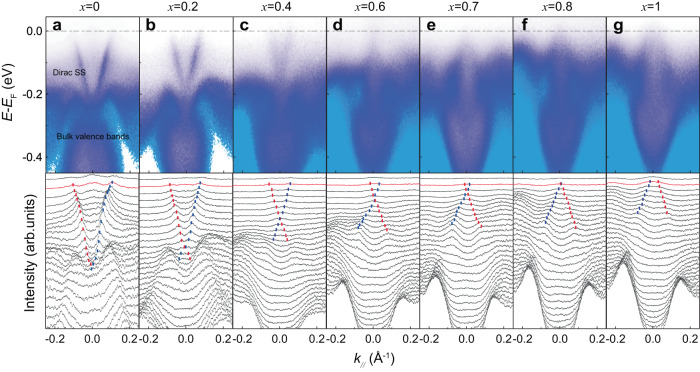
Over the last decade, the possibility of realizing topological superconductivity (TSC) has generated much excitement. TSC can be created in electronic systems where the topological and superconducting orders coexist, motivating the continued exploration of candidate material platforms to this end. Here, we use molecular beam epitaxy (MBE) to synthesize heterostructures that host emergent interfacial superconductivity when a non-superconducting antiferromagnet (FeTe) is interfaced with a topological insulator (TI) (Bi, Sb)2Te3. By performing in-vacuo angle-resolved photoemission spectroscopy (ARPES) and ex-situ electrical transport measurements, we find that the superconducting transition temperature and the upper critical magnetic field are suppressed when the chemical potential approaches the Dirac point. We provide evidence to show that the observed interfacial superconductivity and its chemical potential dependence is the result of the competition between the Ruderman-Kittel-Kasuya-Yosida-type ferromagnetic coupling mediated by Dirac surface states and antiferromagnetic exchange couplings that generate the bicollinear antiferromagnetic order in the FeTe layer.
© 2023. The Author(s).
Conflict of interest statement
The authors declare no competing interests.
Figures



References
-
- Alicea J. Majorana fermions in a tunable semiconductor device. Phys. Rev. B. 2010;81:125318. doi: 10.1103/PhysRevB.81.125318. - DOI
-
- Das A, et al. Zero-bias peaks and splitting in an Al-InAs nanowire topological superconductor as a signature of Majorana fermions. Nat. Phys. 2012;8:887–895. doi: 10.1038/nphys2479. - DOI
Grants and funding
- DE-SC0023113/DOE | SC | Basic Energy Sciences (BES)
- DMR-1847811/NSF | Directorate for Mathematical & Physical Sciences | Division of Materials Research (DMR)
- DMR-2011839/NSF | Directorate for Mathematical & Physical Sciences | Division of Materials Research (DMR)
- DMR-2039351/NSF | Directorate for Mathematical & Physical Sciences | Division of Materials Research (DMR)
- DMR-1644779/NSF | Directorate for Mathematical & Physical Sciences | Division of Materials Research (DMR)
- DMR-2128556/NSF | Directorate for Mathematical & Physical Sciences | Division of Materials Research (DMR)
- DMR-2128556/NSF | Directorate for Mathematical & Physical Sciences | Division of Materials Research (DMR)
- DMR-2128556/NSF | Directorate for Mathematical & Physical Sciences | Division of Materials Research (DMR)
- DMR-2039351/NSF | Directorate for Mathematical & Physical Sciences | Division of Materials Research (DMR)
- DMR-2241327/NSF | Directorate for Mathematical & Physical Sciences | Division of Materials Research (DMR)
- GBMF9063/Gordon and Betty Moore Foundation (Gordon E. and Betty I. Moore Foundation)
LinkOut - more resources
Full Text Sources
