. 2023 Dec;52(12):315-323.
doi: 10.1038/s41684-023-01274-2. Epub 2023 Nov 6.

Aotus nancymaae model predicts human immune response to the placental malaria vaccine candidate VAR2CSA

Affiliations

Aotus nancymaae model predicts human immune response to the placental malaria vaccine candidate VAR2CSA

Justin Doritchamou et al. Lab Anim (NY). 2023 Dec.

Abstract

Placental malaria vaccines (PMVs) are being developed to prevent severe sequelae of placental malaria (PM) in pregnant women and their offspring. The leading candidate vaccine antigen VAR2CSA mediates parasite binding to placental receptor chondroitin sulfate A (CSA). Despite promising results in small animal studies, recent human trials of the first two PMV candidates (PAMVAC and PRIMVAC) generated limited cross-reactivity and cross-inhibitory activity to heterologous parasites. Here we immunized Aotus nancymaae monkeys with three PMV candidates (PAMVAC, PRIMVAC and ID1-ID2a_M1010) adjuvanted with Alhydrogel, and exploited the model to investigate boosting of functional vaccine responses during PM episodes as well as with nanoparticle antigens. PMV candidates induced high levels of antigen-specific IgG with significant cross-reactivity across PMV antigens by enzyme-linked immunosorbent assay. Conversely, PMV antibodies recognized native VAR2CSA and blocked CSA adhesion of only homologous parasites and not of heterologous parasites. PM episodes did not significantly boost VAR2CSA antibody levels or serum functional activity; nanoparticle and monomer antigens alike boosted serum reactivity but not functional activities. Overall, PMV candidates induced functional antibodies with limited heterologous activity in Aotus monkeys, similar to responses reported in humans. The Aotus model appears suitable for preclinical downselection of PMV candidates and assessment of antibody boosting by PM episodes.


Conflict of interest statement

T.G.T. and A. Salanti are named on a patent owned by University of Copenhagen for the use of VAR2CSA as a malaria vaccine. M.A.N., A.F.S., C.M.J., A. Salanti and T.G.T. are named on a patent to use capsid particles in vaccine development. The other authors declare no competing interests.

Figures
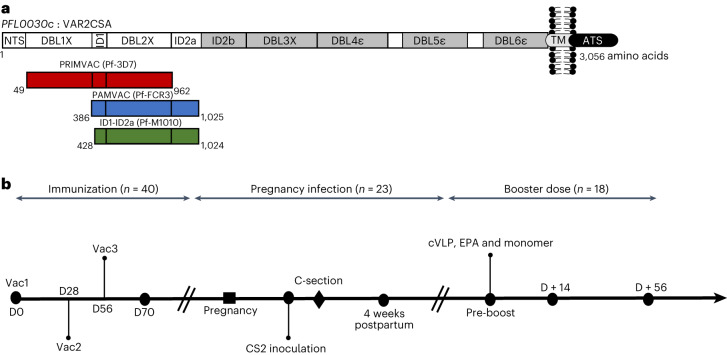
Fig. 1
Fig. 1. PMV constructs and study design.
a, Illustration of the three PMV constructs of VAR2CSA used in this study. Boundaries of each construct are shown as amino acid residues from the corresponding VAR2CSA allele (FCR3 and 3D7) and M1010 composite sequence. b, Flow chart of the study, highlighting the different stages of the study and the number of animals involved in each stage. Timeline indicates three vaccinations (Vac1, Vac2 and Vac3) with PMV and Pfs25 antigens. ATS, acid terminal sequence; cVLP, capsid-based virus like particle; EPA, mutagenized Pseudomonas aeruginosa exoprotein A; TM, transmembrane.
Fig. 2
Fig. 2. Activities of vaccine-induced antibodies from Aotus following immunization.
a, The reactivity of vaccine-induced IgG 2 weeks after the last vaccination dose was assessed against PMV candidates PAMVAC (Pf-FCR3) (n = 9) and PRIMVAC (Pf-3D7) (n = 9) as well as recombinant antigens rID1-ID2a-M1010 (produced from the ID1-ID2a construct of VAR2CSAM1010 sequence) (n = 9) and rPfs25 (n = 13). b,c, Functional characterization of antibodies was evaluated for the ability of IgG to bind antigens expressed on the surface of the IEs by flow cytometry analysis (b), and for CSA-binding inhibition activity against different P. falciparum isolates (c). For each group of vaccinated monkeys, the geometric mean and 95% confidence interval of the antibody activity measured by ELISA and flow cytometry are shown (a and b). For BIA, the mean and s.e.m. are shown (c). Mann–Whitney test was used to compare activity of PMV-induced antibody to that of Pfs25 with P values indicated as *P ≤ 0.05, **P ≤ 0.01, ***P ≤ 0.005 and ****P ≤ 0.001. Source data
Fig. 3
Fig. 3. Correlations between ELISA titers of PMV-induced antibodies and functional activity at D70 post-vaccination.
ac, Spearman (ρ) coefficients and P values are reported to describe the relationship between ELISA titers of PAMVAC antibodies in Aotus (n = 9) and surface reactivity (a) or binding inhibition activity (b) against CS2 parasite. The correlation between surface reactivity and BIA of PAMVAC antibodies is also shown (c). df, The same analyses were performed for PRIMVAC-induced antibodies in Aotus (n = 9). Data for animals immunized with PAMVAC (blue circle) and PRIMVAC (open red square) are shown. Source data
Fig. 4
Fig. 4. Dynamics of VAR2CSA antibodies following a CS2 inoculation during pregnancy.
ac, ELISA titers 2 weeks after the last dose in the primary vaccine series (D70) compared to those measured at the time of CS2 parasite inoculation and 4 weeks postpartum, for each of the vaccine groups (n = 6 for PAMVAC-immunized monkeys, n = 5 for PRIMVAC-immunized monkeys, n = 4 for ID1-ID2a_M1010-immunized monkeys and n = 7 for Pfs25-immunized monkeys). d,e, Flow cytometry for IE surface reactivity. f,g, BIA for parasite blocking activity. For each group of vaccinated monkeys, the geometric mean and 95% confidence interval of the antibody activity measured by ELISA and flow cytometry are shown (ae). For BIA, the mean and s.e.m. are shown (f and g). Wilcoxon matched-pairs signed-rank test was used to evaluate antibody-boosting activity at 4 weeks postpartum following CS2 inoculation during pregnancy. Source data
Fig. 5
Fig. 5. Dynamics of cross-inhibitory and cross-recognition activity of PMV-induced antibodies in Aotus monkeys in response to pregnancy malaria.
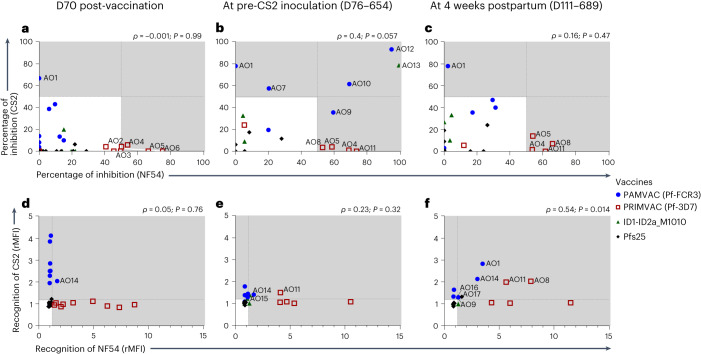
ac, The levels of binding inhibition activity of the PMV-induced antibodies against CS2 and NF54 parasites in samples collected at D70 post-vaccination (a), pre-CS2 inoculation (b) and 4 weeks postpartum (c) are shown. The dashed lines represent 50% inhibition, and the gray-colored area in each graph defines labeled samples with inhibitory activity. df, The recognition levels of surface-expressed VAR2CSA on CS2 and NF54 IE by the PMV-induced antibodies was also analyzed at D70 post-vaccination (d), pre-CS2 inoculation (e) and 4 weeks postpartum (f), with dashed lines representing rMFI 1.2 and the gray-colored area highlighting flow-positive samples. In a and d, n = 9 for PAMVAC-immunized monkeys, n = 9 for PRIMVAC-immunized monkeys, n = 9 for ID1-ID2a_M1010-immunized monkeys and n = 13 for Pfs25-immunized monkeys. In b, c, e and f, n = 6 for PAMVAC-immunized monkeys, n = 5 for PRIMVAC-immunized monkeys, n = 4 for ID1-ID2a_M1010-immunized monkeys and n = 7 for Pfs25-immunized monkeys. Data for animals immunized with PAMVAC (Pf-FCR3) (blue circle), PRIMVAC (Pf-3D7) (open red square), rID1-ID2a-M1010 (green triangle) and rPfs25 (black diamond) are shown and samples with cross-recognition activity are labeled. Spearman (ρ) coefficients and P values are reported for each graph. Source data
Fig. 6
Fig. 6. Activities of PMV-induced antibodies in Aotus monkeys following re-vaccination with monomer or nanoparticle immunogens.
ac, ELISA titer of IgG against PAMVAC (Pf-FCR3) (a), PRIMVAC (Pf-3D7) (b) and ID1-ID2a-M1010 (c) antigens were assessed in monkeys that received the conjugated antigens (solid-line, PAMVACcVLP or ID1-ID2a-M1010-EPA) and those who received the monomer antigens (dashed line). Samples collected before vaccination (pre-bleed) and those collected at D14 and D56 post-vaccination were analyzed. dg, Plasma samples collected at the same time points were also analyzed for their surface reactivity to CS2 (d) and NF54 (e) IEs, as well as their ability to block those parasites binding to CSA (f and g). In ag, PAMVAC-immunized (n = 4) and PRIMVAC-immunized (n = 3) monkeys received PAMVACcVLP; PAMVAC-immunized (n = 3) and PRIMVAC-immunized (n = 3) monkeys received the PAMVAC, while ID1-ID2a_M1010-immunized received the nanoparticle ID1-ID2a-M1010-EPA (n = 2) or monomer ID1-ID2a_M1010 (n = 3). For each group of vaccinated monkeys, the geometric mean and 95% confidence interval of the antibody activity measured by flow cytometry are shown (d and e). For ELISA and BIA, the mean and s.e.m. are shown (ac, f and g). Source data

References

    1. Miller LH, Baruch DI, Marsh K, Doumbo OK. The pathogenic basis of malaria. Nature. 2002;415:673–679. doi: 10.1038/415673a. - DOI - PubMed
    1. Brabin BJ. An analysis of malaria in pregnancy in Africa. Bull. World Health Organ. 1983;61:1005–1016. - PMC - PubMed
    1. Rogerson SJ, et al. Burden, pathology, and costs of malaria in pregnancy: new developments for an old problem. Lancet Infect. Dis. 2018;18:e107–e118. doi: 10.1016/S1473-3099(18)30066-5. - DOI - PubMed
    1. Rogerson SJ, Hviid L, Duffy PE, Leke RF, Taylor DW. Malaria in pregnancy: pathogenesis and immunity. Lancet Infect. Dis. 2007;7:105–117. doi: 10.1016/S1473-3099(07)70022-1. - DOI - PubMed
    1. Desai M, et al. Epidemiology and burden of malaria in pregnancy. Lancet Infect. Dis. 2007;7:93–104. doi: 10.1016/S1473-3099(07)70021-X. - DOI - PubMed

Publication types