. 2023 Nov 6;11(1):176.
doi: 10.1186/s40478-023-01669-9.

Genomic characterization of IDH-mutant astrocytoma progression to grade 4 in the treatment setting

Affiliations

Genomic characterization of IDH-mutant astrocytoma progression to grade 4 in the treatment setting

Kirsi J Rautajoki et al. Acta Neuropathol Commun. .

Abstract

As the progression of low-grade diffuse astrocytomas into grade 4 tumors significantly impacts patient prognosis, a better understanding of this process is of paramount importance for improved patient care. In this project, we analyzed matched IDH-mutant astrocytomas before and after progression to grade 4 from six patients (discovery cohort) with genome-wide sequencing, 21 additional patients with targeted sequencing, and 33 patients from Glioma Longitudinal AnalySiS cohort for validation. The Cancer Genome Atlas data from 595 diffuse gliomas provided supportive information. All patients in our discovery cohort received radiation, all but one underwent chemotherapy, and no patient received temozolomide (TMZ) before progression to grade 4 disease. One case in the discovery cohort exhibited a hypermutation signature associated with the inactivation of the MSH2 and DNMT3A genes. In other patients, the number of chromosomal rearrangements and deletions increased in grade 4 tumors. The cell cycle checkpoint gene CDKN2A, or less frequently RB1, was most commonly inactivated after receiving both chemo- and radiotherapy when compared to other treatment groups. Concomitant activating PDGFRA/MET alterations were detected in tumors that acquired a homozygous CDKN2A deletion. NRG3 gene was significantly downregulated and recurrently altered in progressed tumors. Its decreased expression was associated with poorer overall survival in both univariate and multivariate analysis. We also detected progression-related alterations in RAD51B and other DNA repair pathway genes associated with the promotion of error-prone DNA repair, potentially facilitating tumor progression. In our retrospective analysis of patient treatment and survival timelines (n = 75), the combination of postoperative radiation and chemotherapy (mainly TMZ) outperformed radiation, especially in the grade 3 tumor cohort, in which it was typically given after primary surgery. Our results provide further insight into the contribution of treatment and genetic alterations in cell cycle, growth factor signaling, and DNA repair-related genes to tumor evolution and progression.

Keywords: Cancer genomics; Diffuse glioma; Homologous recombination repair; Longitudinal analysis; Microhomology-mediated end-joining; Non-homologous end-joining; RNA-sequencing; Secondary glioblastoma.


Conflict of interest statement

The authors declare no competing interests.

Figures
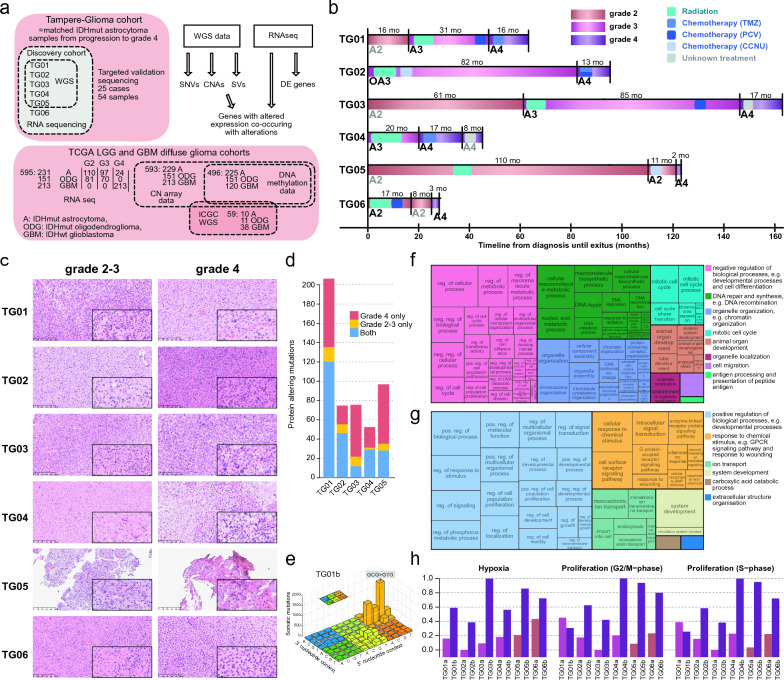
Fig. 1
Fig. 1
Progression to grade 4 is associated with increased hypoxia response, proliferation, and DNA repair. a The discovery cohort comprises six patients with IDHmut low-grade gliomas and relapsed grade 4 tumors. Cases TG01–TG05 were analyzed with WGS and TG01–TG06 with RNA-seq. A larger in-house IDHmut astrocytoma cohort was subjected to targeted DNA-sequencing for validation. In addition, 59 TCGA-ICGC WGS samples, 595 TCGA diffuse glioma RNA-seq samples, and 79 matched GLASS IDHmut astrocytoma samples were used as public validation data cohorts. SNV: single nucleotide variant. b Clinical courses of the patients in the discovery cohort. All six patients received radiation treatment and most patients received chemotherapy, but not TMZ, before progressing to grade 4. Vertical black lines represent surgeries and resected samples shown in gray were not measured as part of the discovery cohort. A: astrocytoma, OA: oligoastrocytoma. Tumor type is followed by the tumor grade. c Representative H&E images of the tumors in the discovery cohort with scale bars corresponding to 250 µm (low magnification) and 50 µm (high magnification). d More protein-altering mutations were detected in TG01 than in other cases (TG02–TG05) in the WGS data. e TG01 samples with full MSH2 deletion and DNMT3A inactivation showed a clear CG > TG substitution signature. fg GO enrichment analysis for upregulated (f) and downregulated (g) genes. Upregulated genes were related to DNA repair, cell proliferation, and angiogenesis, whereas downregulated genes were associated with GPCR signaling pathways and the regulation of development. h Hypoxia response, cell cycle G2/M-phase, and S-phase gene set Z-score activities were upregulated in grade 4 tumors, except for TG01b, where proliferation activities slightly decreased. Gene set activities were scaled between 0 and 1 for visualization
Fig. 2
Fig. 2
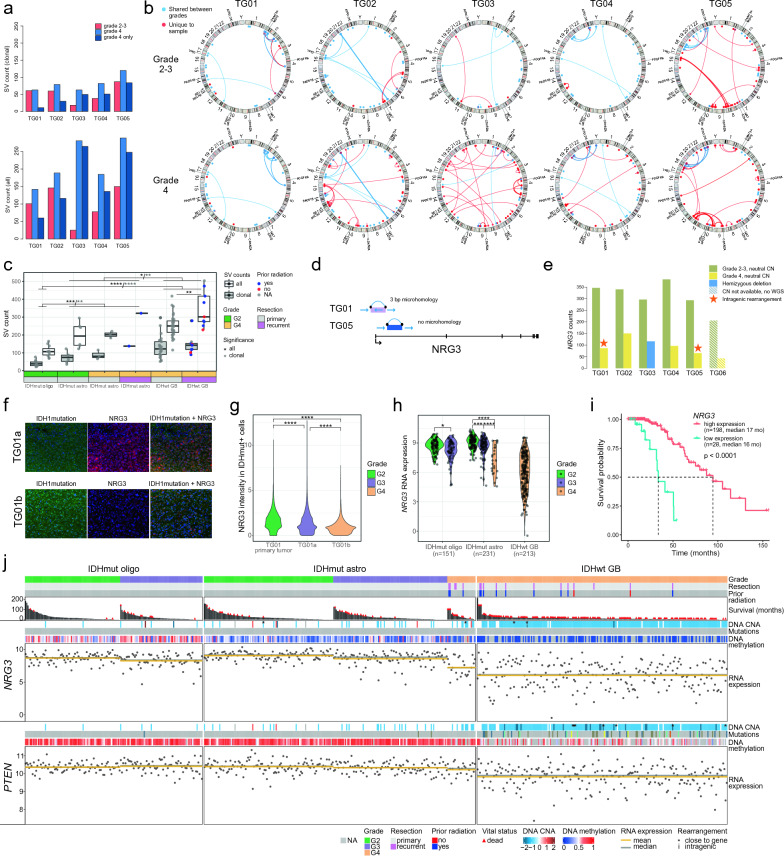
Novel SVs, NRG3 alterations, and decreased NRG3 expression were associated with tumor progression. a The number of SVs was increased in grade 4 tumors. Clonal SVs (upper panel) were used in the subsequent analyses since they are more likely to contribute to progression. b Visualization of clonal SVs with a Circos plot. c In the ICGC cohort, the number of SVs was associated with tumor aggressiveness and recurrence. *p < 0.05, **p < 0.01, ***p < 0.001, and ****p < 0.0001 based on Wilcoxon rank-sum test. d Intragenic rearrangements hit NRG3 gene in two grade 4 tumors. The first exon containing the transcription start site was inverted in TG01b, and a section of the first intron was deleted in TG05b. e NRG3 RNA expression decreased in all the tumors upon progression to grade 4 (p = 0.0022, Wilcoxon rank-sum test). f Representative areas show decreased NRG3 protein expression (red) in IDHmut cells (green) in TG01b. Nuclei are stained with DAPI (blue). g NRG3 level in IDHmut cells was decreased upon progression to grade 4. Quantification of mIHC data across cells in three representative areas per sample. The mean expression for the samples was 1.67, 1.40, and 0.94 for the primary TG01, TG01a, and TG01b tumors, respectively. ****p < 0.0001 based on the Wilcoxon rank-sum test. h NRG3 expression was decreased by tumor grade, especially in grade 4 (p < 0.0001), in 595 TCGA diffuse glioma cases. *p < 0.05, ***p < 0.001, and ****p < 0.0001 based on the Wilcoxon rank-sum test. i Lower NRG3 RNA expression (below 7.7, mean in the entire TCGA diffuse glioma cohort) was associated with shorter OS in TCGA IDHmut astrocytomas (p < 0.0001, log-rank test). j In TCGA IDHmut astrocytoma data, NRG3 was recurrently hemizygously deleted, and its expression was more strongly decreased than PTEN in grade 4 IDHmut astrocytomas. Rearrangements close to genes (*) were observed in cases with gene loss
Fig. 3
Fig. 3
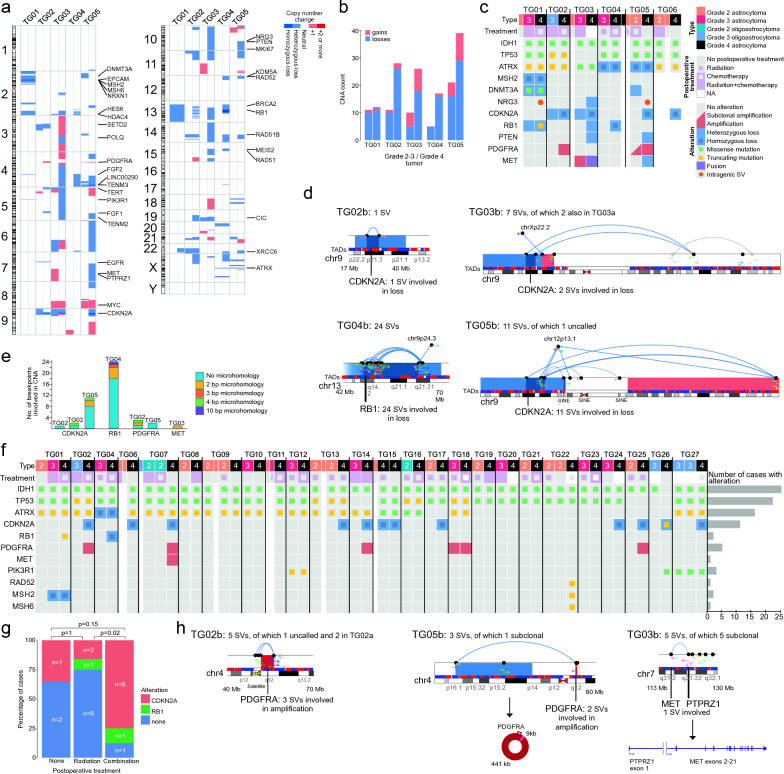
Progression-related CDKN2A/RB1 alterations were associated with postoperative combination therapy and PDGFRA/MET alterations. a DNA copy number patterns of patients TG01–TG05 in grade 2–3 (left column) and grade 4 (right column) tumors. b Number of copy number losses was increased upon progression to grade 4, especially in cases without a hypermutator phenotype. c Summary of tumor characteristics, patient treatment, and genetic alterations in cases TG01–TG06. Narrow columns represent samples not included in the discovery cohort. d CDKN2A and RB1 were homozygously deleted either through simple rearrangements (TG02b) or complex rearrangement patterns. Rearrangements that were already called in grade 2–3 tumors are visualized in gray. Uncalled rearrangements (dashed lines) were aligned to repeat segments (yellow triangles) in TG05b. e Short microhomologous sequences were detected in rearrangements involved in the reported DNA copy number alterations. f Alterations and treatment information in the targeted sequencing validation cohort consisting of IDHmut astrocytomas, including four discovery cohort cases. Only point mutations, amplifications, and full deletions were analyzed. Narrow columns represent samples with no targeted sequencing data. Relapses after progression to grade 4 are not shown. g Patients who underwent both radiation and chemotherapy after surgery were more likely to develop CDKN2A/RB1 inactivation compared to patients who received radiotherapy alone in the combined discovery and targeted sequencing cohort. Only cases with complete treatment information until progression and confirmed event of inactivation upon progression were included. Inactivating alterations in CDKN2A and RB1 are shown separately but were counted together for Fisher´s exact test. h Rearrangement patterns in PDGFRA and MET genes. The rearrangement at the start of PDGFRA amplification in TG02b is located in the centromere and not called because of satellite repeats (yellow triangles). In TG05, PDGFRA was amplified as an extrachromosomal DNA. PTPRZ1-MET fusion was detected from subclonal rearrangements in TG03b. Uncalled and subclonal rearrangements (dashed arrows and arcs) are only visualized when affecting the alteration
Fig. 4
Fig. 4
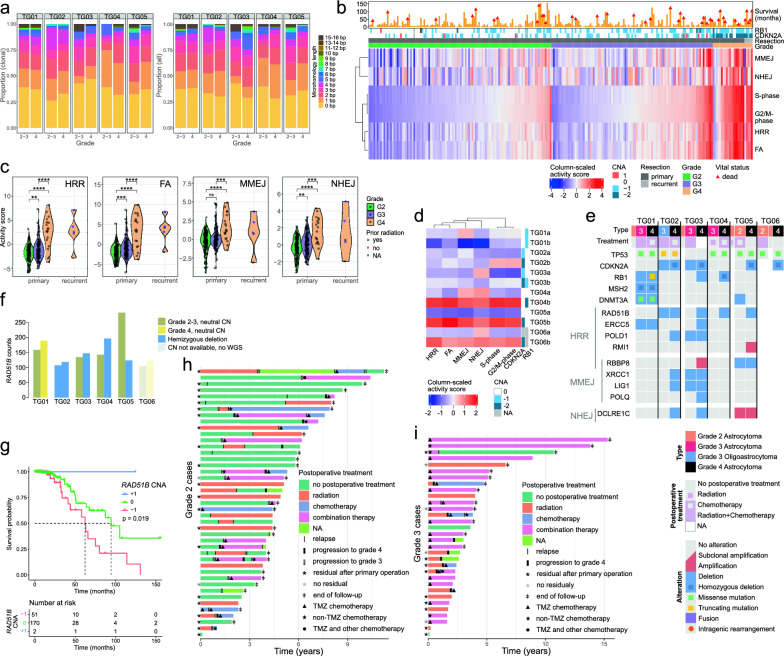
DNA repair is affected upon IDHmut astrocytoma progression. a The proportions of different microhomologous sequence lengths in SV breakpoint junctions. Clonal SVs are visualized on the left, and all SVs are on the right. b Heatmap of gene set activities in the TCGA IDHmut astrocytomas show distinct activity patterns for MMEJ and NHEJ when compared to proliferation (S- and G2/M-phase). Samples are ordered based on the G2/M gene set activity in each tumor group. c DNA repair gene set activities increase with increasing grade in TCGA IDHmut astrocytomas, especially in grade 4. **p < 0.01, ***p < 0.001, and ****p < 0.0001, Wilcoxon rank-sum test. d DNA repair and proliferation gene set activities were increased upon progression, especially in TG04–TG06, in our discovery cohort. The DNA copy number status of CDKN2A and RB1 is marked on the right side of the heatmap. e Oncoprint showing alterations in DNA repair-related genes with progression-related alterations associated with gene expression in our and the TCGA data. f RAD51B expression was higher in TG05a, which was collected after radiation, compared to the grade 4 tumors that were also taken post-radiation. RAD51B expression was decreased and gene hemizygously deleted in grade 4 TG05b tumor. g Hemizygous loss of RAD51B was associated with worse OS in the TCGA IDHmut astrocytomas (p = 0.019, log-rank test). h Heterogeneous treatment paths in grade 2 cohort. The survival cohort comprises 43 patients diagnosed with a grade 2 IDHmut astrocytoma, 29 of which were surgically reoperated and nine progressed to grade 4. Residual tumor information after primary operation (*) was available from 23 patients. i Patients with primary grade 3 IDHmut astrocytoma were mainly treated with postoperative radiation or combination therapy. Timelines of 32 patients, 10 of which were treated surgically for relapse and eight progressed to grade 4. Residual tumor information after primary operation (*) was available from 13 patients

References

    1. Bray F, Ferlay J, Soerjomataram I, Siegel RL, Torre LA, Jemal A. Global cancer statistics 2018: GLOBOCAN estimates of incidence and mortality worldwide for 36 cancers in 185 countries. CA Cancer J Clin. 2018;68:394–424. doi: 10.3322/caac.21492. - DOI - PubMed
    1. Ferlay J, Colombet M, Soerjomataram I, Mathers C, Parkin DM, Piñeros M, et al. Estimating the global cancer incidence and mortality in 2018: GLOBOCAN sources and methods. Int J Cancer. 2019;144:1941–1953. doi: 10.1002/ijc.31937. - DOI - PubMed
    1. WHO Classification of Tumours Editorial Board . Central nervous system tumours: WHO classification of tumours series. 5. Lyon: International Agency for Research on Cancer; 2021.
    1. Miller JJ, Gonzalez Castro LN, McBrayer S, Weller M, Cloughesy T, Portnow J, et al. Isocitrate dehydrogenase (IDH) mutant gliomas: a society for neuro-oncology (SNO) consensus review on diagnosis, management, and future directions. Neuro Oncol. 2023;25:4–25. doi: 10.1093/neuonc/noac207. - DOI - PMC - PubMed
    1. Johnson BE, Mazor T, Hong C, Barnes M, Aihara K, McLean CY, et al. Mutational analysis reveals the origin and therapy-driven evolution of recurrent glioma. Science. 2014;343:189–193. doi: 10.1126/science.1239947. - DOI - PMC - PubMed

Publication types