Review
. 2023 Jul 10;3(5):20220132.
doi: 10.1002/EXP.20220132. eCollection 2023 Oct.

The potential role of synovial cells in the progression and treatment of osteoarthritis

Affiliations
Review

The potential role of synovial cells in the progression and treatment of osteoarthritis

Zaijun Zou et al. Exploration (Beijing). .

Abstract

Osteoarthritis (OA), the commonest arthritis, is characterized by the progressive destruction of cartilage, leading to disability. The Current early clinical treatment strategy for OA often centers on anti-inflammatory or analgesia medication, weight loss, improved muscular function and articular cartilage repair. Although these treatments can relieve symptoms, OA tends to be progressive, and most patients require arthroplasty at the terminal stages of OA. Recent studies have shown a close correlation between joint pain, inflammation, cartilage destruction and synovial cells. Consequently, understanding the potential mechanisms associated with the action of synovial cells in OA could be beneficial for the clinical management of OA. Therefore, this review comprehensively describes the biological functions of synovial cells, the synovium, together with the pathological changes of synovial cells in OA, and the interaction between the cartilage and synovium, which is lacking in the present literature. Additionally, therapeutic approaches based on synovial cells for OA treatment are further discussed from a clinical perspective, highlighting a new direction in the treatment of OA.

Keywords: cartilage; inflammation; osteoarthritis; synovial cells; synovium; treatment.


Conflict of interest statement

The authors declare no conflicts of interest.

Figures

FIGURE 1
FIGURE 1
Normal and OA synovium structure, cellular composition and biological functions of synovial cells. The synovium is divided into two layers, the sublining layer (outer layer) and the lining layer (inner layer). The normal synovial lining layer is mainly composed of fibroblasts and macrophages, of which CX3CR1+ macrophages physically isolate the synovium from the joint cavity by tight junctions, forming an immune barrier, with M2 macrophages predominantly secreting IL‐4 and IL‐10, which are involved in anti‐inflammation. Fibroblasts secrete HA and lubricin, which are involved in joint lubrication. The sublining layer is relatively cell‐free, and the cell types are mainly fibroblasts, SMSCs and a few immune cells. The OA synovial lining layer lost its barrier function due to disruption of the tight junctions between CX3CR1+ macrophages. The lining layer is heavily proliferated by fibroblasts, sublining layer is infiltrated by macrophages (M1 predominant), T cells and B cells, with fibrosis and stromal vascularization. MMPs and ADAMTS secreted by fibroblasts and M1 macrophages are associated with cartilage damage, CCL2, CCL3, IL‐1β, IL‐6, TNF‐α, IL‐18, VEGF, TGF‐β with synovitis, synovial angiogenesis and fibrosis, and NGF with pain. NGF (nerve growth factor), MMPs (matrix metalloproteinases), ADAMTS (a disintegrin and metalloproteinase with thrombospondin motifs), CCL2/CCL3 (chemokine (C‐C motif) ligands 2/3), VEGF (vascular endothelial growth factor), TNF (tumor necrosis factor), TGF (tissue grow factor), HA (hyaluronic acid), IL (interleukin).
FIGURE 2
FIGURE 2
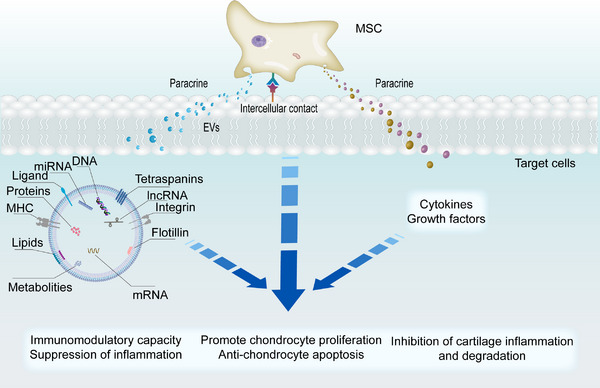
MSC is involved in joint inflammation and cartilage repair through multiple mechanisms. MSC regulates immune cells (T cells, B cells, macrophages) by secreting paracrine factors (cytokines, growth factors and EVs), and intercellular contacts to exert immunomodulatory functions and reduce inflammation, such as inhibiting T and B cell proliferation and inducing macrophage polarization. MSC promotes chondrocyte proliferation, migration and anti‐apoptosis by secreting EVs, and inhibit chondrocyte inflammatory factor release and cartilage degradation by secreting paracrine factors and intercellular contacts.
FIGURE 3
FIGURE 3
Mechanisms of synovial cells and chondrocytes communication in the pathological progression of OA. Cytokines (e.g., IL‐6, TNF‐α, IL‐1β) are secreted by synovial cells (fibroblasts and macrophages) into the synovial fluid and act as upstream regulators, causing changes in chondrocyte phenotype and leading to cartilage degradation. Synovial cells can also secrete MMPs and ADAMTs directly, leading to cartilage degradation. EVs from synovial cells and chondrocytes interact by carrying proteins, RNA, and other cargoes, resulting in altered chondrocyte and synovial cell phenotypes, leading to expression of cartilage degradation genes and secretion of inflammatory cytokines. Cartilage degradation products such as cartilage fragments, crystals and extracellular matrix degradation molecules constitute DAMPs that activate synovial cell surface pattern receptors (PRRs), prompting synovial cells to express inflammatory phenotypes and secrete cytokines, a vicious cycle is formed. Together, these mechanisms contribute to the pathological progression of OA.
FIGURE 4
FIGURE 4
Synovial cells are involved in the process of synovial angiogenesis. In the OA inflammatory environment, synovial macrophages and fibroblasts secrete cytokines such as IL‐6, IL‐8, TNF‐α, which induce the production of growth factors such as VEGF and FGF by macrophages and fibroblasts in the synovial hypoxic environment, and also regulate the secretion of chemokines, MMPs, adhesion molecules, and participate in endothelial cell activation, basement membrane degradation, endothelial cell proliferation and migration, and tubular lumen formation, further promote inflammatory cell infiltration. These factors secreted by synovial cells are called angiogenic factors.
FIGURE 5
FIGURE 5
Potential strategies for synovial cell‐based therapy for OA. Targeted therapeutic strategies include targeting synovial fibroblast and macrophage mediated inflammation, angiogenesis, fibrosis, pain and cartilage damage and the development of related targeted drug delivery systems. SMSC‐based therapies mainly include direct SMSC implantation, combined with advanced technologies such as biological scaffolds or scaffold‐free tissue engineering, and SMSC‐derived EV therapy, which mainly promotes cartilage repair and inhibits inflammation.
FIGURE 6
FIGURE 6
Drug delivery system targeting synovial cells for the treatment of OA. (A) The efficacy of multifunctional anti‐inflammatory drugs (CPHs) targeting synovial cells constructed by targeting ligand‐modified peptide dendrimer nanogels (PDN) for the treatment of OA. Reproduced with permission.[ 148 ] Copyright 2021, Elsevier. (i) Expression levels of IL‐1β, IL‐6 and TNF‐α in joint treated with Dex‐p, CPs and CPHs. (ii) Efficacy of CPHs in treating OA, as shown by the micro‐CT 2D images of the rat knee joint, and by the quantitative measurements of micro‐CT bone remodeling. (iii) Efficacy of CPHs for OA, as shown by cartilage sections. Dex (dexamethasone), CPHs (targeted ligand modification), CPs (no targeted ligand modification). (B) Peptide‐functionalized nanocomposite PEG‐4MAL microgels prolong drug retention and precise targeting in the treatment of OA. Reproduced with permission.[ 149 ] Copyright 2020, American Chemical Society. (i) Nanocomposite PEG‐4MAL microgels exhibit significantly higher retention times compared to free Cy7 dye. (ii) In vivo imaging systems of healthy and OA rat knees showed that free Cy7 dye was cleared from the joint faster than the nanocomposite microgels. (iii) Accumulation of peptide‐functionalized PEG‐4MAL nanocomposite microgels in synovium.
FIGURE 7
FIGURE 7
SMSC combines tissue engineering, nanotechnology, 3D printing and engineered EVs derived from SMSC for the treatment of cartilage defects. (A) Chitosan hydrogel/3D‐printed poly(ε‐caprolactone) (PCL) hybrid scaffold containing SMSCs for cartilage regeneration based on tetrahedral framework nucleic acid recruitment (TFNA). Reproduced with permission.[ 169 ] Copyright 2021, Elsevier. (i) Efficacy of cartilage repair in the control and PCL groups, PCL/CS+SMSCs group (PCS) and PCL/CS+SMSCs+TFNA group (PCST), with better Young's modulus, GAG content and total collagen content in the PCST group. (ii) Histological (H&E, saffron‐O and Sirius red staining) and immunohistochemical analysis of the postoperative cartilage defect area showed the best results for PCLST repair. (B) SMSC‐derived EVs loaded with circRNA3503 combined with biogels to construct PLEL@circRNA3503‐OE‐sEVs nano‐delivery system for the treatment of OA. Reproduced with permission.[ 187 ] Copyright 2021, Elsevier B.V. on behalf of KeAi. (i) The proliferative capacity of chondrocytes after treatment with different types of sEVs were measured by EdU assays. (ii) The migratory capacity of chondrocytes after treatment with different types of sEVs were measured by Transwell assays. (iii) In vivo experiments, histologic analysis with Safranin O & Fast Green and Toluidine Blue staining for different groups showed that PLEL@circRNA3503‐OE‐sEVs significantly inhibited the progression of OA. Wnt5a/b‐dKO‐sEVs: sEVs from SMSCs with Wnt5a and Wnt5b knockdown. dKO‐OE‐sEVs: sEVs from SMSCs overexpressing circRNA3503 with Wnt5a and Wnt5b knockdown.

References

    1. Hunter D. J., March L., Chew M., Lancet 2020, 396, 1711. - PubMed
    1. Xia B., Di C., Zhang J., Hu S., Jin H., Tong P., Calcif. Tissue Int. 2014, 95, 495. - PMC - PubMed
    1. Litwic A., Edwards M. H., Dennison E. M., Cooper C., Br. Med. Bull. 2013, 105, 185. - PMC - PubMed
    1. Di Nicola V., Regener. Ther. 2020, 15, 149. - PMC - PubMed
    1. Mobasheri A., Fonseca J. E., Gualillo O., Henrotin Y., Largo R., Herrero‐Beaumont G., Rocha F. A. C., Front. Med. 2021, 8, 727700. - PMC - PubMed

LinkOut - more resources