Review
. 2023 Nov 7;80(12):352.
doi: 10.1007/s00018-023-05001-5.

Insights into the structure and function of the RNA ligase RtcB

Affiliations
Review

Insights into the structure and function of the RNA ligase RtcB

Matthieu Moncan et al. Cell Mol Life Sci. .

Abstract

To be functional, some RNAs require a processing step involving splicing events. Each splicing event necessitates an RNA ligation step. RNA ligation is a process that can be achieved with various intermediaries such as self-catalysing RNAs, 5'-3' and 3'-5' RNA ligases. While several types of RNA ligation mechanisms occur in human, RtcB is the only 3'-5' RNA ligase identified in human cells to date. RtcB RNA ligation activity is well known to be essential for the splicing of XBP1, an essential transcription factor of the unfolded protein response; as well as for the maturation of specific intron-containing tRNAs. As such, RtcB is a core factor in protein synthesis and homeostasis. Taking advantage of the high homology between RtcB orthologues in archaea, bacteria and eukaryotes, this review will provide an introduction to the structure of RtcB and the mechanism of 3'-5' RNA ligation. This analysis is followed by a description of the mechanisms regulating RtcB activity and localisation, its known partners and its various functions from bacteria to human with a specific focus on human cancer.

Keywords: 3′–5′ RNA ligase; Archease; Cancer; Crystal structure; RNA 2′,3′-cyclic phosphate and 5′-OH ligase [RtcB]; RNA ligation; Transfer RNA [tRNA]; Unfolded protein response [UPR]; X-box-binding protein 1 [XBP1]; tRNA ligase complex.


Conflict of interest statement

AG, AS and LAE are cofounders of Cell Stress Discoveries. LAE is cofounder of ANYO Labs.

Figures
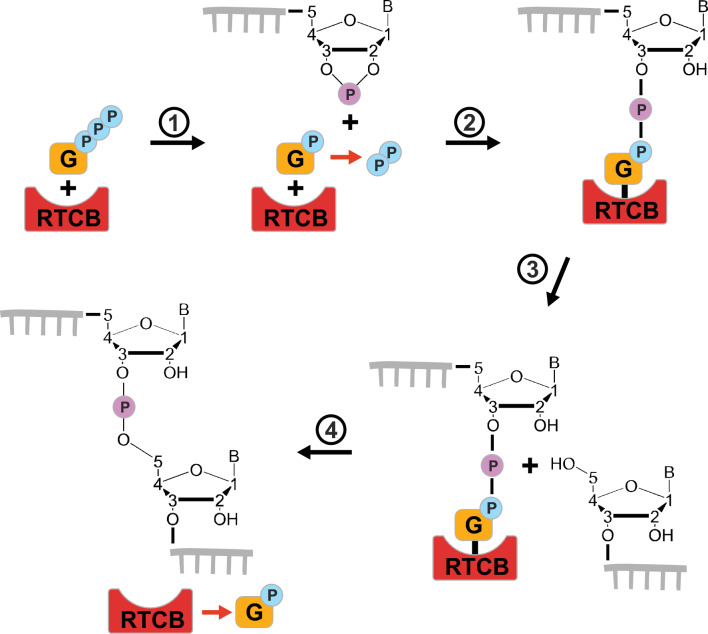
Fig. 1
Fig. 1
RtcB 3′–5′ RNA ligation mechanism. (1) RtcB hydrolyses GTP to form a covalent bond with GMP. (2) RtcB-GMP hydrolyses the 2′–3′-cyclic phosphate of the 3′-end of the RNA substrate, generating a 3′-phosphate-GMP-RtcB intermediate. (3 and 4) The 5′-OH end of the RNA substrate attacks the 3′-phosphate end to form a phosphodiester bond ligating both RNA-ends and provoking the release of GMP from RtcB. Although not represented in this schematic, binding of GMP to RtcB requires two divalent metal ions. While 2′–3′-cyclic phosphate is the main substrate for RtcB RNA ligation, 3′-phosphate ends can also be ligated although with a reduced efficiency
Fig. 2
Fig. 2
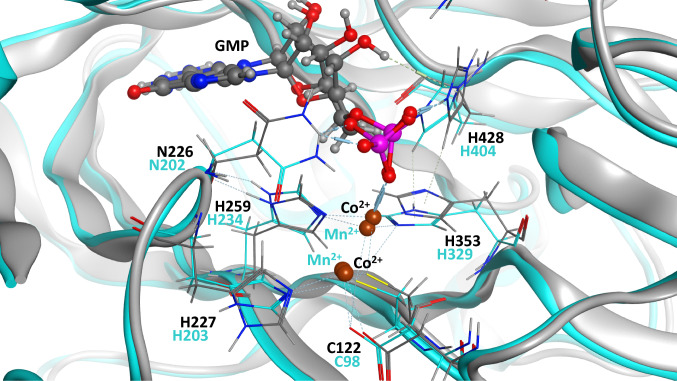
RtcB catalytic site crystal structure. Superposition of H. sapiens (grey) and P. horikoshii (cyan) RtcB catalytic site crystal structures. The high homology between the two catalytic sites demonstrates that both orthologues share the same ligation mechanism with a covalently bound GMP but with different divalent cation specificity. Here, H. sapiens and P. horikoshii RtcB crystal structures are represented in complex with Co2+ and Mn2+ ions, respectively. Key amino acids for RtcB RNA ligation activity are depicted in black for H. sapiens and cyan for P. Horikoshii
Fig. 3
Fig. 3
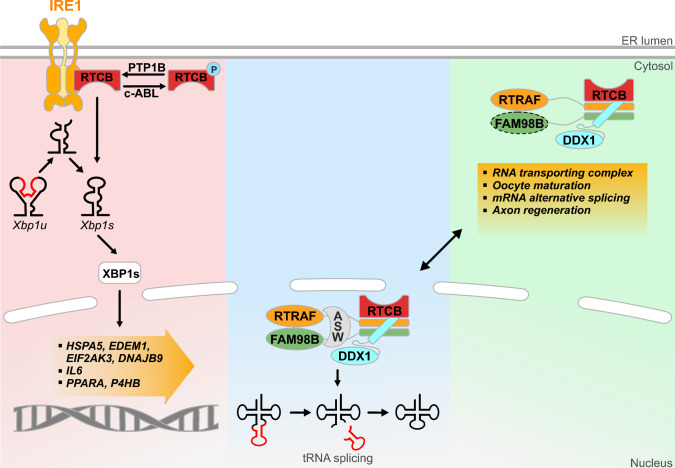
Overview of pathways linked to RtcB activity. RtcB can be found in the cytoplasm and the nucleus, enabling it to achieve its functions. [Left] In the cytoplasm, induction of the unfolded protein response in the ER leads to activation of IRE1, which cuts XBP1 mRNA at two stem-loop structures, removing a 26-nucleotide intron. The 5′ and 3′ ends of the cut fragments are ligated with RtcB generating a new mRNA termed spliced XBP1 (XBP1s). Then, the XBP1s transcription factor induces expression of genes involved in protein folding, immunity and lipids regulation. [Middle] In the nucleus, intron-containing pre-tRNAs have to undergo non-conventional splicing events, removing the intron and generating two exon halves. Then, RtcB tRNA ligase activity re-ligates the exon halves, generating a mature tRNA for protein translation. [Right] RtcB has XBP1- and tRNA-independent functions, which remain to be fully elucidated as the RtcB targets linked to these functions and their cellular localisation remain to be identified. These functions could require the presence of some members of the tRNA ligase complex, of which RtcB, RTRAF and DDX1 have been detected in the cytoplasm with and without FAM98B (dotted line)

References

    1. Yuan Y, et al. Chemoproteomic discovery of a human RNA ligase. Nat Commun. 2023;14(1):842. doi: 10.1038/s41467-023-36451-x. - DOI - PMC - PubMed
    1. Englert M, Sheppard K, Aslanian A, Yates JR, 3rd, Soll D. Archaeal 3′-phosphate RNA splicing ligase characterization identifies the missing component in tRNA maturation. Proc Natl Acad Sci U S A. 2011;108(4):1290–1295. doi: 10.1073/pnas.1018307108. - DOI - PMC - PubMed
    1. Popow J, et al. HSPC117 is the essential subunit of a human tRNA splicing ligase complex. Science. 2011;331(6018):760–764. doi: 10.1126/science.1197847. - DOI - PubMed
    1. Jurkin J, et al. The mammalian tRNA ligase complex mediates splicing of XBP1 mRNA and controls antibody secretion in plasma cells. EMBO J. 2014;33(24):2922–2936. doi: 10.15252/embj.201490332. - DOI - PMC - PubMed
    1. Lu Y, Liang FX, Wang X. A synthetic biology approach identifies the mammalian UPR RNA ligase RtcB. Mol Cell. 2014;55(5):758–770. doi: 10.1016/j.molcel.2014.06.032. - DOI - PMC - PubMed