Top-Down Proteomics and the Challenges of True Proteoform Characterization
- PMID: 37937372
- PMCID: PMC10696603
- DOI: 10.1021/acs.jproteome.3c00416
Top-Down Proteomics and the Challenges of True Proteoform Characterization
Abstract
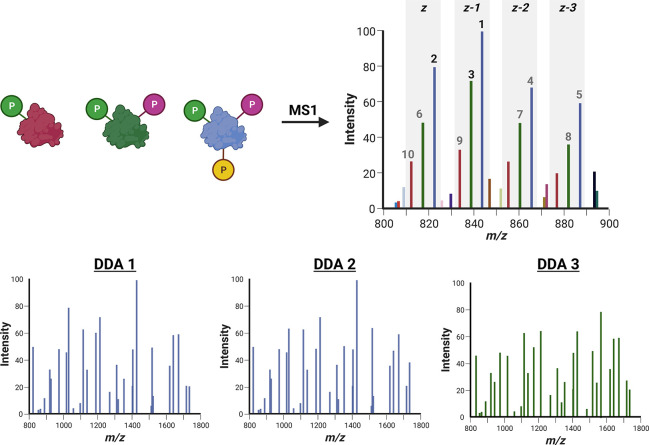
Top-down proteomics (TDP) aims to identify and profile intact protein forms (proteoforms) extracted from biological samples. True proteoform characterization requires that both the base protein sequence be defined and any mass shifts identified, ideally localizing their positions within the protein sequence. Being able to fully elucidate proteoform profiles lends insight into characterizing proteoform-unique roles, and is a crucial aspect of defining protein structure-function relationships and the specific roles of different (combinations of) protein modifications. However, defining and pinpointing protein post-translational modifications (PTMs) on intact proteins remains a challenge. Characterization of (heavily) modified proteins (>∼30 kDa) remains problematic, especially when they exist in a population of similarly modified, or kindred, proteoforms. This issue is compounded as the number of modifications increases, and thus the number of theoretical combinations. Here, we present our perspective on the challenges of analyzing kindred proteoform populations, focusing on annotation of protein modifications on an "average" protein. Furthermore, we discuss the technical requirements to obtain high quality fragmentation spectral data to robustly define site-specific PTMs, and the fact that this is tempered by the time requirements necessary to separate proteoforms in advance of mass spectrometry analysis.
Keywords: phosphorylation; post-translational modification; proteoform; top-down proteomics.
Conflict of interest statement
The authors declare no competing financial interest.
Figures
References
-
- Wilkins M. R.; Sanchez J. C.; Gooley A. A.; Appel R. D.; Humphery-Smith I.; Hochstrasser D. F.; Williams K. L. Progress with proteome projects: why all proteins expressed by a genome should be identified and how to do it. Biotechnol Genet Eng. Rev. 1996, 13, 19–50. 10.1080/02648725.1996.10647923. - DOI - PubMed
Publication types
MeSH terms
Substances
LinkOut - more resources
Full Text Sources
Miscellaneous