. 2023 Nov 8;13(1):19398.
doi: 10.1038/s41598-023-46748-y.

Carbon-infiltrated carbon nanotubes inhibit the development of Staphylococcus aureus biofilms

Affiliations

Carbon-infiltrated carbon nanotubes inhibit the development of Staphylococcus aureus biofilms

Lucy C Bowden et al. Sci Rep. .

Abstract

Staphylococcus aureus forms biofilms that cause considerable morbidity and mortality in patients who receive implanted devices such as prosthetics or fixator pins. An ideal surface for such medical devices would inhibit biofilm growth. Recently, it was reported that surface modification of stainless steel materials with carbon-infiltrated carbon nanotubes (CICNT) inhibits the growth of S. aureus biofilms. The purpose of this study was to investigate this antimicrobial effect on titanium materials with CICNT coated surfaces in a variety of surface morphologies and across a broader spectrum of S. aureus isolates. Study samples of CICNT-coated titanium, and control samples of bare titanium, a common implant material, were exposed to S. aureus. Viable bacteria were removed from adhered biofilms and quantified as colony forming units. Scanning electron microscopy was used to qualitatively analyze biofilms both before and after removal of cells. The CICNT surface was found to have significantly fewer adherent bacteria than bare titanium control surfaces, both via colony forming unit and microscopic analyses. This effect was most pronounced on CICNT surfaces with an average nanotube diameter of 150 nm, showing a 2.5-fold reduction in adherent bacteria. Since S. aureus forms different biofilm structures by isolate and by growth conditions, we tested 7 total isolates and found a significant reduction in the biofilm load in six out of seven S. aureus isolates tested. To examine whether the anti-biofilm effect was due to the structure of the nanotubes, we generated an unstructured carbon surface. Significantly more bacteria adhered to a nonstructured carbon surface than to the 150 nm CICNT surface, suggesting that the topography of the nanotube structure itself has anti-biofilm properties. The CICNT surface possesses anti-biofilm properties that result in fewer adherent S. aureus bacteria. These anti-biofilm properties are consistent across multiple isolates of S. aureus and are affected by nanotube diameter. The experiments performed in this study suggest that this effect is due to the nanostructure of the CICNT surface.


Conflict of interest statement

The authors declare no competing interests.

Figures

Figure 1
Figure 1
(A) Scanning electron micrographs of CICNT of various diameters at 10,000× magnification. (B) Colony forming units (CFU)/mL of bacteria (strain JE2) for CICNT of various diameters and bare titanium (Ti) + /− standard error. Note that CICNT is denoted in blue and bare Ti in grey in this and all subsequent figures. Bars represent n = 7 total samples and three independent experiments for each group. *p < 0.05, **p < 0.005, ***p < 0.0005.
Figure 2
Figure 2
Representative images of bare Ti or CICNT surfaces after performing our protocol for S. aureus CFU analysis, indicating that the protocol is successful at removing the biofilm from both Ti and CICNT surfaces. Images were taken using a scanning electron microscope at 5000x. Red arrows indicate remaining bacteria.
Figure 3
Figure 3
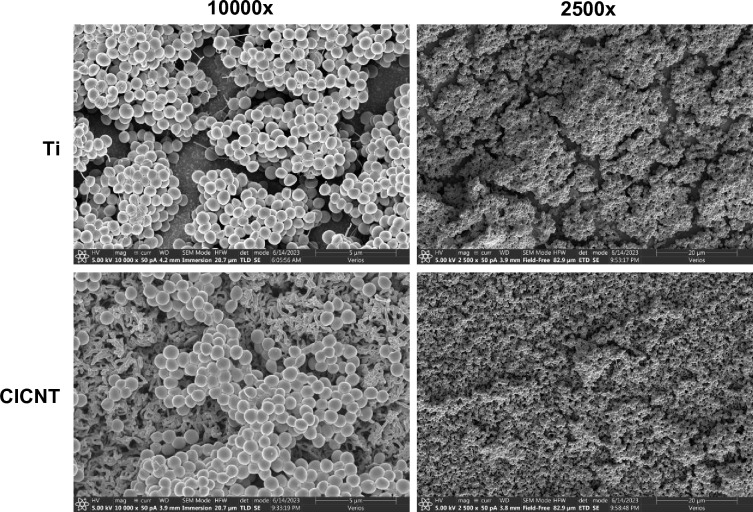
Representative scanning electron microscope images of JE2 biofilms on bare Ti or CICNT surfaces of diameter 150 nm at 10,000× using immersion mode (for greater resolution) and 2500× in a nearby location using field free mode (for a wider view under lower magnification).
Figure 4
Figure 4
Colony Forming Units/mL + /− standard error quantification of bacteria on CICNT and bare Ti at various time points. Bars represent n = 7 total samples and three independent experiments. *p < 0.01, ***p < 0.0001.
Figure 5
Figure 5
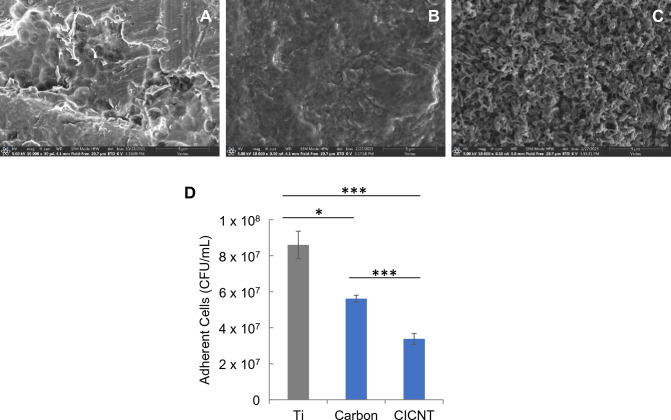
SEM images of (A) bare Ti, (B) carbon control, and (C) CICNT at 10,000×. All images are prior to bacterial growth. (D) CFU/mL for bare Ti, carbon control, and CICNT, + /− standard error. Bars represent n = 7 total samples and three independent experiments. *p < 0.05, ***p < 0.0005.
Figure 6
Figure 6
CFU/plate for CICNT and bare Ti with different S. aureus isolates grown in biofilms + /− standard error. Bars represent at least n = 7 total samples from at least 3 independent experiments. *p < 0.01, **p < 0.001, ***p < 0.0001.
Figure 7
Figure 7
Schematic showing the development and CFU testing of CICNT sample surfaces. Note that the amount of time that the sample surface is exposed to the carbon source ethylene in the furnace controls the size of the resultant carbon nanotubes.

References

    1. Kavanagh KT. Control of MSSA and MRSA in the United States: protocols, policies, risk adjustment and excuses. Antimicrob Resist Infect Control. 2019;8:103. doi: 10.1186/s13756-019-0550-2. - DOI - PMC - PubMed
    1. 2018 Hospital Inpatient National Statistics. https://hcupnet.ahrq.gov/.
    1. Springer BD, Cahue S, Etkin CD, Lewallen DG, McGrory BJ. Infection burden in total hip and knee arthroplasties: An international registry-based perspective. Arthroplast Today. 2017;3:137–140. doi: 10.1016/j.artd.2017.05.003. - DOI - PMC - PubMed
    1. Raphel J, Holodniy M, Goodman SB, Heilshorn SC. Multifunctional coatings to simultaneously promote osseointegration and prevent infection of orthopaedic implants. Biomaterials. 2016;84:301–314. doi: 10.1016/j.biomaterials.2016.01.016. - DOI - PMC - PubMed
    1. Tuon FF, Cieslinski J, Ono AFM, Goto FL, Machinski JM, Mantovani LK, Kosop LR, Namba MS, Rocha JL. Microbiological profile and susceptibility pattern of surgical site infections related to orthopaedic trauma. Int Orthop. 2019;43:1309–1313. doi: 10.1007/s00264-018-4076-7. - DOI - PubMed

LinkOut - more resources