Review
. 2024 Jan 1;45(1):18-31.
doi: 10.1093/eurheartj/ehad720.

Platelet biology and function: plaque erosion vs. rupture

Affiliations
Review

Platelet biology and function: plaque erosion vs. rupture

Constance C F M J Baaten et al. Eur Heart J. .

Abstract

The leading cause of heart disease in developed countries is coronary atherosclerosis, which is not simply a result of ageing but a chronic inflammatory process that can lead to acute clinical events upon atherosclerotic plaque rupture or erosion and arterial thrombus formation. The composition and location of atherosclerotic plaques determine the phenotype of the lesion and whether it is more likely to rupture or to erode. Although plaque rupture and erosion both initiate platelet activation on the exposed vascular surface, the contribution of platelets to thrombus formation differs between the two phenotypes. In this review, plaque phenotype is discussed in relation to thrombus composition, and an overview of important mediators (haemodynamics, matrix components, and soluble factors) in plaque-induced platelet activation is given. As thrombus formation on disrupted plaques does not necessarily result in complete vessel occlusion, plaque healing can occur. Therefore, the latest findings on plaque healing and the potential role of platelets in this process are summarized. Finally, the clinical need for more effective antithrombotic agents is highlighted.

Keywords: Plaque erosion; Plaque rupture; Platelet activation; Thrombus formation.


Figures

Graphical Abstract
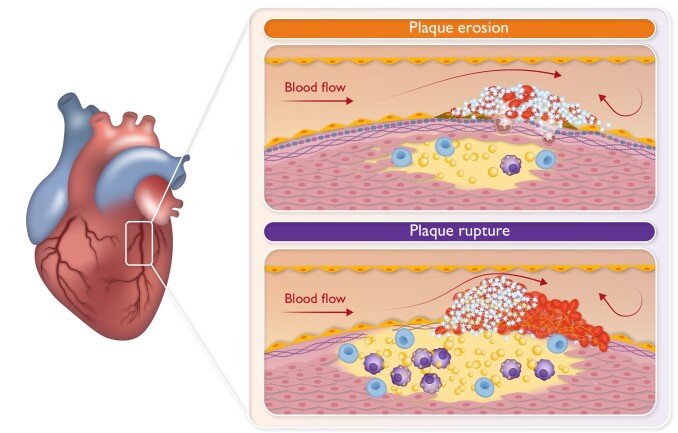
Graphical Abstract
Schematic representation of the differences in thrombus formation induced by either erosion or rupture of coronary atherosclerotic plaques.
Figure 1
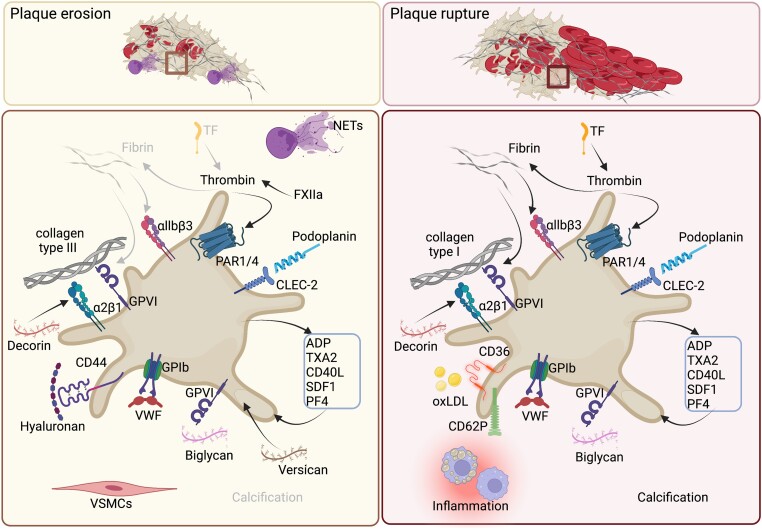
Figure 1
Platelet response towards prominent matrix components and soluble factors in either plaque erosion or rupture. Overview of mechanisms responsible for platelet activation and consequent thrombus formation. For more information, see Matrix components and Soluble factors. ADP, adenosine diphosphate; CD36, cluster of differentiation 36; CD40L, cluster of differentiation 40 ligand; CD44, cluster of differentiation 44; CD62P, P-selectin; CLEC-2, C-type lectin-like type II; FXIIa, activated coagulation factor XII; GPIb, glycoprotein Ib; GPVI, glycoprotein VI; integrin α2β1; integrin αIIbβ3; NETs, neutrophils extracellular traps; oxLDL, oxidized low density lipoprotein; PAR1/4, protease activated receptor 1/4; PF4, platelet factor 4; SDF-1, stromal cell derived factor 1; TF, tissue factor; TXA2, thromboxane A2; VSMCs, vascular smooth muscle cells; VWF, von Willebrand factor. Figure was created with Biorender.com
Figure 2
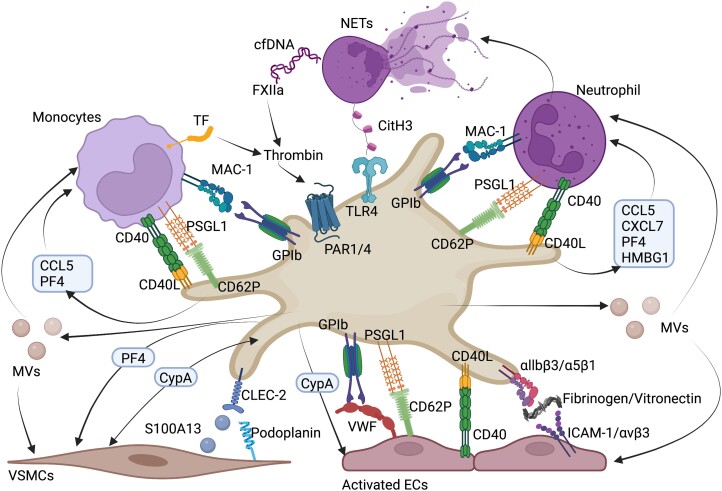
Figure 2
Interactions of platelets with leukocytes, endothelial cells, and vascular smooth muscle cells in atherosclerosis. Overview of ligand–receptor interactions and soluble important factors in the crosstalk between platelets and leukocytes (neutrophils, monocytes, and T cells), endothelial cells, and vascular smooth muscle cells. CCL5, chemokine (C-C motif) ligand 5, CD40, cluster of differentiation 40, CD40L, cluster of differentiation 40 ligand, CD62P, P-selectin, CitH3, citrullinated histone H3, cfDNA, cell free DNA, CLEC-2, C-type lectin-like type II, CypA, cyclophilin A, CXCL7, chemokine (C-X-C motif) ligand 7, ECs, endothelial cells, FXIIa, activated coagulation factor XII, GPIb, glycoprotein Ib, HMGB1, high mobility group box 1 protein, ICAM-1, intracellular adhesion molecule 1, integrin αIIbβ3, integrin α5β1, integrin αvβ3, MAC-1, macrophage-1 antigen, MVs, microvesicles, NETs, neutrophil extracellular traps, PAR1/4, protease activated receptor 1/4, PF4, platelet factor 4, S100A13, S100 calcium binding protein 13, TLR4, toll-like receptor 4, VSMCs, vascular smooth muscle cells, VWF, von Willebrand factor. Figure was created with Biorender.com
Figure 3
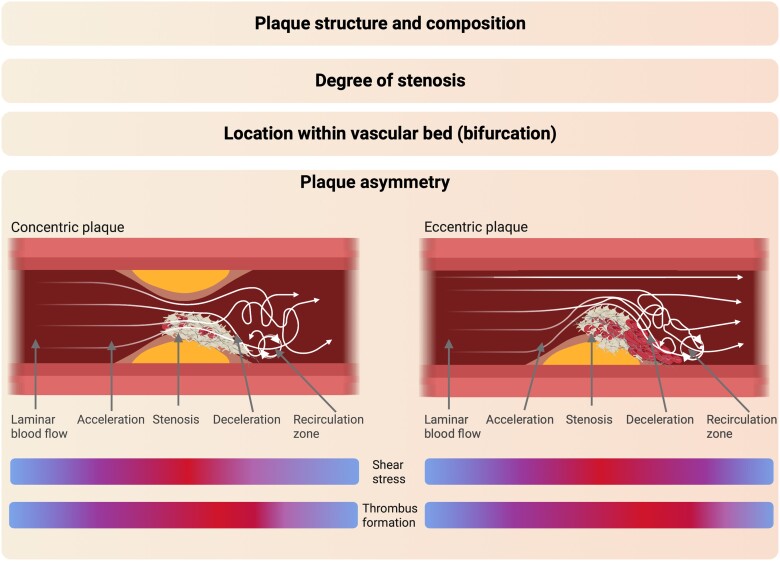
Figure 3
Factors influencing local haemodynamics and contributing to plaque-induced thrombus formation. Schematic representation of factors that have a local effect on haemodynamics and shape thrombus formation. For more information, see Haemodynamic alterations. Figure was created with Biorender.com

References

    1. van der Meijden PEJ, Heemskerk JWM. Platelet biology and functions: new concepts and clinical perspectives. Nat Rev Cardiol 2019;16:166–79. 10.1038/s41569-018-0110-0 - DOI - PubMed
    1. Anfossi G, Trovati M. Role of catecholamines in platelet function: pathophysiological and clinical significance. Eur J Clin Invest 1996;26:353–70. 10.1046/j.1365-2362.1996.150293.x - DOI - PubMed
    1. Yeung AK, Villacorta-Martin C, Hon S, Rock JR, Murphy GJ. Lung megakaryocytes display distinct transcriptional and phenotypic properties. Blood Adv 2020;4:6204–17. 10.1182/bloodadvances.2020002843 - DOI - PMC - PubMed
    1. Pariser DN, Hilt ZT, Ture SK, Blick-Nitko SK, Looney MR, Cleary SJ, et al. . Lung megakaryocytes are immune modulatory cells. J Clin Invest 2021;131:e137377. doi : 10.1172/JCI137377 - DOI - PMC - PubMed
    1. Versteeg HH, Heemskerk JWM, Levi M, Reitsma PH. New fundamentals in hemostasis. Physiol Rev 2013;93:327–58. 10.1152/physrev.00016.2011 - DOI - PubMed