


Head-to-head trial of pegunigalsidase alfa versus agalsidase beta in patients with Fabry disease and deteriorating renal function: results from the 2-year randomised phase III BALANCE study
- PMID: 37940383
- PMCID: PMC11137442
- DOI: 10.1136/jmg-2023-109445
Head-to-head trial of pegunigalsidase alfa versus agalsidase beta in patients with Fabry disease and deteriorating renal function: results from the 2-year randomised phase III BALANCE study
Abstract
Background: Pegunigalsidase alfa is a PEGylated α-galactosidase A enzyme replacement therapy. BALANCE (NCT02795676) assessed non-inferiority of pegunigalsidase alfa versus agalsidase beta in adults with Fabry disease with an annualised estimated glomerular filtration rate (eGFR) slope more negative than -2 mL/min/1.73 m2/year who had received agalsidase beta for ≥1 year.
Methods: Patients were randomly assigned 2:1 to receive 1 mg/kg pegunigalsidase alfa or agalsidase beta every 2 weeks for 2 years. The primary efficacy analysis assessed non-inferiority based on median annualised eGFR slope differences between treatment arms.
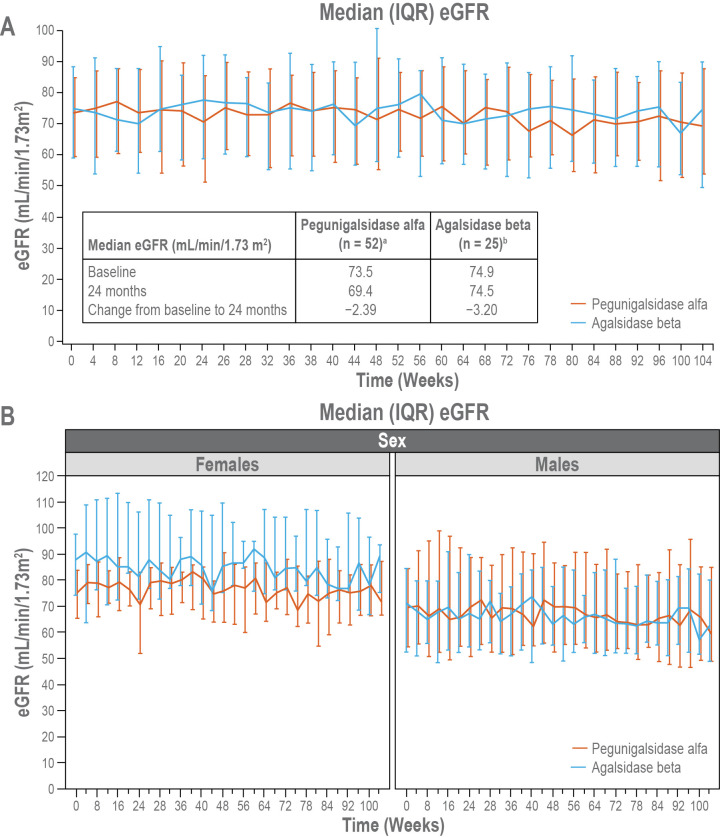
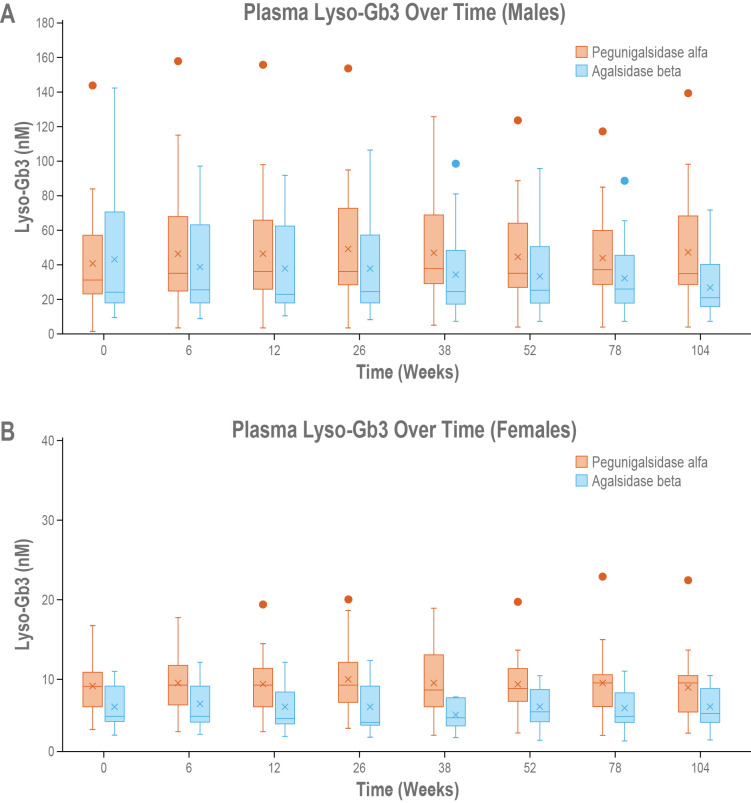
Results: Seventy-seven patients received either pegunigalsidase alfa (n=52) or agalsidase beta (n=25). At baseline, mean (range) age was 44 (18-60) years, 47 (61%) patients were male, median eGFR was 74.5 mL/min/1.73 m2 and median (range) eGFR slope was -7.3 (-30.5, 6.3) mL/min/1.73 m2/year. At 2 years, the difference between median eGFR slopes was -0.36 mL/min/1.73 m2/year, meeting the prespecified non-inferiority margin. Minimal changes were observed in lyso-Gb3 concentrations in both treatment arms at 2 years. Proportions of patients experiencing treatment-related adverse events and mild or moderate infusion-related reactions were similar in both groups, yet exposure-adjusted rates were 3.6-fold and 7.8-fold higher, respectively, with agalsidase beta than pegunigalsidase alfa. At the end of the study, neutralising antibodies were detected in 7 out of 47 (15%) pegunigalsidase alfa-treated patients and 6 out of 23 (26%) agalsidase beta-treated patients. There were no deaths.
Conclusions: Based on rate of eGFR decline over 2 years, pegunigalsidase alfa was non-inferior to agalsidase beta. Pegunigalsidase alfa had lower rates of treatment-emergent adverse events and mild or moderate infusion-related reactions.
Trial registration number: NCT02795676.
Keywords: Drug-Related Side Effects and Adverse Reactions; Fabry Disease; Genetic Diseases, Inborn; Genetic Diseases, X-Linked; alpha-Galactosidase.
© Author(s) (or their employer(s)) 2024. Re-use permitted under CC BY-NC. No commercial re-use. See rights and permissions. Published by BMJ.
Conflict of interest statement
Competing interests: ELW has consulting agreements and/or grants with Sanofi, Protalix, Chiesi, Idorsia, 4DMT, Amicus and Natera. OG-A has conducted contracted research, received consulting fees and/or served on advisory boards with Amicus, Freeline, Genentech, Protalix, Sangamo, Sanofi, Takeda, 4DMT and Avrobio. WRW has been or is currently involved in clinical trials and/or registries with Alexion, Amicus, BioMarin, Chiesi, Freeline, Idorsia, Orphazyme, Pfizer, Protalix, Sanofi, Sangamo, Takeda and 4DMT. He has received honoraria from Alexion, Amicus, BioMarin, Sanofi, Spark and Takeda, and research funding from Amicus and Takeda. MH received speaker-related fees from Protalix and has been, or is currently, involved in clinical trials with Sanofi, Sangamo, Avrobio, Protalix and Idorsia (no direct funding received for these trials because they are institution directed). JB receives research support from Avrobio, BioMarin Pharmaceutical, Chiesi Farmaceutici, Idorsia Pharmaceuticals, Pfizer, Protalix Biotherapeutics, Sangamo Therapeutics, Sanofi, Takeda, Travere Therapeutics; and has received a speaker honorarium from the Fabry Support and Information Group; and has participated in advisory boards for Chiesi USA, Sanofi and Takeda. NL receives research support from and has participated in advisory boards for Amicus, Astellas, Avrobio, BioMarin Pharmaceutical, Homology, Horizon, Moderna, Pfizer, Protalix Biotherapeutics, PTC Biotherapeutics, Reneo, Sanofi, Takeda and Ultragenyx (no direct funding is received because they are institution directed). DH has received honoraria for speaking and consulting fees for advisory boards from Protalix, Takeda, Sanofi, Freeline and Sangamo, administered through University College London consultants and used in part to support research in lysosomal storage diseases. PG has been involved in premarketing studies with Genzyme, Protalix and Idorsia, and has received grants from Sanofi-Genzyme and Takeda; monies received for these activities have been deposited into the Spanish Foundation for the Study and Treatment of Gaucher Disease (FEETEG) to contribute to the development of research in lysosomal storage disorders. MJM, DO, MM, BAB, JK, TG and KN have no disclosures. RJH has received consulting fees from Alexion, Amicus Therapeutics, Inc., Avrobio, Chiesi, Sangamo, Sanofi/Genzyme, and Takeda; advisory fees from Alexion, Amicus Therapeutics, Inc., and Sanofi/Genzyme; speakers' bureau fees from Alexion and Sanofi/Genzyme and grants/research funding from Alexion, Amicus Therapeutics, Inc., Idorsia, Protalix, Sangamo, Sanofi/Genzyme and Takeda. CT has received honoraria, travel support, and/or participated as an investigator in clinical studies supported by Protalix, Sanofi, Idorsia, Takeda, Amicus, Freeline and Acelink. All received honoraria went to her institution Haukeland University Hospital. AL has received consultancy and speaker's honoraria from Amicus Therapeutics, Sanofi, Takeda, 4DMT and Chiesi. PD has been a paid consultant with Sanofi; received speaker honoraria from Sanofi and Takeda and participated in an advisory board with Protalix. AJ has received a grant from Amicus and consultancy and speaker’s honoraria from Takeda, Sanofi and Amicus. VK is an advisory board member for the Sanofi-Genzyme North American Pompe Registry. She is the principal investigator for Sanofi-Genzyme Lysosomal Storage Disease registry at UC Irvine. She has received education grants, lecturing honoraria, and research support from Sanofi-Genzyme. She participates as an investigator in clinical studies supported by Protalix, Sanofi, Idorsia, Chiesi Farmaceutici and Sangamo. BV has received honoraria, travel and accommodation funding from Greenovation Biotech GmbH, Sanofi, Takeda, Amicus, Chiesi and Swixx, and is a member of the EU Advisory Board of Fabry Registry, sponsored by Sanofi. AN received lecturing honoraria and research support from Takeda, Amicus and Sanofi/Genzyme. AP received travel expenses and grants from Takeda, Sanofi, Amicus and Chiesi. DPG has received consulting honoraria from Chiesi, Idorsia Pharmaceuticals, Sanofi and Takeda, and speaker honoraria and travel support from Sanofi and Takeda. IK has received lecture, travel and consulting fees from Amicus, Chiesi, Bayer, Boehringer-Ingelheim, Sanofi-Genzyme and Takeda-Shire. AM has received non-financial support from Chiesi Pharmaceuticals, during the conduct of the study; personal fees from AstraZeneca, Bayer Pharmaceuticals and Janssen Pharmaceuticals, outside the submitted work. AK has received honoraria, travel support and/or participated as an investigator in clinical studies supported by Protalix, Sanofi and Idorsia and on advisory meetings for Protalix, Sanofi, Takeda, Amicus and Chiesi. SW has been a paid consultant to Protalix. ML is involved in premarketing studies with Sanofi-Genzyme, Protalix/Chiesi and Idorsia. Financial arrangements were made through AMC Research BV. No fees, travel support or grants were obtained from the pharmaceutical industry. EBA and RC were full-time employees of Protalix Biotherapeutics at the time of study conduct and analysis and are now consultants to Protalix Biotherapeutics. SA is a full-time employee of Protalix Biotherapeutics. RR is a full-time employee of Chiesi Farmaceutici S.p.A. AS was a paid consultant to Protalix at the time of study conduct and analysis and is currently a paid consultant to Chiesi USA, Inc. DGW is involved in clinical trials/registries/consulting with Amicus, Chiesi, Idorsia and Protalix.
Figures
References
-
- Bokhari SRA, Zulfiqar H, Hariz A. Fabry Disease. Treasure Island (FL): StatPearls, 2022.
Publication types
MeSH terms
Substances
Associated data
Grants and funding
LinkOut - more resources
Full Text Sources
Medical
Research Materials
Miscellaneous
