Review
. 2023 Nov 10;8(1):425.
doi: 10.1038/s41392-023-01649-4.

Nuclear transport proteins: structure, function, and disease relevance

Affiliations
Review

Nuclear transport proteins: structure, function, and disease relevance

Yang Yang et al. Signal Transduct Target Ther. .

Abstract

Proper subcellular localization is crucial for the functioning of biomacromolecules, including proteins and RNAs. Nuclear transport is a fundamental cellular process that regulates the localization of many macromolecules within the nuclear or cytoplasmic compartments. In humans, approximately 60 proteins are involved in nuclear transport, including nucleoporins that form membrane-embedded nuclear pore complexes, karyopherins that transport cargoes through these complexes, and Ran system proteins that ensure directed and rapid transport. Many of these nuclear transport proteins play additional and essential roles in mitosis, biomolecular condensation, and gene transcription. Dysregulation of nuclear transport is linked to major human diseases such as cancer, neurodegenerative diseases, and viral infections. Selinexor (KPT-330), an inhibitor targeting the nuclear export factor XPO1 (also known as CRM1), was approved in 2019 to treat two types of blood cancers, and dozens of clinical trials of are ongoing. This review summarizes approximately three decades of research data in this field but focuses on the structure and function of individual nuclear transport proteins from recent studies, providing a cutting-edge and holistic view on the role of nuclear transport proteins in health and disease. In-depth knowledge of this rapidly evolving field has the potential to bring new insights into fundamental biology, pathogenic mechanisms, and therapeutic approaches.


Conflict of interest statement

The authors declare no competing interests.

Figures
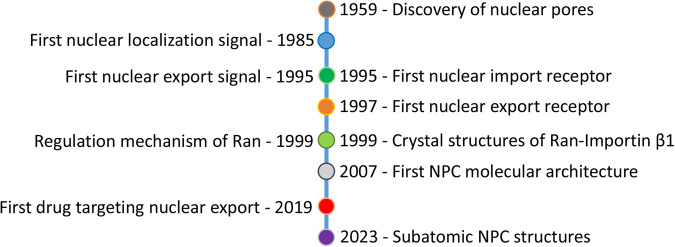
Fig. 1
Fig. 1
Research milestones in the field of nuclear transport
Fig. 2
Fig. 2
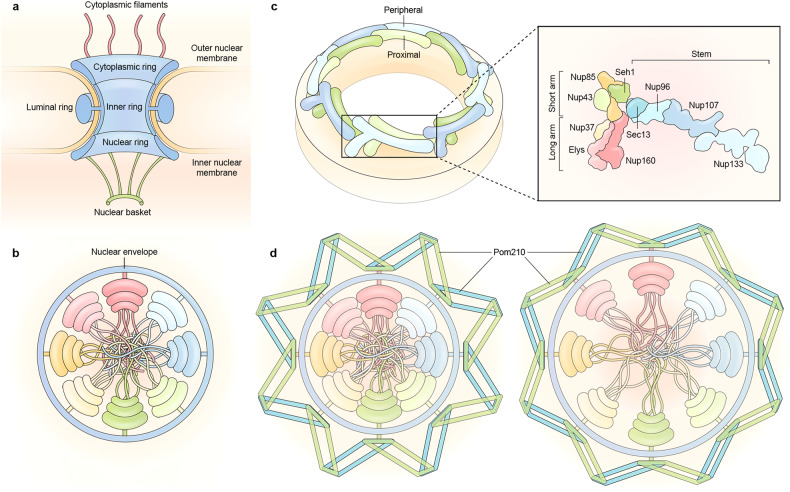
Carton representation of the nuclear pore complex. a The nuclear pore complex can be divided into three parts: the central core, the cytoplasmic filaments, and the nuclear basket. The central core can be further divided into four rings surrounding the central channel: the inner ring, the cytoplasmic ring, the nuclear ring, and the luminal ring. b Inner ring viewed in the direction of transport. The inner ring consists of eight loosely associated subunits surrounding the central channel. The central channel is filled with disordered FG repeat polypeptides that inhibit free diffusion across the nuclear envelope. c Architecture of the outer ring. The two outer rings (the cytoplasmic and nuclear rings) are highly similar, and only one outer ring is drawn for clarity. Each outer ring contains 16 copies of the Y complex, arranged in two concentric rings and stabilized by linker nucleoporins. The Y complex consists of 10 nucleoporins, which can be divided into three regions: the stem, the short arm, and the long arm. d Architecture of the luminal ring. Thirty-two copies of Pom210 connected end-to-end surround the NPC and interact with the inner ring on the other side of the nuclear envelope. The parallelogram architectural features of Pom210 allows deformation that contract (left panel) or dilate (right panel) the central channel
Fig. 3
Fig. 3
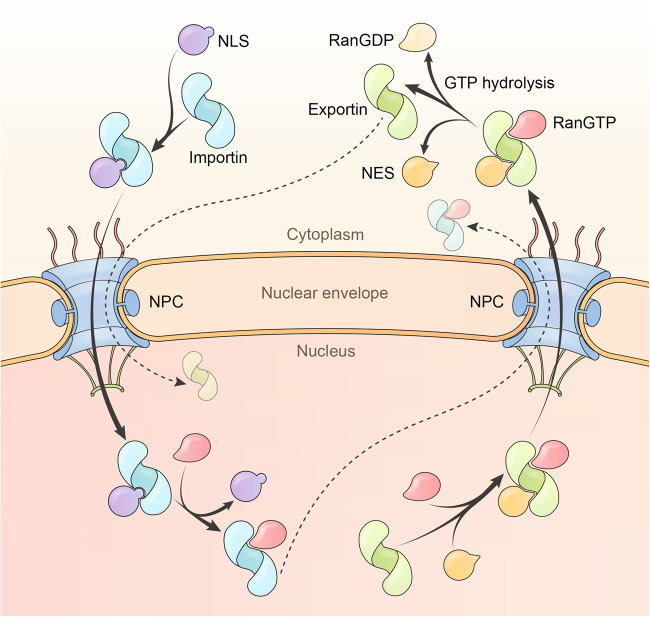
Model of protein nuclear import and export. Imported cargoes containing nuclear localization signals (NLSs) form complexes with importins in the cytoplasm, enter the nucleus through the NPC, and are dissociated from the importins with the aid of RanGTP. Nuclear export of cargoes starts with the formation of trimeric complexes consisting of exportin, nuclear export signal (NES)-containing cargo, and RanGTP. The trimeric complex transits through the NPC and is dissembled in the cytoplasm upon the hydrolysis of RanGTP. Certain species of RNA utilize protein adaptors to cross NPCs
Fig. 4
Fig. 4
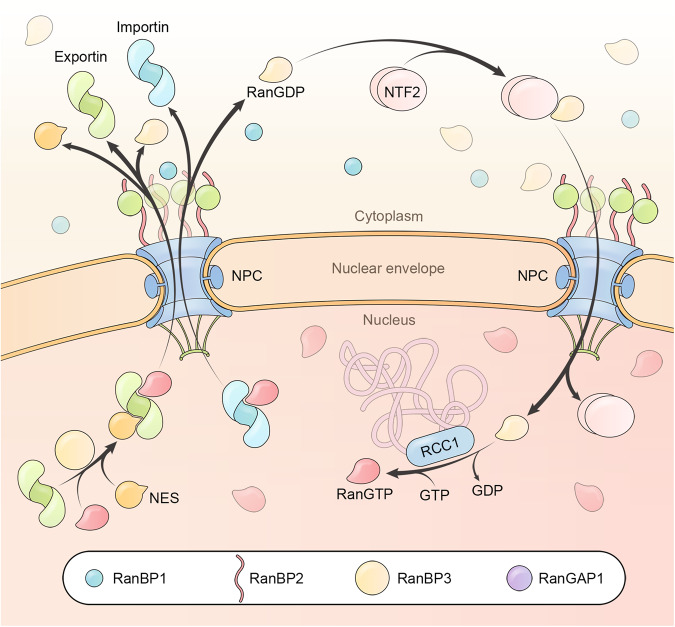
The RanGTP system and regulatory proteins. Ran is predominantly GTP-bound in the nucleus and GDP-bound in the cytoplasm. RanGTP is exported to the cytoplasm in complexes with karyopherins (either importins or export-cargo-bound exportins). In the cytoplasm, RanBP1 or RanBP2 (Nup358) promotes the dissociation of RanGTP from karyopherin complexes, allowing RanGAP1-mediated GTP hydrolysis. RanGDP is recycled back to the nucleus by NTF2, dissociated from NTF2, and reloaded with GTP by chromatin-bound RCC1 (GEF). RanBP3 enhances the recruitment of RanGTP to exportins
Fig. 5
Fig. 5
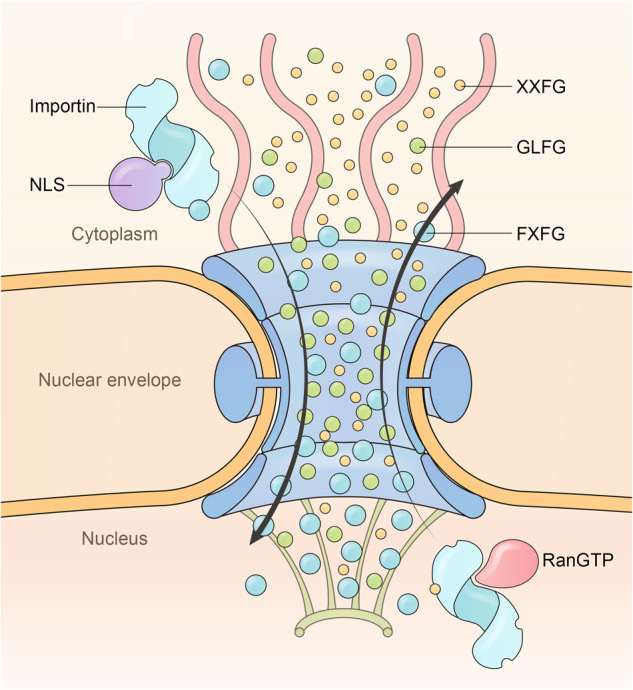
Model of uni-directional translocation within NPCs. In NPC, XXFG (small ball), GLFG (medium ball), and FXFG (large ball) repeats are not uniformly distributed but exist in concentration gradients. NLS binding to importin in the cytoplasm rearranges importin HEAT repeats to generate large pockets with high affinity for FXFG repeats, thereby moving importin and the bound cargo toward the nucleus with the aid of the FG gradient. Nuclear RanGTP binding renders importin surface pockets small and selective for XXFG repeats, driving the export of the complex. Exportin can also take advantage of this FG concentration gradient. Concentration gradients of different FG repeats provides a traction force and restrains directionality, thereby contributing to the high transport efficiency of NPCs. This model also explains the biological significance of the cytoplasmic filaments and the nuclear basket in nuclear transport (see text)
Fig. 6
Fig. 6
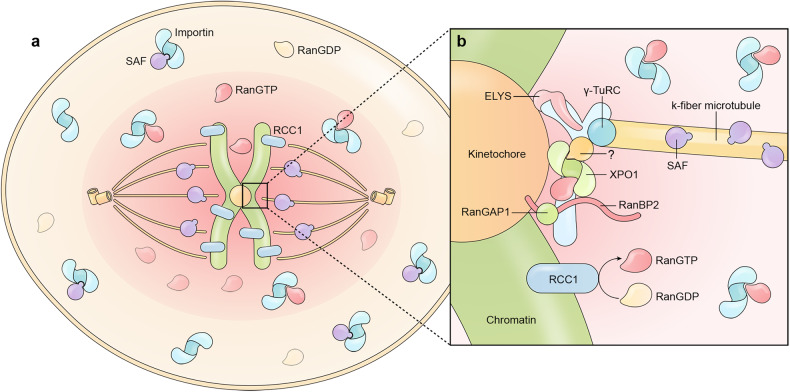
Role of nuclear transport proteins in mitotic spindle assembly and chromatid segregation. a Chromosome-bound RCC1 catalyzes the production of RanGTP around chromosomes. RanGTP near the chromosomes dissociates spindle assembly factors (SAFs) from bound importins, and the released SAFs promote spindle assembly. In the cortical region of the cell, spindle assembly is inhibited by excess importins. b The Y complex nucleoporins are critical for the recruitment of γ-TuRC, which induces k-fiber formation (kinetochore-initiated spindle microtubules). XPO1 is recruited to the Y complex and strengthens the connection between the k-fiber and the kinetochore. RanBP2 and RanGAP1 are recruited by XPO1 and mediate chromatid segregation at anaphase
Fig. 7
Fig. 7
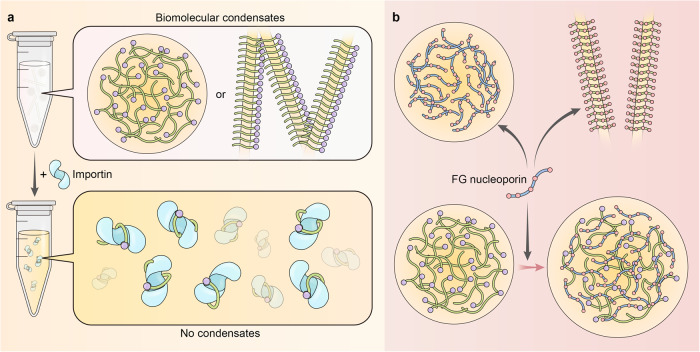
Role of nuclear transport proteins in regulating biomolecular condensates. a Importins can act as molecular chaperons for highly positively charged cargoes, such as many RNA binding proteins. The interaction between importin and cargo inhibits cargo aggregation and disaggregates biomolecular condensates (including fibers) formed by cargo. Purple dots represent nuclear localization signal of cargo proteins. b Many FG nucleoporins can form biomolecular condensates either on their own and/or coaggregate with other biomolecular condensates, such as TDP-43 droplets and stress granules. Red dots represent FG dipeptides
Fig. 8
Fig. 8
Role of nuclear transport proteins in cancer. a Overexpression of XPO1 leads to mislocalization and subsequent inactivation of many tumor suppressors, such as P53. Inhibition of XPO1, for example, by the FDA-approved drug selinexor, correctly repositions the tumor suppressors in the nucleus and inhibits cancer cell growth. b In several hematopoietic cancers, nucleoporin fusion proteins cocondensate with other transcription factors around chromatin, induce aberrant chromatin looping and activate HOXA cluster oncogenes
Fig. 9
Fig. 9
Vicious cycle between cytoplasmic condensation of RNA binding proteins (RBPs) and defective nuclear transport. Cytoplasmic condensation of RBPs (such as FUS and TDP-43) recruits many nuclear transport proteins (such as importins, nucleoporins, and Ran system proteins) into the condensates and disrupts normal nuclear transport (especially import). Impaired nuclear transport further leads to cytoplasmic accumulation of RBPs and excessive condensation. The vicious cycle can be triggered by genetic factors such as mutations or external factors such as chronic stress

References

    1. Macara, I. G. Transport into and out of the nucleus. Microbiol Mol. Biol. Rev.65, 570–594 (2001). table of contents. - PMC - PubMed
    1. Cautain, B., Hill, R., de Pedro, N. & Link, W. Components and regulation of nuclear transport processes. FEBS J.282, 445–462 (2015). - PMC - PubMed
    1. Beck, M. & Hurt, E. The nuclear pore complex: understanding its function through structural insight. Nat. Rev. Mol. Cell Biol.18, 73–89 (2017). - PubMed
    1. Wing, C. E., Fung, H. Y. J. & Chook, Y. M. Karyopherin-mediated nucleocytoplasmic transport. Nat. Rev. Mol. Cell Biol.23, 307–328 (2022). - PMC - PubMed
    1. Izaurralde, E. et al. The asymmetric distribution of the constituents of the Ran system is essential for transport into and out of the nucleus. EMBO J.16, 6535–6547 (1997). - PMC - PubMed

MeSH terms

Substances