


A phase I study of the combination of atezolizumab, tiragolumab, and stereotactic body radiation therapy in patients with metastatic multiorgan cancer
- PMID: 37946136
- PMCID: PMC10633948
- DOI: 10.1186/s12885-023-11534-6
A phase I study of the combination of atezolizumab, tiragolumab, and stereotactic body radiation therapy in patients with metastatic multiorgan cancer
Abstract
Background: Immunotherapy targeting the PD-1/PD-L1 pathway is a standard of care in a number of metastatic malignancies, but less than a fifth of patients are expected to respond to ICIs (Immune Checkpoint Inhibitors). In a clinical trial, combining the anti-TIGIT (T cell immunoreceptor with Ig and ITIM domains) Mab (monoclonal antibody) tiragolumab with atezolizumab improved outcomes in non-small cell lung cancer. In preclinical models, SBRT (Stereotactic Body Radiation Therapy) could increase expression levels of the inhibitory co-receptors TIGIT and PD-L1. We aim to assess the combination of tiragolumab with atezolizumab and SBRT in metastatic, previously treated by ICIs, non-small cell lung cancer, head and neck cancer, bladder cancer, and renal cell cancer.
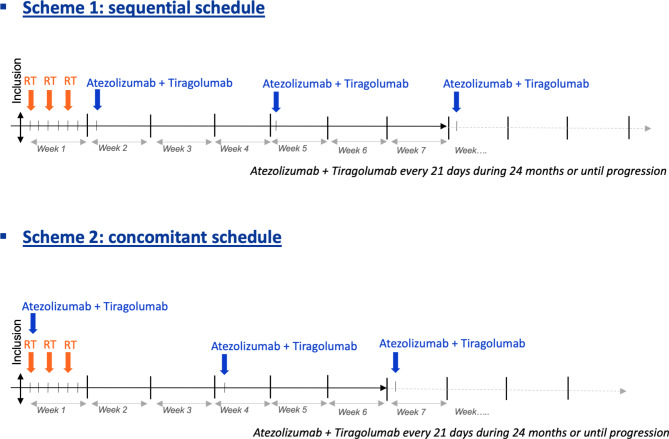
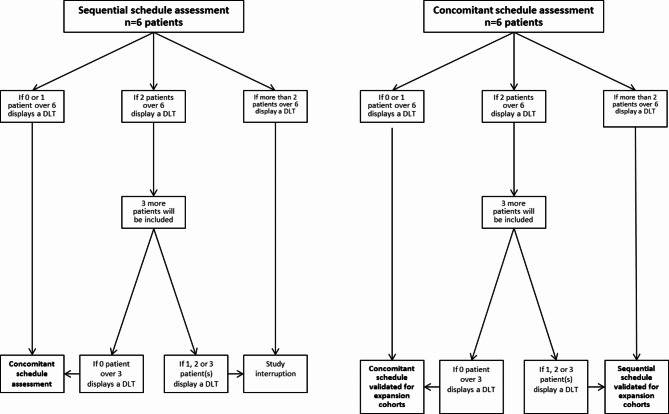
Methods: This phase I study (ClinicalTrials.gov NCT05259319) will assess the efficacy and safety of the combination of atezolizumab with tiragolumab and stereotactic body radiation therapy in patients with histologically proven metastatic non-small cell lung cancer, renal cell cancer, bladder cancer, and head and neck cancer previously treated. First part: 2 different schedules of SBRT in association with a fixed dose of atezolizumab and tiragolumab will be investigated only with metastatic non-small cell lung cancer patients (cohort 1). The expansion cohorts phase will be a multicentric, open-label study at the recommended scheme of administration and enroll additional patients with metastatic bladder cancer, renal cell cancer, and head and neck cancer (cohort 2, 3 and 4). Patients will be treated until disease progression, unacceptable toxicity, intercurrent conditions that preclude continuation of treatment, or patient refusal in the absence of progression or intolerance. The primary endpoint of the first phase is the safety of the combination in a sequential or concomitant scheme and to determine the expansion cohorts phase recommended scheme of administration. The primary endpoint of phase II is to evaluate the efficacy of tiragolumab + atezolizumab + SBRT in terms of 6-month PFS (Progression-Free Survival). Ancillary analyses will be performed with peripheral and intratumoral immune biomarker assessments.
Trial registration: This study is registered on ClinicalTrials.gov: NCT05259319, since February 28th, 2022.
Keywords: Atezolizumab; Bladder cancer; Head and neck cancer; Immunotherapy; Non-small cell lung cancer; PDL-1; Renal cell cancer; SBRT; Stereotactic body radiation therapy; TIGIT; Tiragolumab.
© 2023. The Author(s).
Conflict of interest statement
The authors declare no competing interests.
Figures

References
-
- Vaddepally RK, Kharel P, Pandey R, Garje R, Chandra AB. Review of Indications of FDA-Approved Immune Checkpoint Inhibitors per NCCN Guidelines with the Level of Evidence. Cancers [Internet]. 2020 Mar 20 [cited 2022 Dec 6];12(3):738. Available from: https://www.mdpi.com/2072-6694/12/3/738. - PMC - PubMed
-
- Planchard D, Popat S, Kerr K, Novello S, Smit EF, Faivre-Finn C et al. Metastatic non-small cell lung cancer: ESMO Clinical Practice Guidelines for diagnosis, treatment and follow-up. Annals of Oncology [Internet]. 2018 Oct [cited 2022 Nov 28];29:iv192–237. Available from: https://linkinghub.elsevier.com/retrieve/pii/S0923753419317107. - PubMed
-
- Escudier B, Porta C, Schmidinger M, Rioux-Leclercq N, Bex A, Khoo V et al. Renal cell carcinoma: ESMO Clinical Practice Guidelines for diagnosis, treatment and follow-up. Annals of Oncology [Internet]. 2019 May [cited 2022 Nov 28];30(5):706–20. Available from: https://linkinghub.elsevier.com/retrieve/pii/S0923753419311573. - PubMed
-
- Powles T, Bellmunt J, Comperat E, De Santis M, Huddart R, Loriot Y et al. Bladder cancer: ESMO Clinical Practice Guideline for diagnosis, treatment and follow-up. Annals of Oncology [Internet]. 2022 Mar [cited 2022 Nov 28];33(3):244–58. Available from: https://linkinghub.elsevier.com/retrieve/pii/S0923753421048274. - PubMed
-
- Machiels JP, René Leemans C, Golusinski W, Grau C, Licitra L, Gregoire V. Squamous cell carcinoma of the oral cavity, larynx, oropharynx and hypopharynx: EHNS–ESMO–ESTRO Clinical Practice Guidelines for diagnosis, treatment and follow-up. Annals of Oncology [Internet]. 2020 Nov [cited 2022 Nov 28];31(11):1462–75. Available from: https://linkinghub.elsevier.com/retrieve/pii/S092375342039949X. - PubMed
Publication types
MeSH terms
Substances
Associated data
LinkOut - more resources
Full Text Sources
Medical
Research Materials
