. 2023 Dec 19;14(6):e0215623.
doi: 10.1128/mbio.02156-23. Epub 2023 Nov 10.

The contribution of DNA repair pathways to Staphylococcus aureus fitness and fidelity during nitric oxide stress

Affiliations

The contribution of DNA repair pathways to Staphylococcus aureus fitness and fidelity during nitric oxide stress

Kelly E Hurley et al. mBio. .

Abstract

Pathogenic bacteria must evolve various mechanisms in order to evade the host immune response that they are infecting. One aspect of the primary host immune response to an infection is the production of an inflammatory effector component, nitric oxide (NO⋅). Staphylococcus aureus has uniquely evolved a diverse array of strategies to circumvent the inhibitory activity of nitric oxide. One such mechanism by which S. aureus has evolved allows the pathogen to survive and maintain its genomic integrity in this environment. For instance, here, our results suggest that S. aureus employs several DNA repair pathways to ensure replicative fitness and fidelity under NO⋅ stress. Thus, our study presents evidence of an additional strategy that allows S. aureus to evade the cytotoxic effects of host NO⋅.

Keywords: DNA repair; Staphylococcus aureus; nitric oxide.


Conflict of interest statement

The authors declare no conflict of interest.

Figures
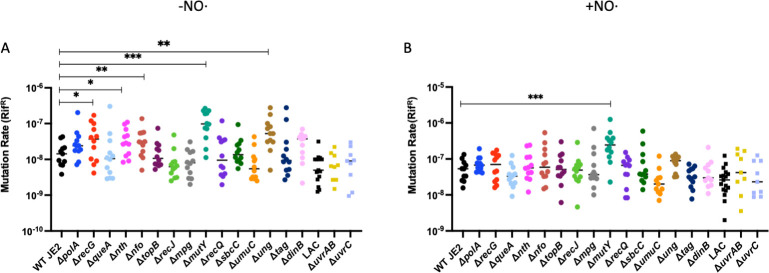
FIG 1
FIG 1
Elevated mutation rates suggest that MutY may play a role in modulating mutagenicity in the presence of NO⋅ in S. aureus. Mutability of S. aureus WT JE2 and 15 DNA repair transposon mutants shown either unexposed (A) or exposed (B) to a disc of 500 mM diethylenetriamine NONOate ( (n = 12). Data were analyzed via the Wilcoxon rank-sum test for nonparametric analyses (*, P < 0.05; **, P < 0.005; ***, P < 0.0005).
FIG 2
FIG 2
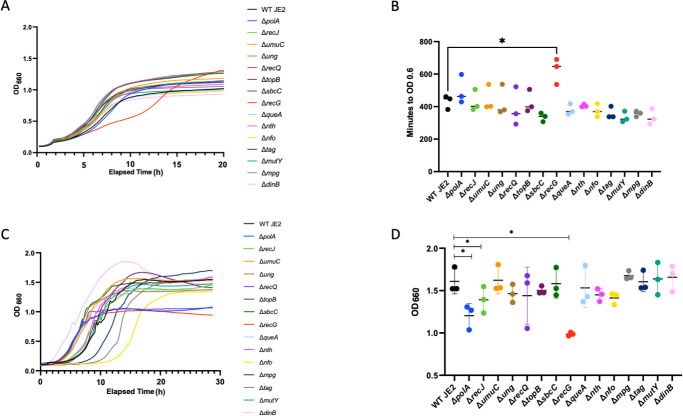
Growth curves suggest that RecG may contribute to S. aureus ability to confer fitness under NO⋅ stress. A representative growth curve is shown for S. aureus WT JE2 and 15 DNA repair transposon mutants grown in tryptic soy broth with a mixture of 1 mM DEANO and 10 mM NOC-12 added at OD 0.2 (A) (n = 3). The amount of time it took each mutant strain to reach an OD of 0.6 with a mixture of 1 mM DEANO and 10 mM NOC-12 added at OD 0.2 (B) (n = 3). A representative growth curve is shown for S. aureus WT JE2 and 15 DNA repair transposon mutants grown in PNG with the addition of 10 mM DETA/NO at inoculum (C) (n = 3). Average terminal OD from growth curves (C) of S. aureus WT JE2 and 15 DNA repair transposon mutants grown in PNG minimal media with 10 mM DETA/NO added at inoculum (D) (n = 3). Data were analyzed via one-way analysis of variance with Dunnett’s multiple comparisons test for correction (*, P < 0.05) or Student’s two-tailed t-test (*, P < 0.05) where appropriate.
FIG 3
FIG 3
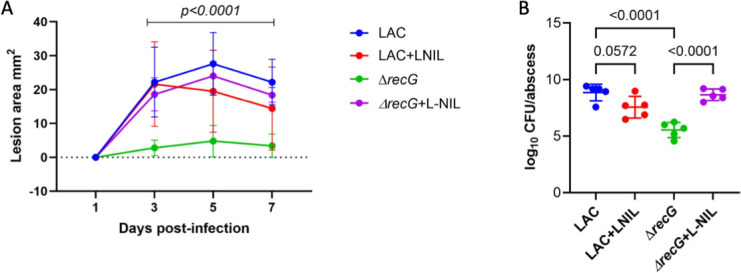
In vivo results suggest that RecG plays a role in maintaining replication integrity in S. aureus in the presence of host NO⋅ production. C57BL/6J mice were infected subcutaneously with 107 CFU of either WT LAC or the ΔrecG mutant (n = 5). A representative graph of lesion sizes measured on days 1, 3, 5, and 7 post infection is shown in A. Bacterial burden was measured by harvesting the abscess 7 days post infection and enumerating the bacteria (B). Data were analyzed via one-way analysis of variance with Tukey’s multiple comparisons test for correction.

References

    1. Klevens RM, Morrison MA, Nadle J, Petit S, Gershman K, Ray S, Harrison LH, Lynfield R, Dumyati G, Townes JM, Craig AS, Zell ER, Fosheim GE, McDougal LK, Carey RB, Fridkin SK, Active Bacterial Core surveillance (ABCs) MRSA Investigators . 2007. Invasive methicillin-resistant Staphylococcus aureus infections in the United States. JAMA 298:1763–1771. doi: 10.1001/jama.298.15.1763 - DOI - PubMed
    1. Otto M. 2010. Staphylococcus colonization of the skin and antimicrobial peptides. Expert Rev Dermatol 5:183–195. doi: 10.1586/edm.10.6 - DOI - PMC - PubMed
    1. Monaco M, Pimentel de Araujo F, Cruciani M, Coccia EM, Pantosti A. 2017. Worldwide epidemiology and antibiotic resistance of Staphylococcus aureus. Curr Top Microbiol Immunol 409:21–56. doi: 10.1007/82_2016_3 - DOI - PubMed
    1. Thurlow LR, Joshi GS, Richardson AR. 2012. Virulence strategies of the dominant USA300 lineage of community-associated Methicillin-resistant Staphylococcus aureus (CA-MRSA). FEMS Immunol Med Microbiol 65:5–22. doi: 10.1111/j.1574-695X.2012.00937.x - DOI - PMC - PubMed
    1. Richardson AR, Dunman PM, Fang FC. 2006. The nitrosative stress response of Staphylococcus aureus is required for resistance to innate immunity. Mol Microbiol 61:927–939. doi: 10.1111/j.1365-2958.2006.05290.x - DOI - PubMed

Publication types

LinkOut - more resources