


Effect of Neutralizing Monoclonal Antibody Treatment on Early Trajectories of Virologic and Immunologic Biomarkers in Patients Hospitalized With COVID-19
- PMID: 37948759
- PMCID: PMC10938202
- DOI: 10.1093/infdis/jiad446
Effect of Neutralizing Monoclonal Antibody Treatment on Early Trajectories of Virologic and Immunologic Biomarkers in Patients Hospitalized With COVID-19
Abstract
Background: Neutralizing monoclonal antibodies (nmAbs) failed to show clear benefit for hospitalized patients with coronavirus disease 2019 (COVID-19). Dynamics of virologic and immunologic biomarkers remain poorly understood.
Methods: Participants enrolled in the Therapeutics for Inpatients with COVID-19 trials were randomized to nmAb versus placebo. Longitudinal differences between treatment and placebo groups in levels of plasma nucleocapsid antigen (N-Ag), anti-nucleocapsid antibody, C-reactive protein, interleukin-6, and D-dimer at enrollment, day 1, 3, and 5 were estimated using linear mixed models. A 7-point pulmonary ordinal scale assessed at day 5 was compared using proportional odds models.
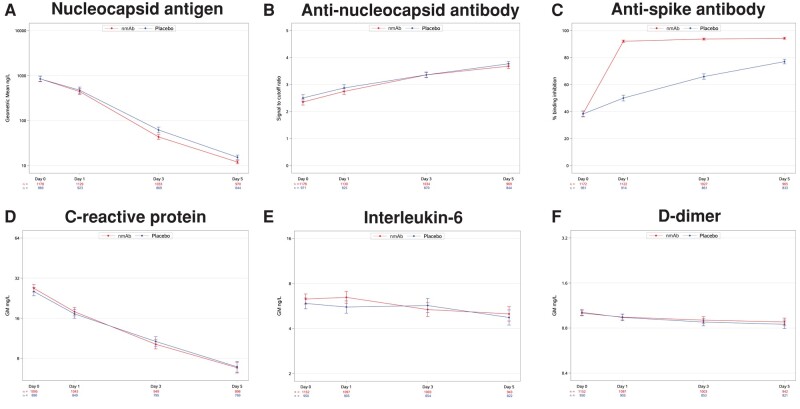
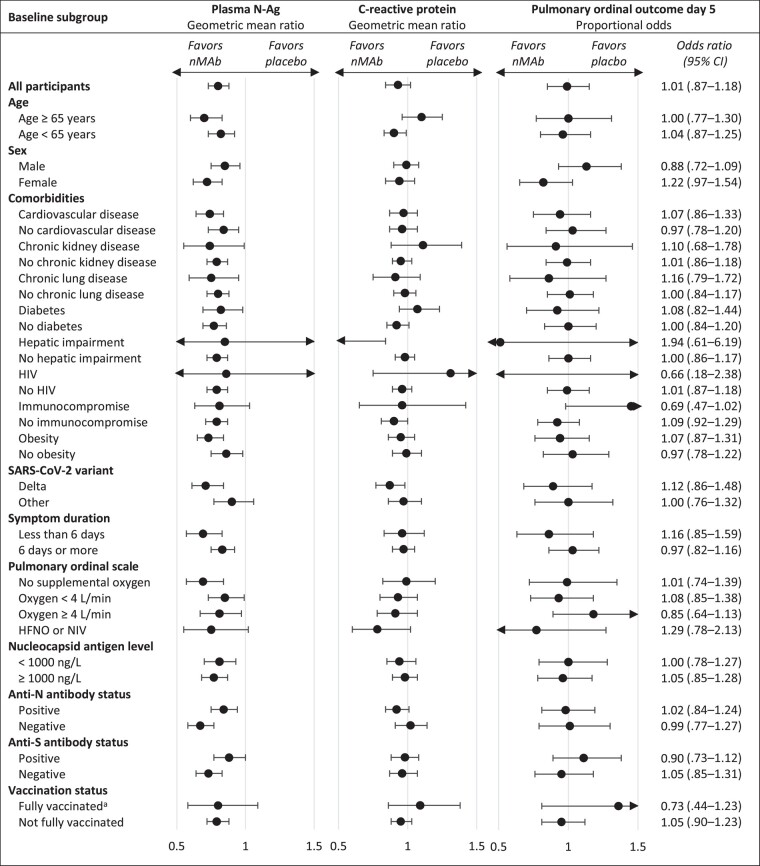
Results: Analysis included 2149 participants enrolled between August 2020 and September 2021. Treatment resulted in 20% lower levels of plasma N-Ag compared with placebo (95% confidence interval, 12%-27%; P < .001), and a steeper rate of decline through the first 5 days (P < .001). The treatment difference did not vary between subgroups, and no difference was observed in trajectories of other biomarkers or the day 5 pulmonary ordinal scale.
Conclusions: Our study suggests that nmAb has an antiviral effect assessed by plasma N-Ag among hospitalized patients with COVID-19, with no blunting of the endogenous anti-nucleocapsid antibody response. No effect on systemic inflammation or day 5 clinical status was observed.
Clinical trials registration: NCT04501978.
Keywords: COVID-19; anti-nucleocapsid antibody; inflammatory biomarkers; neutralizing monoclonal antibody; plasma nucleocapsid antigen.
© The Author(s) 2023. Published by Oxford University Press on behalf of Infectious Diseases Society of America.
Conflict of interest statement
Potential conflicts of interest. A. L. G. reports receiving institutional funding from Novavax, insititutaional partnership with Astra Zeneca, and reports being personally named as inventor on a patent used by Astra Zeneca. D. D. M. reports receiving grant from the Danish National research Foundation. E. M. reports payments to his institution received from SciClone Pharmaceuticals, Regeneron Pharmaceuticals, Pfizer, Chemic Labs/KODA Therapeutics, Cidara, and Leidos Biomedical Research Inc; E. M. also reports being on an advisory board for Basilea. K. W. reports receiving a honorarium for international ARDS conference and travel support from UCSF. M. A. reports a grant from NINDS. M. A. M. reports institutional grants from NHLBI/NIAID, the department of defence, California Institute of Regeneration, Roche-Genentech, and Quantum Health. M. A. M. has also received personal consulting fees from Novartis, Pliant Therapeutics, Johnson and Johnson, Gilead, and Citius Pharmaceuticals. M. K. J. reports institutional grants from Gilead, Laurent, and Regeneron; personal consulting fees from Gilead; and personal honoraria from Cooper Clinic. S. T. is funded by grants from the Australian Medical Foundation and New South Wales Health. The remaining authors report no potential conflicts. All authors have submitted the ICMJE Form for Disclosure of Potential Conflicts of Interest. Conflicts that the editors consider relevant to the content of the manuscript have been disclosed.
Figures
References
Publication types
MeSH terms
Substances
Associated data
Grants and funding
LinkOut - more resources
Full Text Sources
Medical
Research Materials
