


Finite element analysis comparing a PEEK posterior fixation device versus pedicle screws for lumbar fusion
- PMID: 37950318
- PMCID: PMC10636999
- DOI: 10.1186/s13018-023-04349-5
Finite element analysis comparing a PEEK posterior fixation device versus pedicle screws for lumbar fusion
Abstract
Background: Pedicle screw loosening and breakage are common causes of revision surgery after lumbar fusion. Thus, there remains a continued need for supplemental fixation options that offer immediate stability without the associated failure modes. This finite element analysis compared the biomechanical properties of a novel cortico-pedicular posterior fixation (CPPF) device with those of a conventional pedicle screw system (PSS).
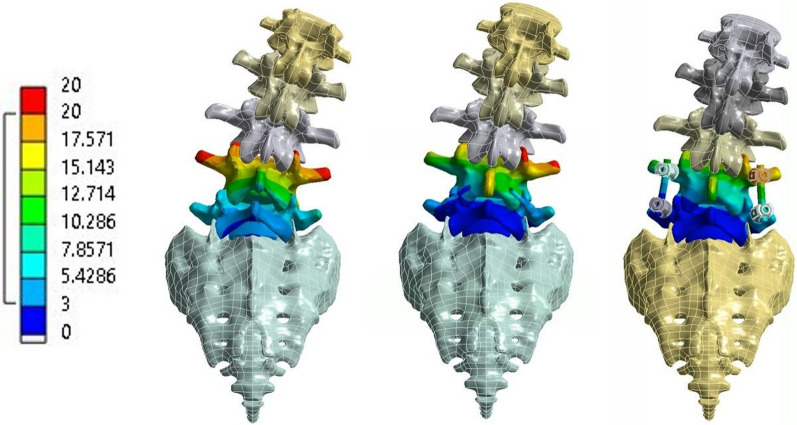
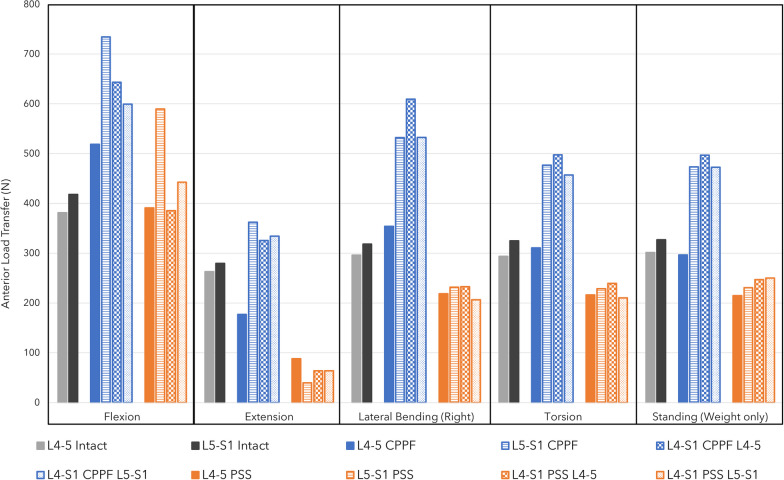
Methods: The CPPF device is a polyetheretherketone strap providing circumferential cortical fixation for lumbar fusion procedures via an arcuate tunnel. Using a validated finite element model, we compared the stability and load transfer characteristics of CPPF to intact conditions under a 415 N follower load and PSS conditions under a 222 N preload. Depending on the instrumented levels, two different interbody devices were used: a lateral lumbar interbody device at L4-5 or an anterior lumbar interbody device at L5-S1. Primary outcomes included range of motion of the functional spinal units and anterior load transfer, defined as the total load through the disk and interbody device after functional motion and follower load application.
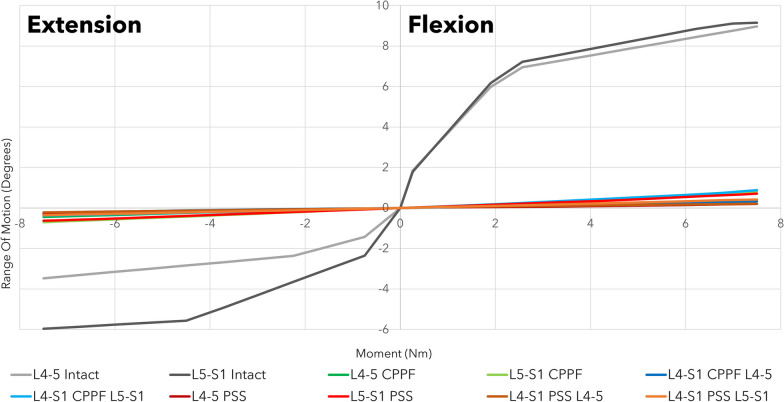
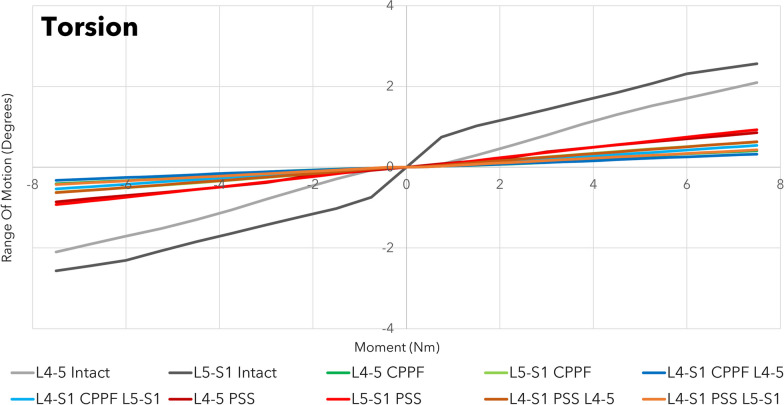
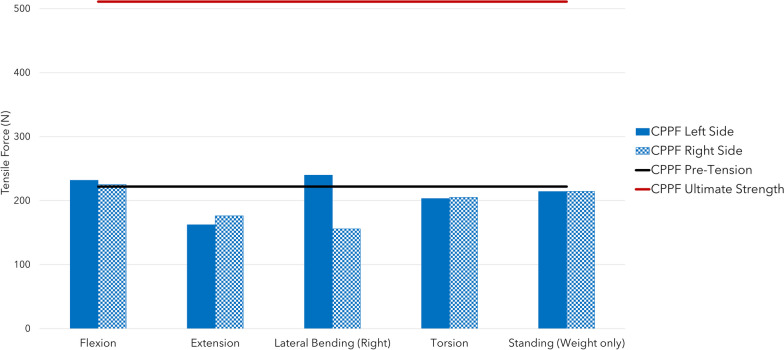
Results: Across all combinations of interbody devices and lumbar levels evaluated, CPPF consistently demonstrated significant reductions in flexion (ranging from 90 to 98%), extension (ranging from 88 to 94%), lateral bending (ranging from 75 to 80%), and torsion (ranging from 77 to 86%) compared to the intact spine. Stability provided by the CPPF device was comparable to PSS in all simulations (range of motion within 0.5 degrees for flexion-extension, 0.6 degrees for lateral bending, and 0.5 degrees for torsion). The total anterior load transfer was higher with CPPF versus PSS, with differences across all tested conditions ranging from 128 to 258 N during flexion, 89-323 N during extension, 135-377 N during lateral bending, 95-258 N during torsion, and 82-250 N during standing.
Conclusion: Under the modeled conditions, cortico-pedicular fixation for supplementing anterior or lateral interbody devices between L4 and S1 resulted in comparable stability based on range of motion measures and less anterior column stress shielding based on total anterior load transfer measures compared to PSS. Clinical studies are needed to confirm these finite element analysis findings.
Keywords: Cortical fixation; Karma; Lumbar spine; Pedicle screw; Posterior fixation.
© 2023. The Author(s).
Conflict of interest statement
KP has no relevant financial or non-financial interests to disclose. RE, PN, LM, PL, JC, and AA disclose consultancy with Spinal Elements (Carlsbad, CA, USA). AV discloses consultancy with Globus. He has also served on the scientific advisory board/board of directors/committees for Accelus, Sentryx, AOSpine, and National Spine Health Foundation. He has received royalty payments from Atlas Spine, Medtronic, Stryker Spine, Globus, Aesculap, Thieme, Jaypee, Elsevier, and Taylor Francis/Hodder and Stoughton. He has stock/stock option ownership interests in Accelus, Atlas Spine, AVKN Patient Driving Care, Replication Medica, Globus, Paradigm Spine, Stout Medical, Progressive Spinal Technologies, Advanced Spinal Intellectual Properties, Spine Medica, Computational Biodynamics, Spineology, Orthobullets, Parvizi Surgical Innoavtion, In Vivo, Flagship Surgical, Cytonics, Bonovo Orthopaedics, Electrocore, FlowPharma, R.S.I., Rothman Institute and Related Properties, Innovative Surgical Design, and Avaz Surgical. In addition, he has also provided expert testimony. He has also served as deputy editor/editor of Clinical Spine Surgery. MS reports consulting with Camber Spine, K2M. NuVasive, Organogenesis, ReGelTec, Simplify Medical, Spineology, and Zimmer Biomet; and a grant from Wright Medical.
Figures



References
-
- Resnick DK, Choudhri TF, Dailey AT, Groff MW, Khoo L, Matz PG, Mummaneni P, Watters WC, 3rd, Wang J, Walters BC, Hadley MN, American Association of Neurological Surgeons/Congress of Neurological S. Guidelines for the performance of fusion procedures for degenerative disease of the lumbar spine. Part 12: pedicle screw fixation as an adjunct to posterolateral fusion for low-back pain. J Neurosurg Spine. 2005;2:700–706.10.3171/spi.2005.2.6.0700 - PubMed
MeSH terms
Substances
LinkOut - more resources
Full Text Sources
