Review
. 2023 Nov 11;6(1):1150.
doi: 10.1038/s42003-023-05544-0.

Taming the perils of photosynthesis by eukaryotes: constraints on endosymbiotic evolution in aquatic ecosystems

Affiliations
Review

Taming the perils of photosynthesis by eukaryotes: constraints on endosymbiotic evolution in aquatic ecosystems

Shin-Ya Miyagishima. Commun Biol. .

Abstract

An ancestral eukaryote acquired photosynthesis by genetically integrating a cyanobacterial endosymbiont as the chloroplast. The chloroplast was then further integrated into many other eukaryotic lineages through secondary endosymbiotic events of unicellular eukaryotic algae. While photosynthesis enables autotrophy, it also generates reactive oxygen species that can cause oxidative stress. To mitigate the stress, photosynthetic eukaryotes employ various mechanisms, including regulating chloroplast light absorption and repairing or removing damaged chloroplasts by sensing light and photosynthetic status. Recent studies have shown that, besides algae and plants with innate chloroplasts, several lineages of numerous unicellular eukaryotes engage in acquired phototrophy by hosting algal endosymbionts or by transiently utilizing chloroplasts sequestrated from algal prey in aquatic ecosystems. In addition, it has become evident that unicellular organisms engaged in acquired phototrophy, as well as those that feed on algae, have also developed mechanisms to cope with photosynthetic oxidative stress. These mechanisms are limited but similar to those employed by algae and plants. Thus, there appear to be constraints on the evolution of those mechanisms, which likely began by incorporating photosynthetic cells before the establishment of chloroplasts by extending preexisting mechanisms to cope with oxidative stress originating from mitochondrial respiration and acquiring new mechanisms.


Conflict of interest statement

The author declares no competing interests.

Figures
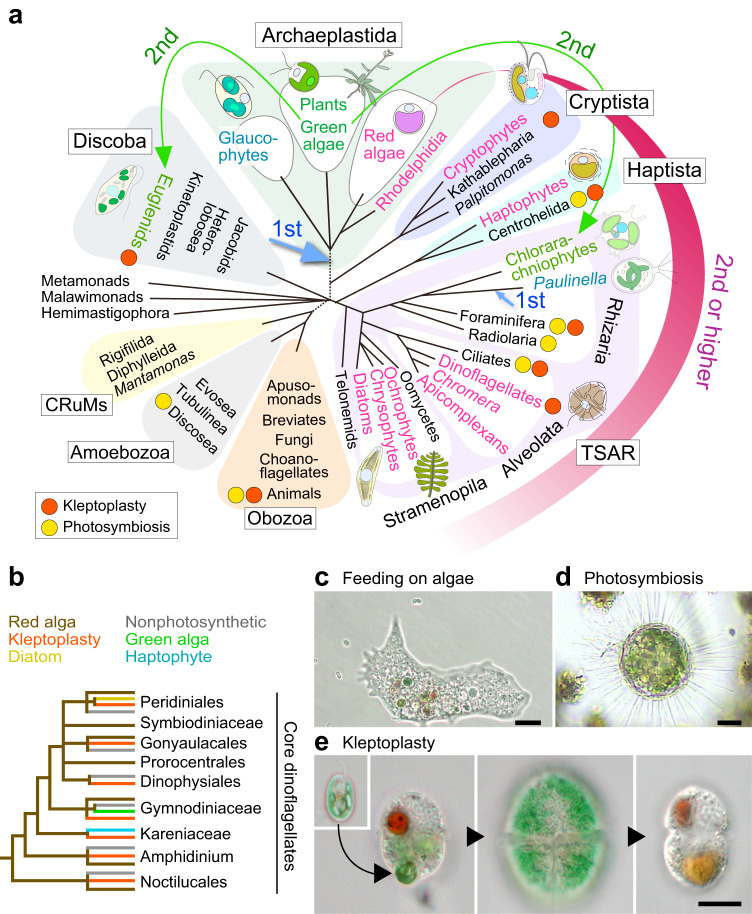
Fig. 1
Fig. 1. Phylogenetic distribution of eukaryotes that engage in kleptoplasty, accommodate algal endosymbionts, and possess innate chloroplasts.
a Phylogenetic tree of eukaryotes showing primary endosymbiotic events involving a cyanobacterium and secondary or higher-order endosymbiotic events involving green or red algae. Higher-order endosymbiotic events in certain dinoflagellates (shown in b) were not included in the diagram. The position and number of horizontal transfers of red algal chloroplasts are still a subject of debate. The tree topology is based on refs. ,. Orange and yellow circles on the tree represent the presence of kleptoplasty and photosymbiosis on respective lineages. The broken lines denote the uncertainty of branch positions in the tree. Red algae and groups possessing complex chloroplasts (or non-photosynthetic plastids) of red algal origin are shown in red. Viridiplantae (green algae and land plants) and groups possessing chloroplasts of green algal origin are shown in green. b Phylogenetic tree of core dinoflagellates indicating the origins of their original (i.e., red algal origin) or replaced chloroplasts and lineages exhibiting kleptoplasty. Tree topology is based on refs. ,. Microscopic images of an ameba feeding on unicellular algae (c; bar = 20 µm), a centrohelid that harbors algal endosymbionts (d; bar = 20 µm), and the kleptoplastic dinoflagellate N. aeruginosum (e; Gymnodiniaceae; bar = 10 µm). For N. aeruginosum, images are shown of the source of the kleptoplast (i.e., the cryptomonad Chroomonas sp), cells during algal cell ingestion, with an enlarged kleptoplast, and during the digestion of the kleptoplast in this order. Figure panels are courtesy of Dr. Ryo Onuma (N. aeruginosum) and Mr. Kaoru Okada (the ameba and centrohelid).
Fig. 2
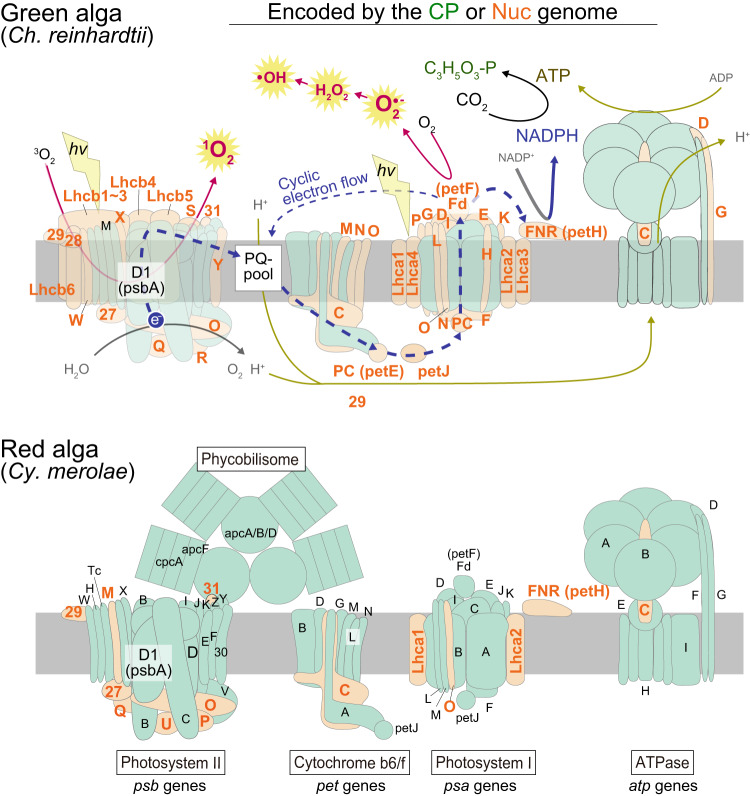
Fig. 2. Composition of and ROS generation by the photosynthetic apparatus.
The illustration is modified from ref. . and shows the photosynthetic apparatus in the green alga Chlamydomonas reinhardtii and the red alga Cyanidioschyzon merolae. Components encoded by the chloroplast and nuclear genomes are depicted in green and orange, respectively. In the green algal photosynthetic apparatus, the light-harvesting, electron flow, and ROS generation are also shown. In addition to the linear electron flow (thick blue dotted line) that generates ATP and NADPH and releases oxygen as a byproduct, the cyclic electron flow (thin blue dotted line) which generates ATP but does not produce NADPH or release oxygen is also depicted.
Fig. 3
Fig. 3. Several types of kleptoplasty.
a Simple kleptoplasty with faster turnover rates observed in several lineages. Here, only the chloroplast of the prey is sequestered and utilized. b Kleptoplasty with slower turnover rates, supported by a kleptokaryon, as observed in the ciliate M. rubrum/major and the dinoflagellate N. aeruginosum. Here, the kleptokaryon is inherited by only one of the two daughter cells. In cells that have lost the kleptokaryon, the kleptoplast ceases to grow and then undergoes digestion. c Kleptoplasty with slower turnover rates, supported by kleptoplast-targeted proteins that are encoded in the host nuclear genome, as observed in the dinoflagellates Dinophysis and RSD, and a recently found kleptoplastic euglenoid, Rapaza viridis. Here, the kleptoplast grows for a certain period in Dinophysis, as depicted in the figure, but does not grow in RSD.
Fig. 4
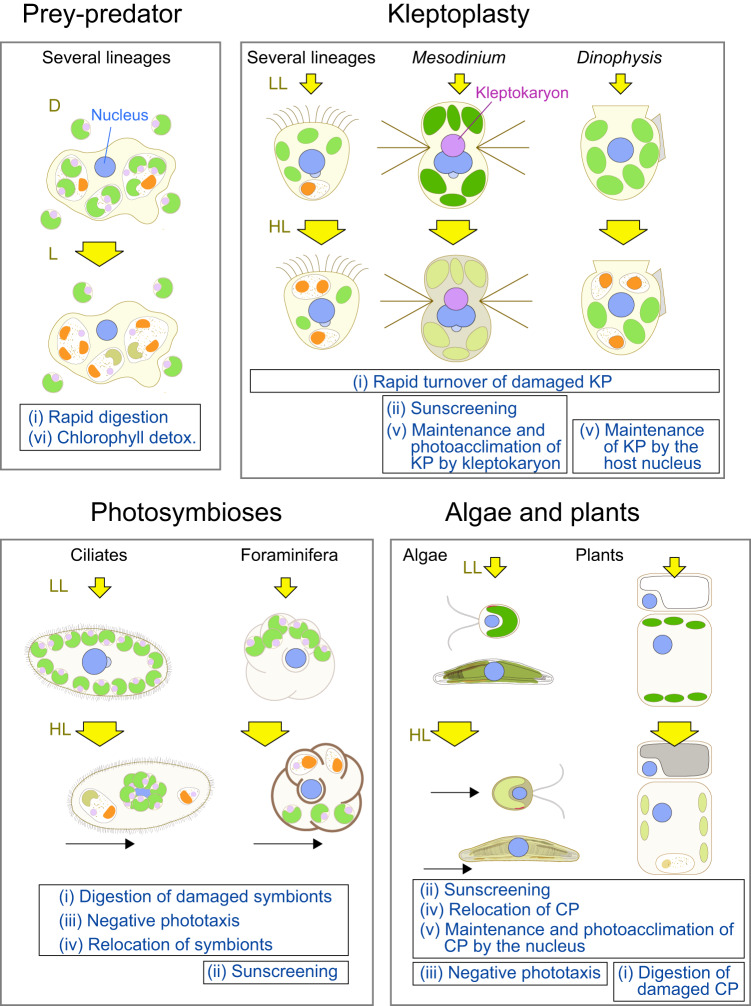
Fig. 4. Comparison of mechanisms evolved in several types of eukaryotes to mitigate photosynthetic oxidative stress.
The figure highlights mechanisms other than ROS scavenging and compares them among eukaryotes that feed on algae (i.e., prey-predator interactions), engage in kleptoplasty or photosymbiosis, or possess innate primary or complex chloroplasts (i.e., algae and plants). Related mechanisms are assigned the same Roman numeral. Details and relevant references are provided in Supplementary Table 1. L, D, LL, HL, and KP indicate light, dark, low light, high light, and kleptoplasts, respectively.

References

    1. Stoecker DK, Johnson M, deVargas C, Not F. Acquired phototrophy in aquatic protists. Aquat. Micro. Ecol. 2009;57:279–310. doi: 10.3354/ame01340. - DOI
    1. Johnson MD. The acquisition of phototrophy: adaptive strategies of hosting endosymbionts and organelles. Photosynth. Res. 2011;107:117–132. doi: 10.1007/s11120-010-9546-8. - DOI - PubMed
    1. Nowack ECM, Weber APM. Genomics-informed insights into endosymbiotic organelle evolution in photosynthetic eukaryotes. Annu. Rev. Plant Biol. 2018;69:51–84. doi: 10.1146/annurev-arplant-042817-040209. - DOI - PubMed
    1. Sibbald SJ, Archibald JM. Genomic insights into plastid evolution. Genome Biol. Evol. 2020;12:978–990. doi: 10.1093/gbe/evaa096. - DOI - PMC - PubMed
    1. Ponce-Toledo RI, Lopez-Garcia P, Moreira D. Horizontal and endosymbiotic gene transfer in early plastid evolution. N. Phytol. 2019;224:618–624. doi: 10.1111/nph.15965. - DOI - PMC - PubMed

Publication types