


"The project did not come to us with a solution": Perspectives of research teams on implementing a study about electronic health record-embedded individualized pain plans for emergency department treatment of vaso-occlusive episodes in adults with sickle cell disease
- PMID: 37953236
- PMCID: PMC10641983
- DOI: 10.1186/s12913-023-10255-7
"The project did not come to us with a solution": Perspectives of research teams on implementing a study about electronic health record-embedded individualized pain plans for emergency department treatment of vaso-occlusive episodes in adults with sickle cell disease
Abstract
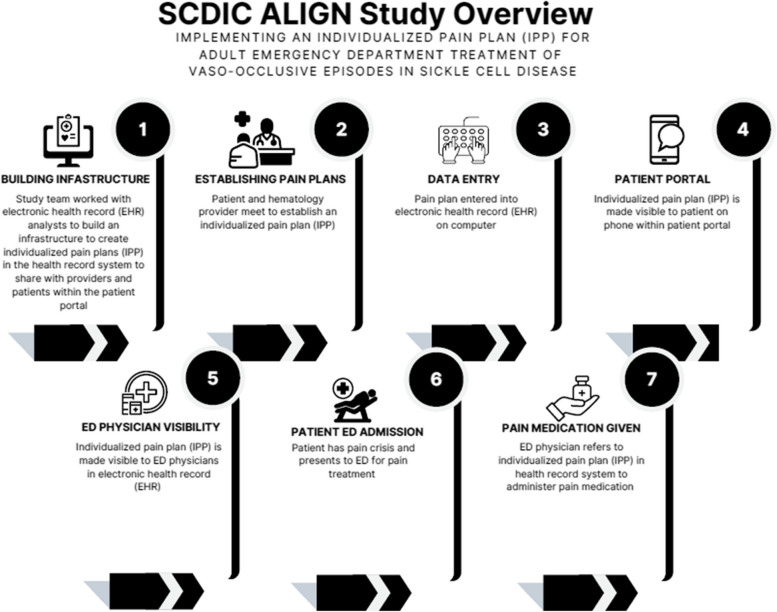
Background: This study aimed to capture the implementation process of the ALIGN Study, (An individualized Pain Plan with Patient and Provider Access for Emergency Department care of Sickle Cell Disease). ALIGN aimed to embed Individualized Pain Plans in the electronic health record (E-IPP) and provide access to the plan for both adult patients with sickle cell disease (SCD) and emergency department providers when a person with SCD comes to the emergency department in vaso-occlusive crises.
Methods: Semi-structured interviews were conducted with research teams from the 8 participating sites from the ALIGN study. Seventeen participants (principal investigators and study coordinators) shared their perspectives about the implementation of ALIGN in their sites. Data were analyzed in three phases using open coding steps adapted from grounded theory and qualitative content analysis.
Results: A total of seven overarching themes were identified: (1) the E-IPP structure (location and upkeep) and collaboration with the informatics team, (2) the role of ED champion, (3) the role of research coordinators, (4) research team communication, and communication between research team and clinical team, (5) challenges with the study protocol, (6) provider feedback: addressing over-utilizers, patient mistrust, and the positive feedback about the intervention, and (7) COVID-19 and its effects on study implementation.
Conclusions: Findings from this study contribute to learning how to implement E-IPPs for adult patients with SCD in ED. The study findings highlight the importance of early engagement with different team members, a champion from the emergency department, study coordinators with different skills and enhancement of communication and trust among team members. Further recommendations are outlined for hospitals aiming to implement E-IPP for patients with SCD in ED.
Keywords: Emergency department; Implementation science; Sickle cell disease.
© 2023. The Author(s).
Conflict of interest statement
PT is a consultant for CSL Behring. The other authors report no competing interest.
References
-
- Hassell KL. Population estimates of sickle cell disease in the U.S. Am J Prev Med. 2010;38(4 Suppl):S512–21. 10.1016/j.amepre.2009.12.022 - PubMed
-
- Foundation THJKF. State health facts - life expectancy at birth (in years), by race/ethnicity Accessed 19 March 2018, http://kff.org/other/state-indicator/life-expectancy-by-re/
-
- Homer CJ, Oyeku SO. Sickle Cell Disease: A Roadmap for Getting to Excellence Everywhere. Am J Preventive Med. 2016;51(1, Supplement 1):S3-S4. 10.1016/j.amepre.2015.10.018 - PubMed
-
- Lane PA. Sickle cell disease. Pediatric Clinics of North America. 1996;43(3):639–664. 10.1016/S0031-3955(05)70426-0 - PubMed
MeSH terms
Grants and funding
- U24 HL133948/HL/NHLBI NIH HHS/United States
- U01 HL134042/HL/NHLBI NIH HHS/United States
- U01 HL133994/HL/NHLBI NIH HHS/United States
- U01 HL133964/HL/NHLBI NIH HHS/United States
- U01 HL134007/HL/NHLBI NIH HHS/United States
- U01 HL133997/HL/NHLBI NIH HHS/United States
- U24HL133948, U01HL133964, U01HL133990, U01HL133996, U01HL133994, U01HL133997, U01HL134004, U01HL134007, U01HL134042/HL/NHLBI NIH HHS/United States
- U01 HL134004/HL/NHLBI NIH HHS/United States
- U01 HL133990/HL/NHLBI NIH HHS/United States
- U01 HL133996/HL/NHLBI NIH HHS/United States
