


Everyone knows what behavior is but they just don't agree on it
- PMID: 37953955
- PMCID: PMC10638025
- DOI: 10.1016/j.isci.2023.108210
Everyone knows what behavior is but they just don't agree on it
Abstract
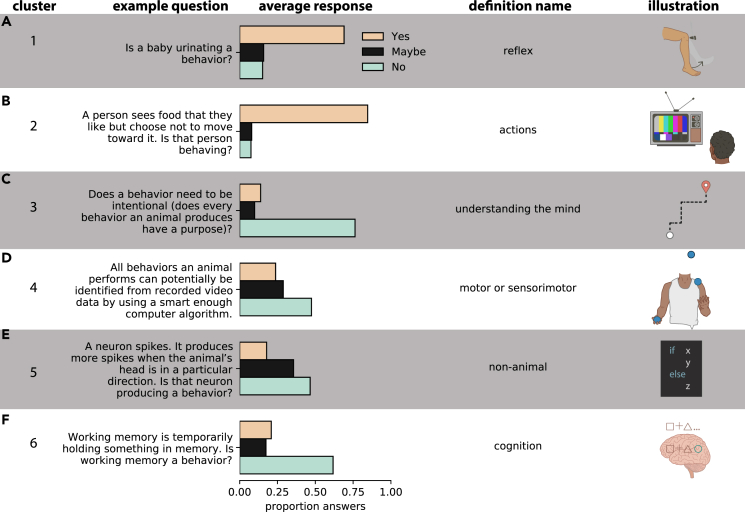
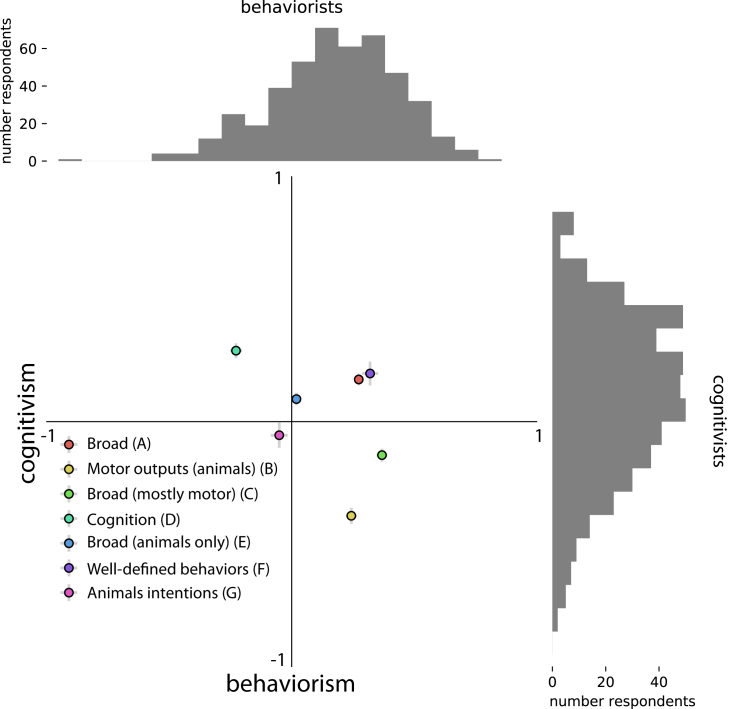
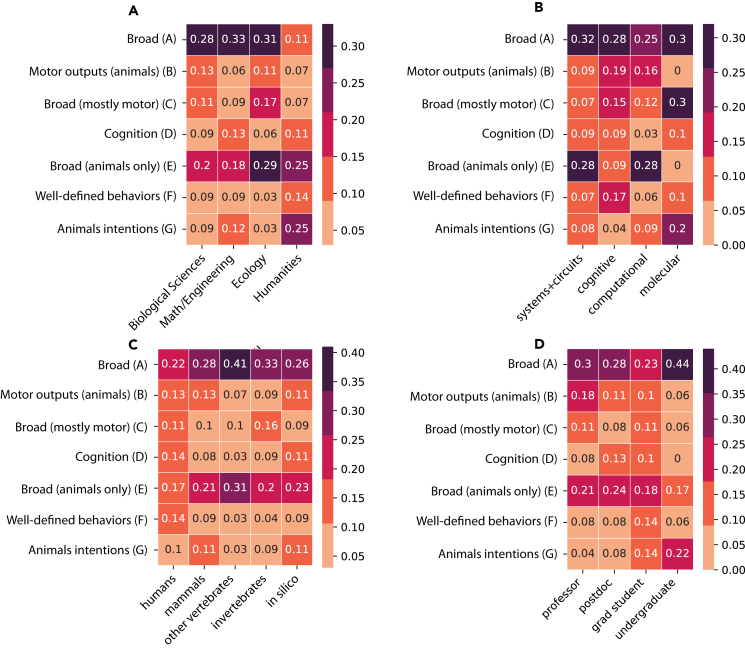
Studying "behavior" lies at the heart of many disciplines. Nevertheless, academics rarely provide an explicit definition of what "behavior" actually is. What range of definitions do people use, and how does that vary across disciplines? To answer these questions, we have developed a survey to probe what constitutes "behavior." We find that academics adopt different definitions of behavior according to their academic discipline, animal model that they work with, and level of academic seniority. Using hierarchical clustering, we identify at least six distinct types of "behavior" which are used in seven distinct operational archetypes of "behavior." Individual respondents have clear consistent definitions of behavior, but these definitions are not consistent across the population. Our study is a call for academics to clarify what they mean by "behavior" wherever they study it, with the hope that this will foster interdisciplinary studies that will improve our understanding of behavioral phenomena.
Keywords: Biological sciences; Ecology; Neuroscience; Zoology.
© 2023 The Author(s).
Conflict of interest statement
Authors have no competing interests.
Figures




References
-
- Aristotle (350 BC), ‘On the Soul’.
-
- Wiener N. MIT press; 2019. Cybernetics or Control and Communication in the Animal and the Machine.
-
- Rosenblueth A., Wiener N., Bigelow J. Behavior, purpose and teleology. Philos. Sci. 1943;10:18–24.
-
- Von Neumann J. Yale university press; 2012. The Computer and the Brain.
-
- Lorenz K. Springer Science & Business Media; 2013. The Foundations of Ethology.
Grants and funding
LinkOut - more resources
Full Text Sources
Miscellaneous
