


Elevated symptoms of depression and anxiety among family members and friends of critically ill COVID-19 patients - an observational study of five cohorts across four countries
- PMID: 37953992
- PMCID: PMC10636287
- DOI: 10.1016/j.lanepe.2023.100733
Elevated symptoms of depression and anxiety among family members and friends of critically ill COVID-19 patients - an observational study of five cohorts across four countries
Abstract
Background: Little is known regarding the mental health impact of having a significant person (family member and/or close friend) with COVID-19 of different severity.
Methods: The study included five prospective cohorts from four countries (Iceland, Norway, Sweden, and the UK) with self-reported data on COVID-19 and symptoms of depression and anxiety during March 2020-March 2022. We calculated prevalence ratios (PR) of depression and anxiety in relation to having a significant person with COVID-19 and performed a longitudinal analysis in the Swedish cohort to describe temporal patterns.
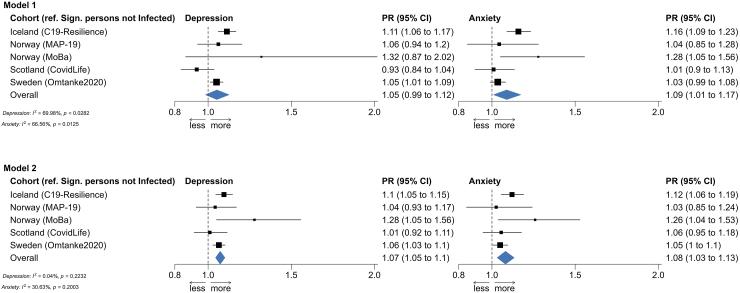
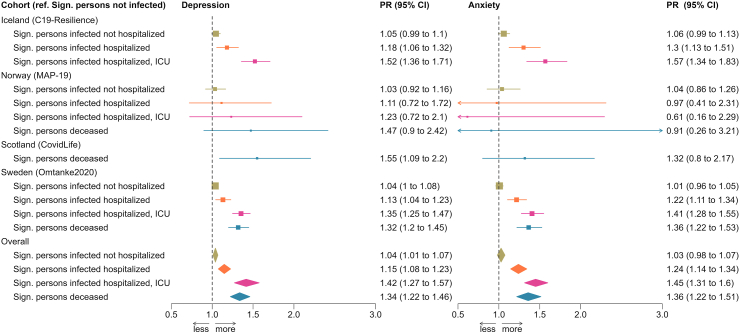
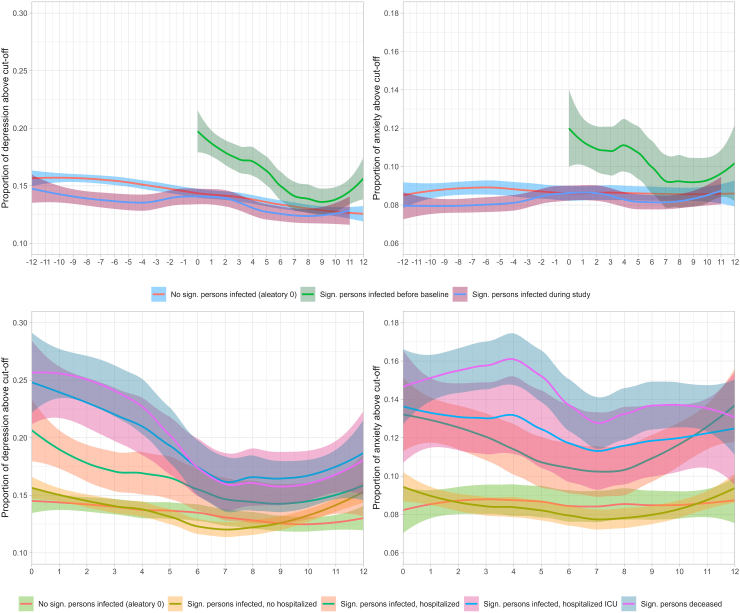
Findings: 162,237 and 168,783 individuals were included in the analysis of depression and anxiety, respectively, of whom 24,718 and 27,003 reported a significant person with COVID-19. Overall, the PR was 1.07 (95% CI: 1.05-1.10) for depression and 1.08 (95% CI: 1.03-1.13) for anxiety in relation to having a significant person with COVID-19. The respective PRs for depression and anxiety were 1.15 (95% CI: 1.08-1.23) and 1.24 (95% CI: 1.14-1.34) if the patient was hospitalized, 1.42 (95% CI: 1.27-1.57) and 1.45 (95% CI: 1.31-1.60) if the patient was ICU-admitted, and 1.34 (95% CI: 1.22-1.46) and 1.36 (95% CI: 1.22-1.51) if the patient died. Individuals with a significant person with hospitalized, ICU-admitted, or fatal COVID-19 showed elevated prevalence of depression and anxiety during the entire year after the COVID-19 diagnosis.
Interpretation: Family members and close friends of critically ill COVID-19 patients show persistently elevated prevalence of depressive and anxiety symptoms.
Funding: This study was primarily supported by NordForsk (COVIDMENT, 105668) and Horizon 2020 (CoMorMent, 847776).
Keywords: Anxiety; COVID-19; Cross-country study; Depression; Significant person.
© 2023 The Author(s).
Conflict of interest statement
AL received a grant from the Fredrik and Ingrid Thuring Foundation. DLM is a part-time employee of Optima Partners Ltd. EMF received payment for keynote lecture from Astra Zeneca. HA received a grant from the Research Council of Norway. PFS received a grant from the Swedish Research Council (Vetenskapsrådet, award D0886501) and is a consultant and shareholder Neumora Therapeutics for work not directly related to the topics of this paper. OAA received grants from NordForsk (Grant 105668) and the European Union’s Horizon2020 Research and Innovation Programme (Grant 847776; CoMorMent) for the current project and received grants from NIH NIMH, the Research Council of Norway, the South-East Regional Health Authority, Horizon2020, Stiftelsen Kristian Gerhard Jebsen, consulting fees from Biogen, Cortechs.ai and Milken, payment or honoraria from Janssen, Lundbeck and Sunovion, and reports patent Intranasal Administration, US20160310683 A1, participation on DSMB 21 board as PI, and stock options with Cortechs.ai. UAV received grants from NordForsk (Grants 138929 and 105668). FF received grants from NordForsk, the Swedish Research Council for Health, Working Life and Welfare, the Horizon2020 programme, Swedish Research Council, Swedish Cancer Society, US CDC, US NIH, and the European Research Council. The other authors declare no conflict of interest.
Figures
References
LinkOut - more resources
Full Text Sources
Research Materials
