Mixed methods study protocol for combining stakeholder-led rapid evaluation with near real-time continuous registry data to facilitate evaluations of quality of care in intensive care units
- PMID: 37954925
- PMCID: PMC10638482
- DOI: 10.12688/wellcomeopenres.18710.3
Mixed methods study protocol for combining stakeholder-led rapid evaluation with near real-time continuous registry data to facilitate evaluations of quality of care in intensive care units
Abstract
Background: Improved access to healthcare in low- and middle-income countries (LMICs) has not equated to improved health outcomes. Absence or unsustained quality of care is partly to blame. Improving outcomes in intensive care units (ICUs) requires delivery of complex interventions by multiple specialties working in concert, and the simultaneous prevention of avoidable harms associated with the illness and the treatment interventions. Therefore, successful design and implementation of improvement interventions requires understanding of the behavioural, organisational, and external factors that determine care delivery and the likelihood of achieving sustained improvement. We aim to identify care processes that contribute to suboptimal clinical outcomes in ICUs located in LMICs and to establish barriers and enablers for improving the care processes.
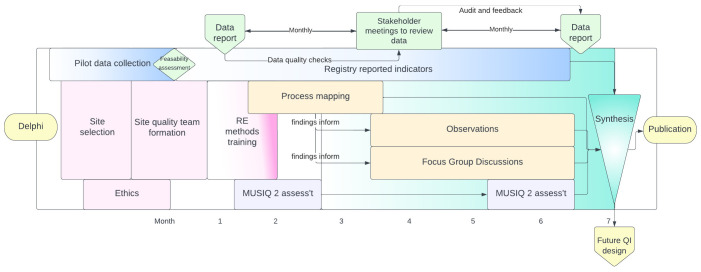
Methods: Using rapid evaluation methods, we will use four data collection methods: 1) registry embedded indicators to assess quality of care processes and their associated outcomes; 2) process mapping to provide a preliminary framework to understand gaps between current and desired care practices; 3) structured observations of processes of interest identified from the process mapping and; 4) focus group discussions with stakeholders to identify barriers and enablers influencing the gap between current and desired care practices. We will also collect self-assessments of readiness for quality improvement. Data collection and analysis will be led by local stakeholders, performed in parallel and through an iterative process across eight countries: Kenya, India, Malaysia, Nepal, Pakistan, South Africa, Uganda and Vietnam.
Conclusions: The results of our study will provide essential information on where and how care processes can be improved to facilitate better quality of care to critically ill patients in LMICs; thus, reduce preventable mortality and morbidity in ICUs. Furthermore, understanding the rapid evaluation methods that will be used for this study will allow other researchers and healthcare professionals to carry out similar research in ICUs and other health services.
Keywords: critical illness; intensive care; learning health systems; low- and middle-income countries; quality of care; rapid evaluation.
Copyright: © 2023 The Collaboration for Research, Implementation and Training in Critical Care in Asia and Africa (CCAA) et al.
Conflict of interest statement
No competing interests were disclosed.
Figures
References
-
- Agency for Healthcare Research and Quality: Understanding Quality Measurement. 2020; [Accessed 13th April 2021]. Reference Source
Associated data
Grants and funding
LinkOut - more resources
Full Text Sources
Research Materials
Miscellaneous