


Skin cancer prevention behaviors, beliefs, distress, and worry among hispanics in Florida and Puerto Rico
- PMID: 37957686
- PMCID: PMC10644628
- DOI: 10.1186/s12889-023-17039-y
Skin cancer prevention behaviors, beliefs, distress, and worry among hispanics in Florida and Puerto Rico
Abstract
Background: Incidence of skin cancer has been increasing among U.S. Hispanics, who often are diagnosed with larger lesions and at later stage disease. Behaviors to decrease exposure to ultraviolet radiation can reduce risk of skin cancer. We describe skin cancer prevention behaviors and psychosocial variables among Hispanic participants recruited into a skin cancer prevention trial.
Methods: Self-reported Hispanic participants from eight primary care clinics in Tampa, Florida and Ponce, Puerto Rico were recruited into a randomized controlled prevention trial. Information on demographics, sun-related behaviors, and psychosocial variables were collected before intervention materials were provided. Multivariable regression models were used to compare baseline sun-related behaviors and psychosocial variables across groups defined by geographic location and language preference.
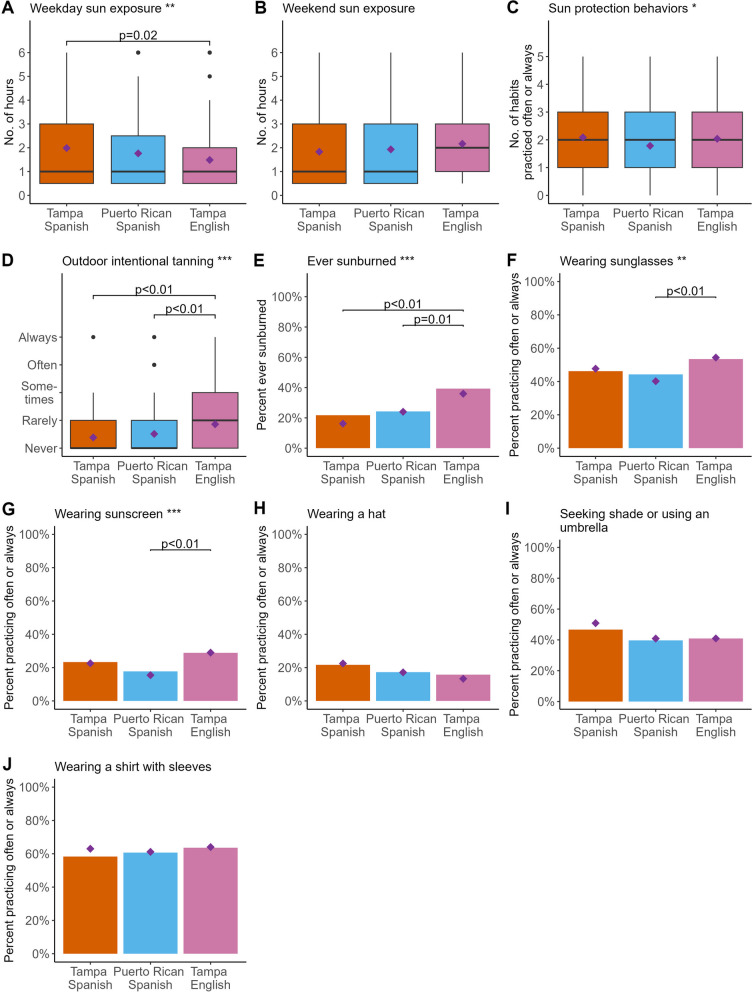
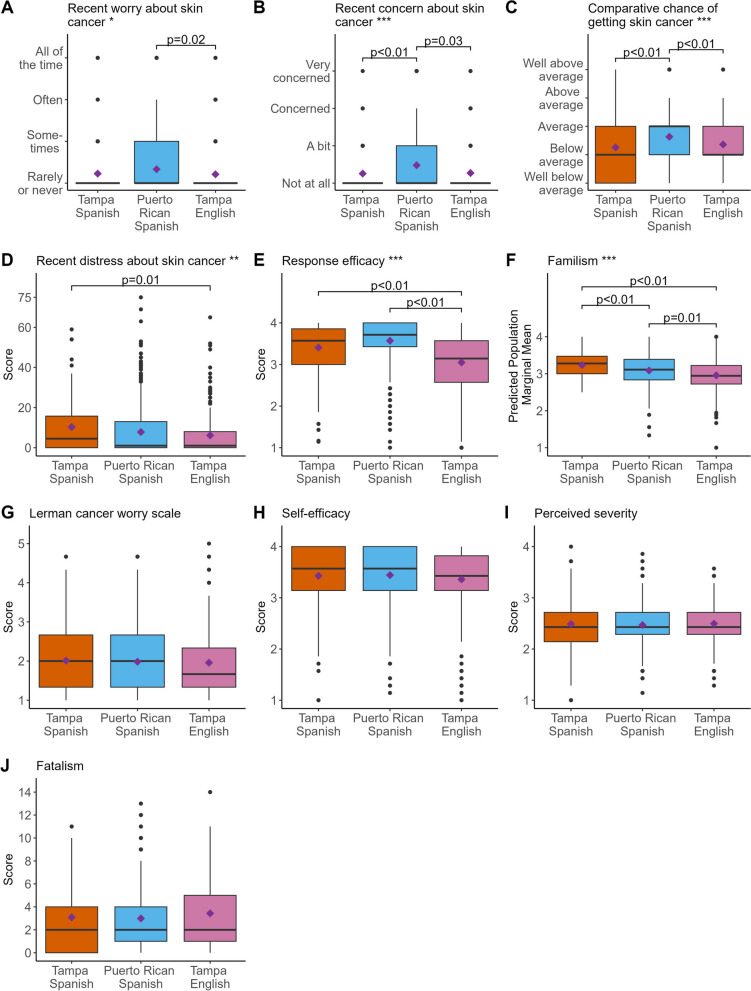
Results: Participants reported low levels of intentional outdoor tanning, weekday and weekend sun exposure, and very low levels of indoor tanning. However, only a minority of participants practiced sun-protective behaviors often or always, and about 30% experienced a sunburn in the past year. Participants had low levels of recent worry and concern about skin cancer, modest levels of perceived risk and severity, and high levels of response efficacy and self-efficacy. When comparing across groups defined by geographic location and language preference, English-preferring Tampa residents (hereafter referred to as Tampeños) had the highest proportion who were sunburned (35.9%) and tended toward more risky behavior but also had higher protective behavior than did Spanish-preferring Tampeños or Puerto Ricans. Spanish-preferring Puerto Ricans had higher recent concern about skin cancer, comparative chance of getting skin cancer, and response efficacy compared to either English- or Spanish-preferring Tampeños. Spanish-preferring Tampeños had the highest levels of familism and recent distress about skin cancer.
Conclusions: Our results mirror previous observations of low levels of sun-protective behavior among U.S. Hispanics compelling the need for culturally appropriate and translated awareness campaigns targeted to this population. Because Hispanics in Tampa and Puerto Rico reported modest levels of perceived risk and severity, and high levels of response efficacy and self-efficacy, interventions aiming to improve skin cancer prevention activities that are anchored in Protection Motivation Theory may be particularly effective in this population subgroup.
Keywords: Florida; Hispanic/Latino; Prevention behaviors; Protection motivation theory; Puerto Rico; Skin cancer.
© 2023. The Author(s).
Conflict of interest statement
The authors declare that they have no known competing financial interests or personal relationships that could have appeared to influence the work reported in this paper.
Figures
References
-
- De La Torre-Lugo EM, Figueroa LD, Sanchez JL, Morales-Burgos A, Conde D. Skin cancer in Puerto Rico: a multiannual incidence comparative study. P R Health Sci J. 2010;29(3):312–316. - PubMed
-
- Perez MI. Skin cancer in Hispanics in the United States. J Drugs Dermatol. 2019;18(3):117–120. - PubMed
-
- SEER*Explorer: an interactive website for SEER cancer statistics. https://seer.cancer.gov/explorer/.
-
- Pew Research Center. Hispanic Americans’ Trust in and Engagement With Science. 2022.
Publication types
MeSH terms
Grants and funding
LinkOut - more resources
Full Text Sources
Medical
Miscellaneous
