Review
. 2023 Nov 1;13(21):3359.
doi: 10.3390/diagnostics13213359.

Lung Cancer Staging: Imaging and Potential Pitfalls

Affiliations
Review

Lung Cancer Staging: Imaging and Potential Pitfalls

Lauren T Erasmus et al. Diagnostics (Basel). .

Abstract

Lung cancer is the leading cause of cancer deaths in men and women in the United States. Accurate staging is needed to determine prognosis and devise effective treatment plans. The International Association for the Study of Lung Cancer (IASLC) has made multiple revisions to the tumor, node, metastasis (TNM) staging system used by the Union for International Cancer Control and the American Joint Committee on Cancer to stage lung cancer. The eighth edition of this staging system includes modifications to the T classification with cut points of 1 cm increments in tumor size, grouping of lung cancers associated with partial or complete lung atelectasis or pneumonitis, grouping of tumors with involvement of a main bronchus regardless of distance from the carina, and upstaging of diaphragmatic invasion to T4. The N classification describes the spread to regional lymph nodes and no changes were proposed for TNM-8. In the M classification, metastatic disease is divided into intra- versus extrathoracic metastasis, and single versus multiple metastases. In order to optimize patient outcomes, it is important to understand the nuances of the TNM staging system, the strengths and weaknesses of various imaging modalities used in lung cancer staging, and potential pitfalls in image interpretation.

Keywords: CT; PET/CT; TNM; lung cancer; staging.


Conflict of interest statement

The authors declare no conflict of interest.

Figures
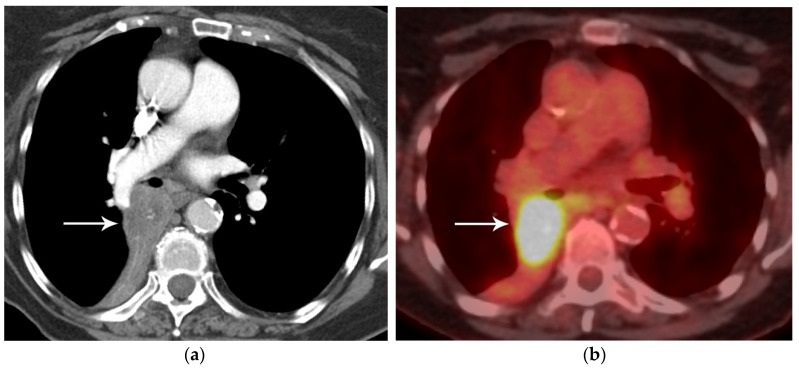
Figure 1
Figure 1
T2 disease. (a) Contrast-enhanced CT shows right lower lobe collapse due to central obstructing tumor (arrow). (b) Axial PET/CT shows FDG avidity of the primary tumor, differentiating it from adjacent atelectatic lung. Tumor size of 3.5 cm is T2a; lobar/lung atelectasis is also T2 disease. As there is no nodal and no distant metastasis, the final stage is stage IB.
Figure 2
Figure 2
T3 disease. (a) Contrast-enhanced CT, and (b) axial PET/CT show the FDG-avid right upper lobe 4 cm primary tumor invading the chest wall (arrow). The size of 4 cm is T2a disease while chest wall invasion is T3 disease. With no nodal or distant metastases, the stage is IIB.
Figure 3
Figure 3
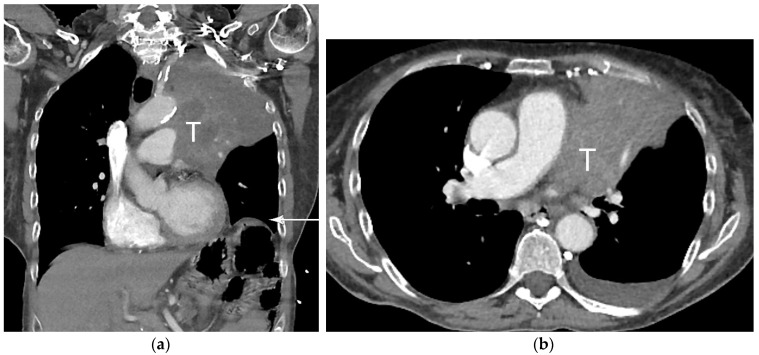
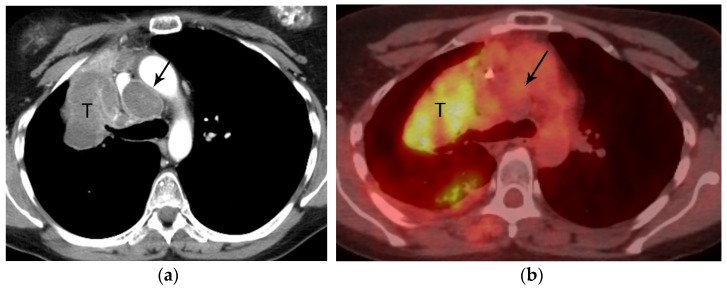
T4 disease. (a) Axial contrast-enhanced CT, and (b) coronal CT show 10 cm left upper lobe primary tumor (T) invading the mediastinum. Involvement of the left phrenic nerve resulted in elevation of the left hemidiaphragm (arrow). Involvement of the phrenic nerve is T3 disease. However, both size of greater than 7 cm and mediastinal invasion are T4 descriptors, dictating the T classification in this case.
Figure 4
Figure 4
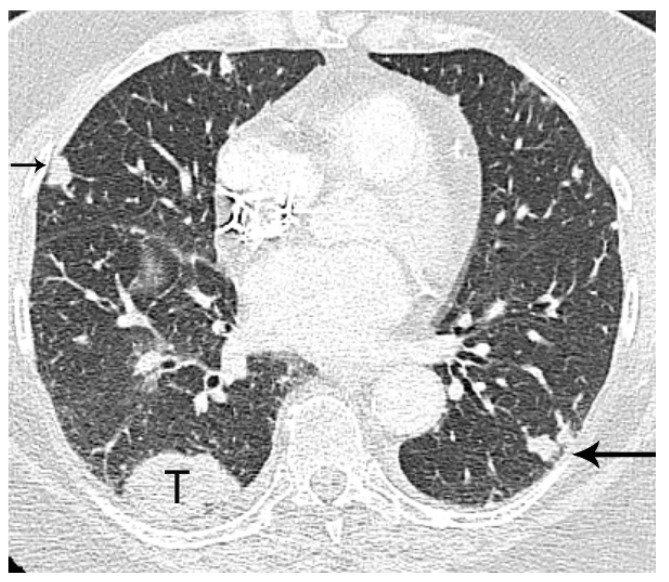
M1a disease, intrathoracic metastasis. Contrast-enhanced CT shows a 4 cm primary tumor (T) in the right lower lobe. Separate nodule in the right middle lobe (short arrow) as the primary tumor is T4 disease. Separate nodule (long arrow) in the left lower lobe (contralateral lung) as the primary tumor is M1a disease.
Figure 5
Figure 5
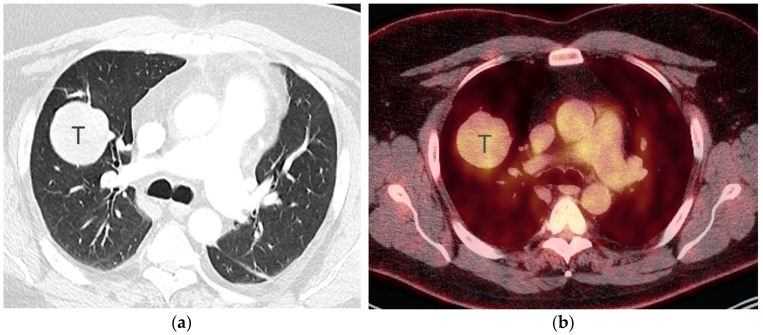
Bronchopulmonary carcinoid. (a) CT shows a 5 cm well-circumscribed solid mass (T) in the right middle lobe. (b) Axial PET/CT shows the right middle lobe lesion (T) has low-grade FDG uptake, similar to that of the mediastinum. Biopsy showed low-grade neuroendocrine tumor.
Figure 6
Figure 6
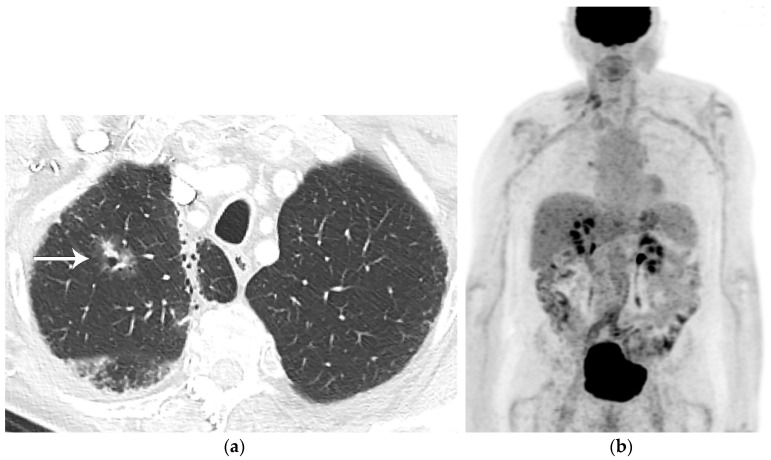
Lung adenocarcinoma. (a) CT shows a right upper lobe 2 cm part-solid nodule with focal “bubbly” internal lucencies and a solid component along the anterolateral aspect. Radiation fibrosis is noted in the right apex medially. (b) Whole-body PET shows the nodule is not FDG-avid. Biopsy revealed well-differentiated adenocarcinoma. Part-solid lung adenocarcinomas may not be FDG avid due to slow cell proliferation or poor cellularity.
Figure 7
Figure 7
N2 nodal metastasis. (a) CT shows a 6.5 cm tumor (T) in the right upper lobe and low attenuation right paratracheal adenopathy (arrow). (b) PET/CT shows FDG avidity of the primary tumor (T) but the biopsy-proven N2 ipsilateral nodal metastasis is not FDG avid. Necrotic nodal metastases can give false negative results on PET/CT.
Figure 8
Figure 8
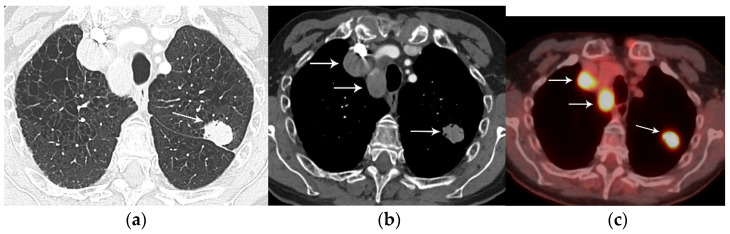
N3 nodal metastases. (a) CT shows a 2.5 cm tumor (arrow) in the left upper lobe. (b) Contrast-enhanced CT and (c) axial fused PET/CT show FDG-avid adenopathy in the right mediastinum in the paratracheal and prevascular regions (horizontal arrows). Biopsy confirmed nodal metastases in N3 (right paratracheal). Staging is T1N3M0, stage IIIB.
Figure 9
Figure 9
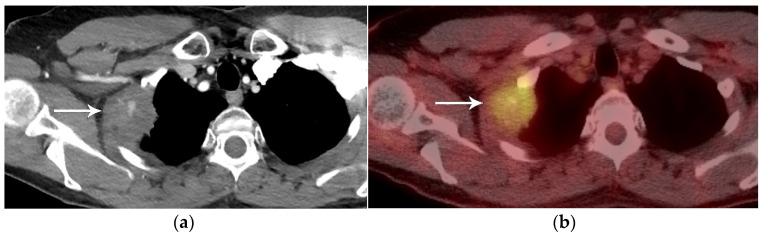
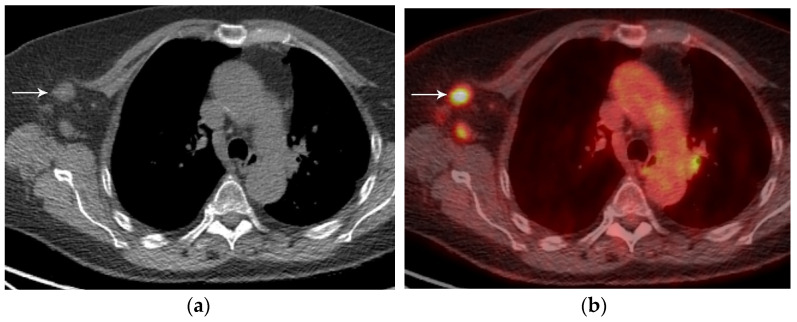
Left lung cancer and right axillary nodal metastases. (a) CT, and (b) axial PET/CT show FDG-avid right axillary adenopathy (arrow). Biopsy confirmed metastatic disease from the left lung cancer. The N status represents regional spread of disease. Lymph nodes not addressed in N classification, such as internal mammary, axillary, and retroperitoneal, represent distant metastatic disease.
Figure 10
Figure 10
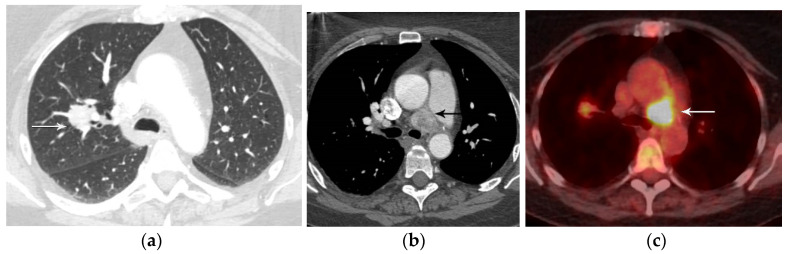
Paraganglioma mimicking N3 nodal metastasis. (a) CT shows a right upper lobe primary lung cancer (arrow). (b) Contrast-enhanced CT shows enhancing soft tissue in the left lower paratracheal region (arrow). (c) PET/CT shows the left mediastinal soft tissue is FDG avid, suspicious for N3 contralateral mediastinal nodal metastasis. Biopsy of the left paratracheal mass showed paraganglioma.
Figure 11
Figure 11
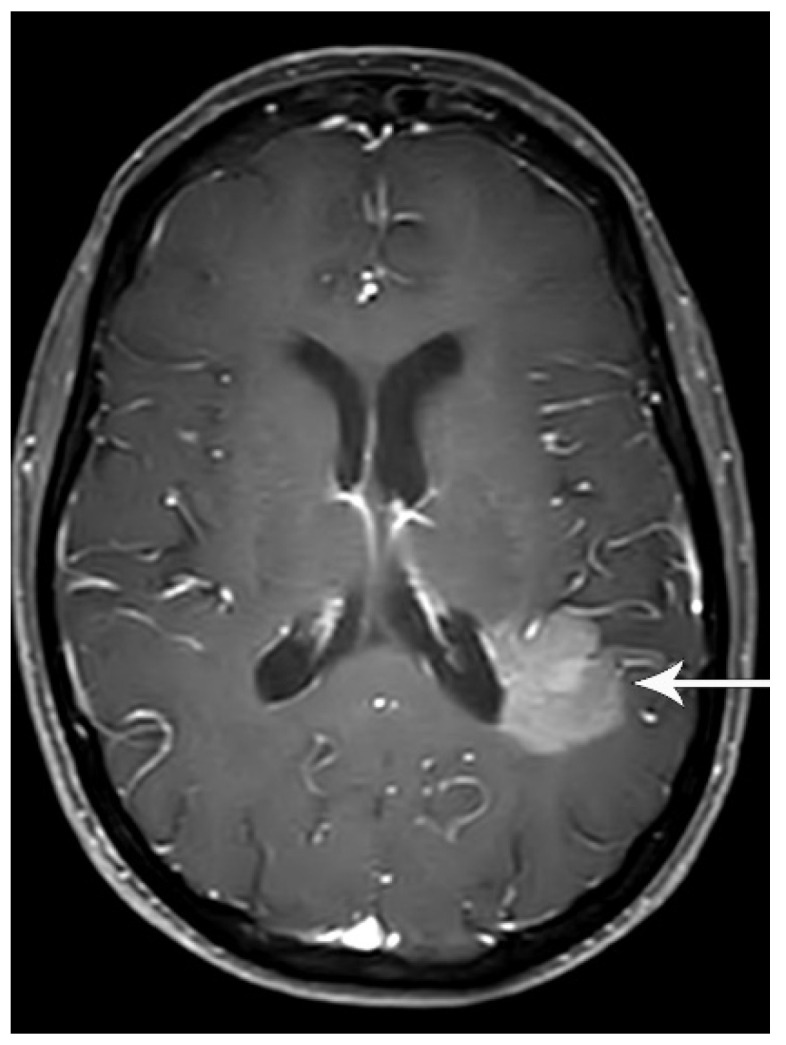
M1b disease, single extrathoracic metastasis. Contrast-enhanced brain MRI shows a left parietal enhancing metastasis (arrow). A single focus of extrathoracic metastasis is M1b disease, which constitutes stage IVA.
Figure 12
Figure 12
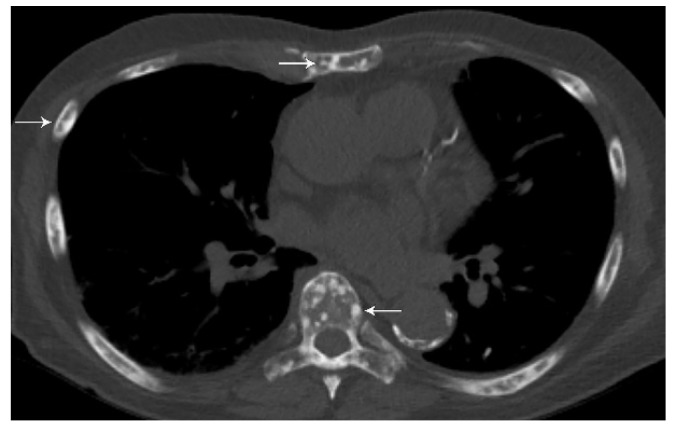
M1c disease, multiple extrathoracic metastases. CT shows multiple sclerotic bone metastases in the ribs, sternum, and spine (arrows). M1c disease, multiple extrathoracic metastases, constitutes stage IVB.
Figure 13
Figure 13
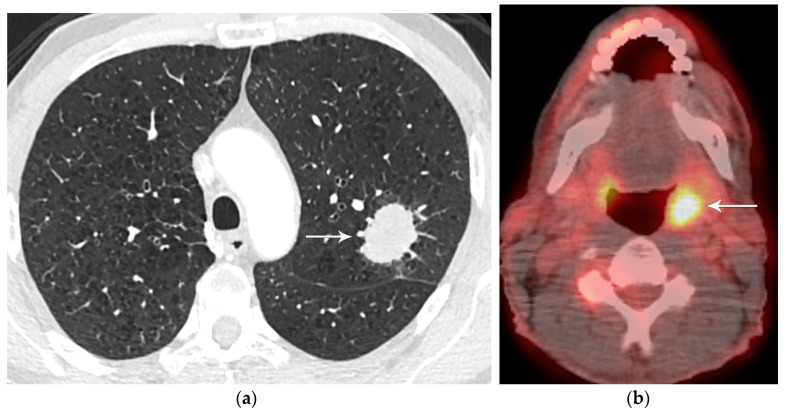
Second malignancy. (a) Contrast-enhanced CT shows a left upper lobe lung malignancy (arrow). Biopsy showed adenocarcinoma. (b) Axial PET/CT shows FDG-avid focus in the left tonsil (arrow). Biopsy revealed squamous cell cancer. With no nodal and distant metastases, the patient proceeded to left upper lobectomy. FDG-avid lesions suspicious for metastases in NSCLC patients being considered for surgical resection should be biopsied to obtain a histopathologic diagnosis. PET/CT is useful in the detection of extrathoracic metastases as well as second primaries.
Figure 14
Figure 14
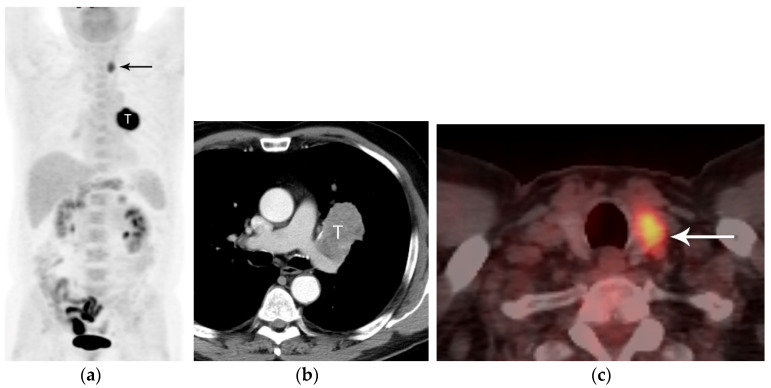
FDG-avid lesion unrelated to lung cancer. (a) Whole-body PET shows the left upper lobe primary tumor (T) and an FDG-avid focus in the left neck (arrow). (b) CT shows the left upper lobe tumor (T). (c) Axial PET/CT shows the FDG-avid focus is localized to the left lobe of the thyroid. Biopsy showed colloid nodule.

References

    1. NCCN Clinical Practice Guidelines in Oncology, Non-Small Cell Lung Cancer, Version 4. 2023. [(accessed on 20 September 2023)]. Available online: https://www.nccn.org/
    1. Thai A.A., Solomon B.J., Sequist L.V., Gainor J.F., Heist R.S. Lung cancer. Lancet. 2021;398:535–554. doi: 10.1016/S0140-6736(21)00312-3. - DOI - PubMed
    1. Carter B.W., Lichtenberger J.P., III, Benveniste M.K., de Groot P.M., Wu C.C., Erasmus J.J., Truong M.T. Revisions to the TNM Staging of Lung Cancer: Rationale, Significance, and Clinical Application. Radiographics. 2018;38:374–391. doi: 10.1148/rg.2018170081. - DOI - PubMed
    1. Goldstraw P., Chansky K., Crowley J., Rami-Porta R., Asamura H., Eberhardt W.E., Nicholson A.G., Groome P., Mitchell A., Bolejack V., et al. The IASLC Lung Cancer Staging Project: Proposals for Revision of the TNM Stage Groupings in the Forthcoming (Eighth) Edition of the TNM Classification for Lung Cancer. J. Thorac. Oncol. 2016;11:39–51. doi: 10.1016/j.jtho.2015.09.009. - DOI - PubMed
    1. Nicholson A.G., Chansky K., Crowley J., Beyruti R., Kubota K., Turrisi A., Eberhardt W.E., van Meerbeeck J., Rami-Porta R., Staging and Prognostic Factors Committee et al. The International Association for the Study of Lung Cancer Lung Cancer Staging Project: Proposals for the Revision of the Clinical and Pathologic Staging of Small Cell Lung Cancer in the Forthcoming Eighth Edition of the TNM Classification for Lung Cancer. J. Thorac. Oncol. 2016;11:300–311. doi: 10.1016/j.jtho.2015.10.008. - DOI - PubMed

LinkOut - more resources