Review
. 2023 Oct 27;15(21):5169.
doi: 10.3390/cancers15215169.

ESR1 Gene Mutations and Liquid Biopsy in ER-Positive Breast Cancers: A Small Step Forward, a Giant Leap for Personalization of Endocrine Therapy?

Affiliations
Review

ESR1 Gene Mutations and Liquid Biopsy in ER-Positive Breast Cancers: A Small Step Forward, a Giant Leap for Personalization of Endocrine Therapy?

Margaux Betz et al. Cancers (Basel). .

Abstract

The predominant forms of breast cancer (BC) are hormone receptor-positive (HR+) tumors characterized by the expression of estrogen receptors (ERs) and/or progesterone receptors (PRs). Patients with HR+ tumors can benefit from endocrine therapy (ET). Three types of ET are approved for the treatment of HR+ BCs and include selective ER modulators, aromatase inhibitors, and selective ER downregulators. ET is the mainstay of adjuvant treatment in the early setting and the backbone of the first-line treatment in an advanced setting; however, the emergence of acquired resistance can lead to cancer recurrence or progression. The mechanisms of ET resistance are often related to the occurrence of mutations in the ESR1 gene, which encodes the ER-alpha protein. As ESR1 mutations are hardly detectable at diagnosis but are present in 30% to 40% of advanced BC (ABC) after treatment, the timeline of testing is crucial. To manage this resistance, ESR1 testing has recently been recommended; in ER+ HER2- ABC and circulating cell-free DNA, so-called liquid biopsy appears to be the most convenient way to detect the emergence of ESR1 mutations. Technically, several options exist, including Next Generation Sequencing and ultra-sensitive PCR-based techniques. In this context, personalization of ET through the surveillance of ESR1 mutations in the plasma of HR+ BC patients throughout the disease course represents an innovative way to improve the standard of care.

Keywords: ESR1 gene; breast cancer; endocrine therapy; liquid biopsy.


Conflict of interest statement

Jean-Louis Merlin received honoraria, financial support for meetings, and research grants from Menarini Stemline, Novartis, and Astra Zeneca; Alexandre Harlé received honoraria, financial support for meetings, and research grants from Astra Zeneca and Sophia Genetics; and Vincent Masssard received honoraria, financial support for meetings, and research grants from Menarini Stemline. All other authors declare no conflict of interest.

Figures

Figure 1
Figure 1
The estrogen receptor: signaling, treatment, and resistance. Androgens are the starting point of the estrogen receptor (ER) signaling pathway, quickly converted to estrogens by aromatase. This conversion is the target of aromatase inhibitors (AIs), which prevent the synthesis of estrogen. In absence of AIs, estrogens bind to the receptor, activating the recruitment of coactivators. Selective estrogen receptor downregulators (SERDs) block the binding of estrogen to the receptor, while selective estrogen receptor modulators (SERMs) block the coactivator recruitment. Those three endocrine therapies (ETs) effectively block the ER-driven transcription. However, in cases of mutations on the ESR1 gene, which codes for ERs, estrogens, SERMs, and SERDs are unable to bind to the receptor. The activating mutations change the receptor to an apo conformation and allow ligand-independent transcription. Novel therapies were developed to respond to ESR1-driven ET resistance. Complete estrogen receptor antagonists (CERANs) bind to the receptor in place of estrogen and lead to its degradation by the ubiquitin–proteasome system (UPS) after DNA binding, while proteolysis targeting chimeras (PROTACs) induce degradation by UPS before DNA binding. Finally, selective estrogen receptor covalent antagonists (SERCAs) block the transcription by covalently binding to the specific ESR1 residue C530.
Figure 2
Figure 2
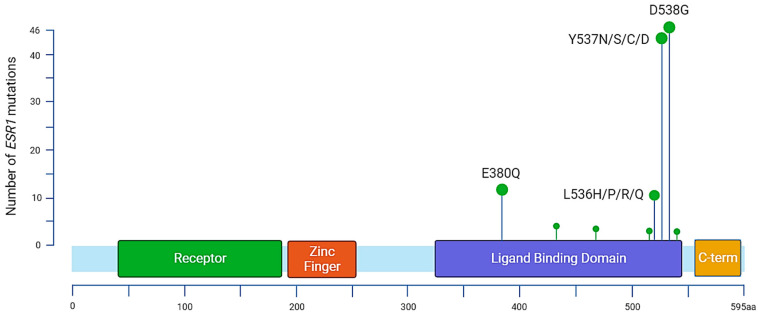
Distribution of annotated substitutions in the ESR1 gene according to MSKCC-Impact data. The most prevalent mutations are located in the ligand binding domain. There are 13 identified mutations for variant E380Q, 3 substitutions for S432L, 3 for S463P, 1 for V534E, 12 for L536, 44 for Y537, 46 for D538, and 1 for L540.
Figure 3
Figure 3
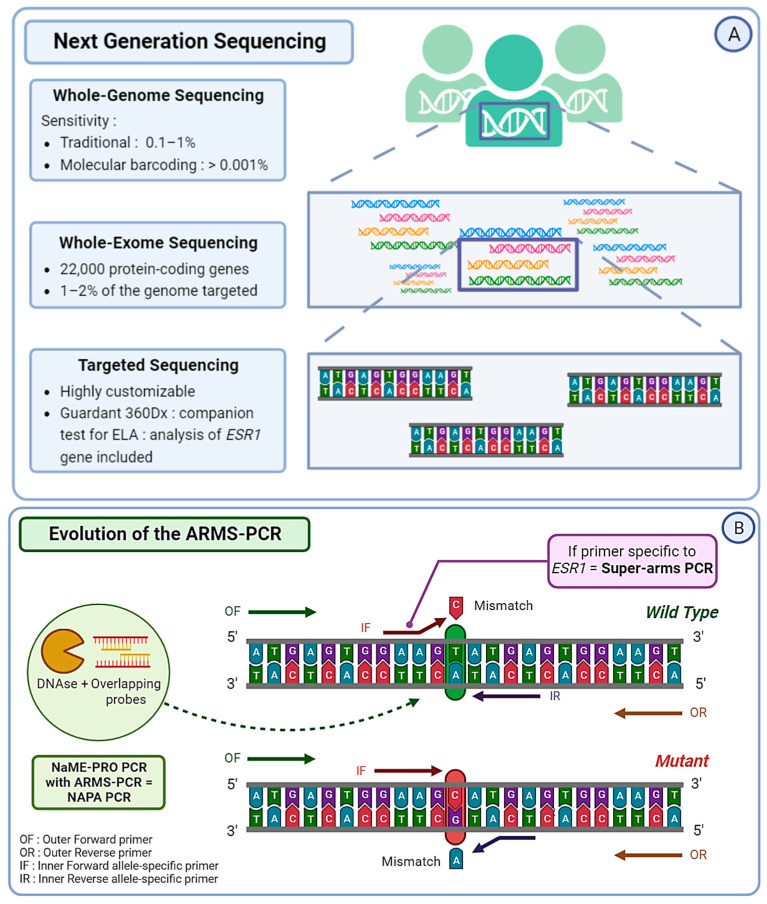
(A) Next Generation Sequencing (NGS) can be divided into three categories. Whole Genome Sequencing (WGS) covers the entire genome and has a limit of detection of approximately 0.1–1%, albeit it can reach 0.001% if molecular barcoding is used. Whole Exome Sequencing (WES) analyzes around 22,000 protein-coding genes, which represent only 1–2% of the whole genome. Targeted sequencing, which is a highly customizable approach, covers only specific regions of the genome or panels of genes. For example, Guardant360CDx is a commercial gene panel including the ESR1 gene, used as a companion test to guide ELA treatment. (B) The Amplification Refractory Mutation System (ARMS) PCR is a technique requiring four primers, with two outer gene-specific primers and two inner allele-specific primers. Here, the inner forward primer is specific to the mutant allele, whereas the inner reverse primer is specific to the wild-type (WT) allele. This will allow the outer primers to amplify the sequence, but also either of the inner–outer couples of primers. This produces three types of amplicons: one wild-type and one of each extremity of the mutant allele. In order to increase the specificity of this method, the Super-arms technique was designed with inner primers specific to ESR1 gene mutations. Finally, to reduce the number of WT amplicons produced by the approach, a DNA-specific nuclease (DNAse) can be used for Nuclease-assisted Minor Allele Enrichment using probe overlap (NAME-PRO) PCR. The combination of this method with the ARMS-PCR (NAPA-PCR) allows for the inhibition of WT amplification as the DNAse recognizes and degrades the WT DNA hybridized with the overlapping probes. (C) Two methods derived from conventional droplet digital PCR (ddPCR) approach were designed to improve its sensitivity and specificity. The locked nucleic acid (LNA) clamp ddPCR uses a wild-type (WT) specific probe that hybridizes with the WT DNA, preventing the fixation of target probe and thus blocking the fluorescent signal. Only the mutant sequence will allow the hybridization of the target probe and produce a signal. Another approach called the “drop-off” PCR was employed in several studies, including the PADA-1 trial. Here, two probes are used with different fluorophores. The reference probe is hybridized with a constant sequence and is combined with a target probe that is specific to the WT DNA sequence of interest. When encountering a mutated sequence, the target probe will not hybridize, resulting in only one of the two signals. With this technique, the difference in fluorescence is used to measure the number of mutated amplicons.
Figure 3
Figure 3
(A) Next Generation Sequencing (NGS) can be divided into three categories. Whole Genome Sequencing (WGS) covers the entire genome and has a limit of detection of approximately 0.1–1%, albeit it can reach 0.001% if molecular barcoding is used. Whole Exome Sequencing (WES) analyzes around 22,000 protein-coding genes, which represent only 1–2% of the whole genome. Targeted sequencing, which is a highly customizable approach, covers only specific regions of the genome or panels of genes. For example, Guardant360CDx is a commercial gene panel including the ESR1 gene, used as a companion test to guide ELA treatment. (B) The Amplification Refractory Mutation System (ARMS) PCR is a technique requiring four primers, with two outer gene-specific primers and two inner allele-specific primers. Here, the inner forward primer is specific to the mutant allele, whereas the inner reverse primer is specific to the wild-type (WT) allele. This will allow the outer primers to amplify the sequence, but also either of the inner–outer couples of primers. This produces three types of amplicons: one wild-type and one of each extremity of the mutant allele. In order to increase the specificity of this method, the Super-arms technique was designed with inner primers specific to ESR1 gene mutations. Finally, to reduce the number of WT amplicons produced by the approach, a DNA-specific nuclease (DNAse) can be used for Nuclease-assisted Minor Allele Enrichment using probe overlap (NAME-PRO) PCR. The combination of this method with the ARMS-PCR (NAPA-PCR) allows for the inhibition of WT amplification as the DNAse recognizes and degrades the WT DNA hybridized with the overlapping probes. (C) Two methods derived from conventional droplet digital PCR (ddPCR) approach were designed to improve its sensitivity and specificity. The locked nucleic acid (LNA) clamp ddPCR uses a wild-type (WT) specific probe that hybridizes with the WT DNA, preventing the fixation of target probe and thus blocking the fluorescent signal. Only the mutant sequence will allow the hybridization of the target probe and produce a signal. Another approach called the “drop-off” PCR was employed in several studies, including the PADA-1 trial. Here, two probes are used with different fluorophores. The reference probe is hybridized with a constant sequence and is combined with a target probe that is specific to the WT DNA sequence of interest. When encountering a mutated sequence, the target probe will not hybridize, resulting in only one of the two signals. With this technique, the difference in fluorescence is used to measure the number of mutated amplicons.

References

    1. Hanker A.B., Sudhan D.R., Arteaga C.L. Overcoming Endocrine Resistance in Breast Cancer. Cancer Cell. 2020;37:496–513. doi: 10.1016/j.ccell.2020.03.009. - DOI - PMC - PubMed
    1. Burstein H.J., DeMichele A., Somerfield M.R., Henry N.L., for the Biomarker Testing and Endocrine and Targeted Therapy in Metastatic Breast Cancer Expert Panels Testing for ESR1 Mutations to Guide Therapy for Hormone Receptor–Positive, Human Epidermal Growth Factor Receptor 2–Negative Metastatic Breast Cancer: ASCO Guideline Rapid Recommendation Update. JCO. 2023;41:3423–3425. doi: 10.1200/JCO.23.00638. - DOI - PubMed
    1. Reinert T., Gonçalves R., Bines J. Implications of ESR1 Mutations in Hormone Receptor-Positive Breast Cancer. Curr. Treat. Options Oncol. 2018;19:24. doi: 10.1007/s11864-018-0542-0. - DOI - PubMed
    1. Ferreira Almeida C., Oliveira A., João Ramos M., Fernandes P.A., Teixeira N., Amaral C. Estrogen receptor-positive (ER+) breast cancer treatment: Are multi-target compounds the next promising approach? Biochem. Pharmacol. 2020;177:113989. doi: 10.1016/j.bcp.2020.113989. - DOI - PubMed
    1. Clusan L., Le Goff P., Flouriot G., Pakdel F. A Closer Look at Estrogen Receptor Mutations in Breast Cancer and Their Implications for Estrogen and Antiestrogen Responses. Int. J. Mol. Sci. 2021;22:756. doi: 10.3390/ijms22020756. - DOI - PMC - PubMed