Review
. 2023 Oct 30;28(21):7349.
doi: 10.3390/molecules28217349.

Recent Advances in the Synthesis and Antioxidant Activity of Low Molecular Mass Organoselenium Molecules

Affiliations
Review

Recent Advances in the Synthesis and Antioxidant Activity of Low Molecular Mass Organoselenium Molecules

João M Anghinoni et al. Molecules. .

Abstract

Selenium is an essential trace element in living organisms, and is present in selenoenzymes with antioxidant activity, like glutathione peroxidase (GPx) and thioredoxin reductase (TrxR). The search for small selenium-containing molecules that mimic selenoenzymes is a strong field of research in organic and medicinal chemistry. In this review, we review the synthesis and bioassays of new and known organoselenium compounds with antioxidant activity, covering the last five years. A detailed description of the synthetic procedures and the performed in vitro and in vivo bioassays is presented, highlighting the most active compounds in each series.

Keywords: ABTS; DPPH; FRAP; GPx-like; SOD; antioxidant; catalase; lipid peroxidation; organoselenium.


Conflict of interest statement

M.J.D. is a Director and major shareholder in Seleno Therapeutics plc, which holds patents on selenosugar compounds. The other authors declare no conflict of interest.

Figures
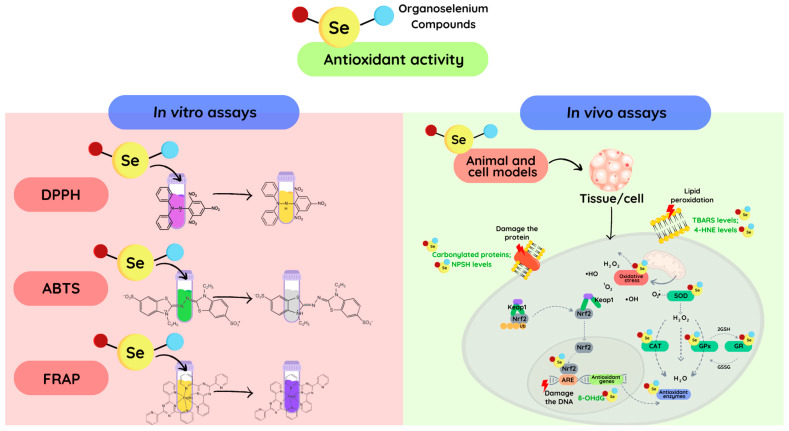
Figure 1
Figure 1
The routes of the mainly antioxidant assays for exploring the antioxidant properties of novel organoselenium compounds. The antioxidant properties can be studied in a cell through the reduction of the oxidative damage caused to DNA, proteins, and cell membranes, or by mimicking antioxidant enzymes (SOD, CAT, GPx, etc.). Additionally, the redox activity can be observed in vitro through the reduction of oxidant concentrations or synthetic radicals, such as DPPH and ABTS. Finally, oxidants can be directly measured using specific techniques, such as electron paramagnetic (spin) resonance and fluorescent probes. In the DPPH assay, after the reduction of the DPPH radical the color changes from purple to pale yellow. In the ABTS assay, upon reduction of the ABTS radical, the green color discoloration occurs. In the FRAP test, the reduction of Fe3+ yields a violet-blue color.
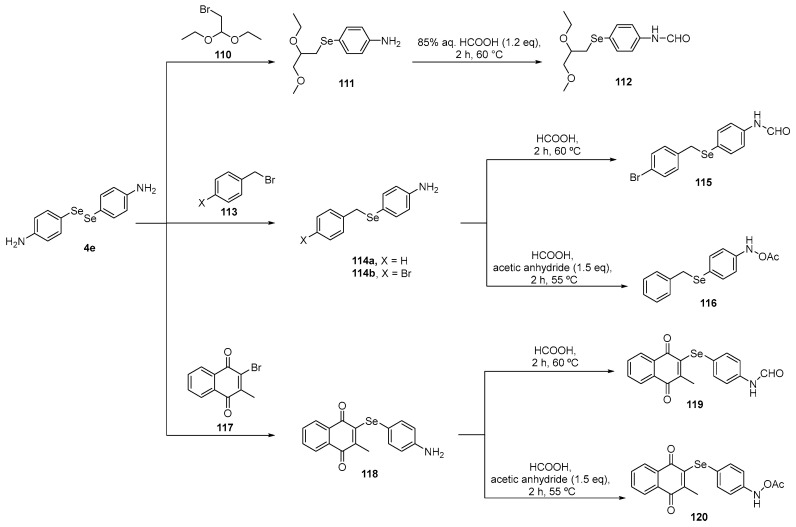
Figure 2
Figure 2
The Nrf2 pathway is regulated by interactions between Nrf2 and the Keap1 protein in the cytoplasm. Under basal conditions, Nrf2 expression is maintained at low levels through proteasome activity. When the level of reactive species is elevated (oxidative stress), Keap1 is modified, resulting in the accumulation and translocation of Nrf2 to the nucleus, where it binds to AREs and activates the transcription of antioxidant genes, including those coding for SOD, CAT, and GPxs. This adaptive response plays a critical role in protecting cells against damage.
Scheme 1
Scheme 1
Synthesis of diselenoamino acid derivatives 2.
Scheme 2
Scheme 2
Synthesis of diselenides 4.
Scheme 3
Scheme 3
Synthesis of aniline-derived diselenides 7.
Scheme 4
Scheme 4
Synthesis of differently substituted β-hydroxy dialkyl- and alkyl-aryl selenides.
Scheme 5
Scheme 5
Synthesis of novel regenerable and multifunctional selenazolonamines 14 and 15.
Scheme 6
Scheme 6
Synthesis of 3,3′-diselenodipropionic acid 17 (DSePA).
Scheme 7
Scheme 7
Synthesis of methyl anthranilate-based organodiselenide hybrids.
Scheme 8
Scheme 8
Synthesis of N-substituted unsymmetrical phenylselenides 26.
Scheme 9
Scheme 9
Synthesis of novel N-methylated ebselenamine derivatives 27.
Scheme 10
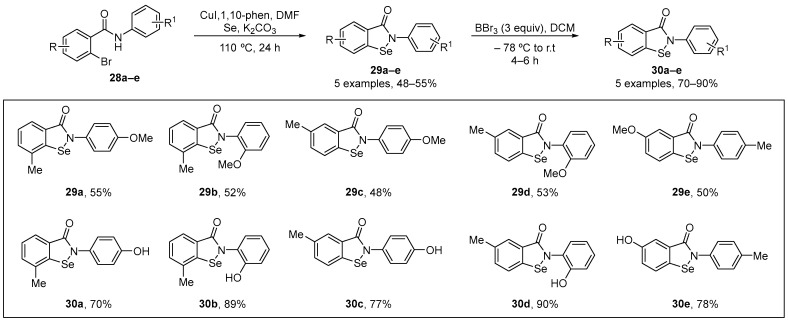
Scheme 10
Synthesis of methoxy-substituted isoselenazolones via C-Se and Se-N bond formation.
Scheme 11
Scheme 11
Studies on the oxidation of diselenide 13b.
Scheme 12
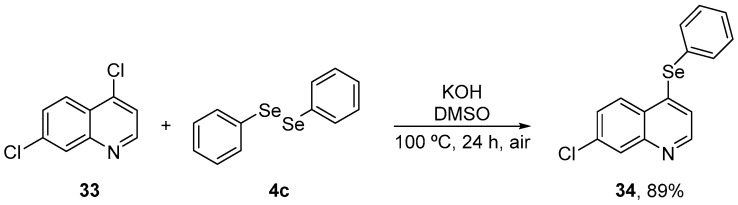
Scheme 12
Synthesis of 7-chloro-4-(phenylselanyl)quinoline 34 in basic medium.
Scheme 13
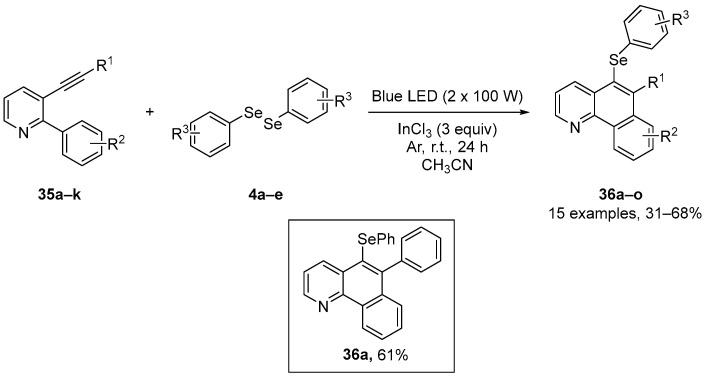
Scheme 13
Synthesis of 6-organyl-5-(arylselanyl)benzo[h]quinolines 36.
Scheme 14
Scheme 14
Synthesis of 7-chloro-4-(phenylselanyl)quinoline 34 in acidic medium.
Scheme 15
Scheme 15
Synthesis of 3-[(4-methoxyphenyl)selanyl]-2-phenylimidazo[1,2-a]pyridine (38a).
Scheme 16
Scheme 16
Synthesis of 3-((2-methoxyphenyl)selanyl)-7-methyl-2-phenylimidazo[1,2-a]pyridine (38b).
Scheme 17
Scheme 17
Copper-catalyzed 1,3-dipolar cycloaddition of azidomethyl arylselenides with alkynes.
Scheme 18
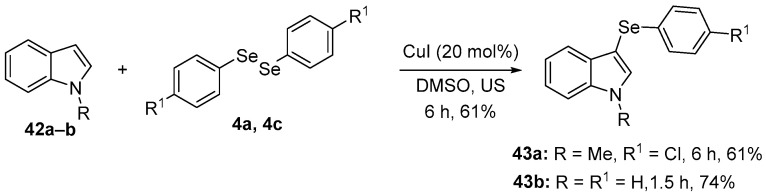
Scheme 18
Direct selenation of N-methylindole to prepare 43a and 43b.
Scheme 19
Scheme 19
Synthesis of selanyl-substituted pyrazoles 46.
Scheme 20
Scheme 20
Synthesis of Cu(II) complex 47 derived from 46a.
Scheme 21
Scheme 21
Synthesis of 5-amino-4-(arylselanyl)-1H-pyrazoles 49.
Scheme 22
Scheme 22
Synthesis of 7-imino[1,3]selenazolo[4,5-d]pyrimidine-5(4H)-thiones 52.
Scheme 23
Scheme 23
Synthesis of resveratrol-derivative benzoselenophenes 56.
Scheme 24
Scheme 24
Synthesis of benzo[b]selenophenes 60 and Ebselen analogues 62.
Scheme 25
Scheme 25
Synthesis of 2-organylselenopheno[2,3-b]pyridines 65.
Scheme 26
Scheme 26
Synthesis of benzo[c][1,2,5]selenadiazole derivatives 69 and 70.
Scheme 27
Scheme 27
Synthesis of imidazole-fused selenazolium and selenazinium selenocyanates.
Scheme 28
Scheme 28
Synthesis of di-hydroxy selenides 83 and 85.
Scheme 29
Scheme 29
Synthesis of pyrimidine-fused selenophenes 89.
Scheme 30
Scheme 30
Synthetic route to the synthesis of α-(phenylselanyl)acetophenone 91.
Scheme 31
Scheme 31
Synthesis of β-functionalized symmetric and non-symmetric selenides.
Scheme 32
Scheme 32
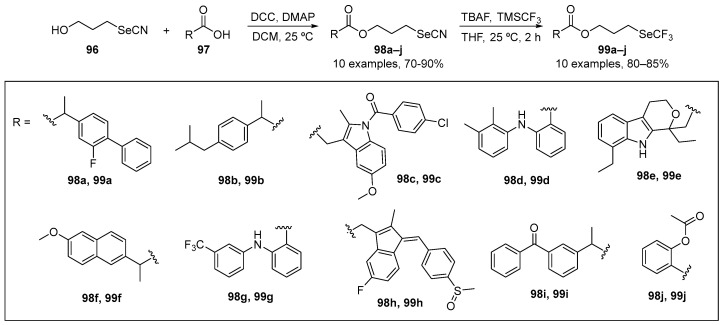
Synthesis of SeCN and SeCF3 derivatives.
Scheme 33
Scheme 33
Synthesis of selenide-based azo compounds 101 and 104.
Scheme 34
Scheme 34
Synthesis of selenium-containing amino-thymide derivatives 107.
Scheme 35
Scheme 35
Benzeneseleninic acid in the selenofunctionalization of 2-naphthol derivatives.
Scheme 36
Scheme 36
Synthesis of functionalized selenides 114, 115, 116, 119, and 120.
Scheme 37
Scheme 37
Synthesis of functionalized selenides 124, 125, 128, and 129.
Scheme 38
Scheme 38
Synthesis of phenol-substituted selenides 131, 133, and 135.
Scheme 39
Scheme 39
Synthesis of macrocycles 138, 139, and 142144.
Scheme 40
Scheme 40
Synthesis of diselenide 148 and benzoselenazole 150.
Scheme 41
Scheme 41
Synthesis of chiral selenides (R)-152 and (S)-152.
Scheme 42
Scheme 42
Synthesis of acyl-selenoureas 156.
Scheme 43
Scheme 43
Synthesis of selenoureas 160.
Scheme 44
Scheme 44
Synthesis of ferrocene-functionalized selenoureas 166.
Scheme 45
Scheme 45
Synthesis of selenylsulfides 169.
Scheme 46
Scheme 46
Synthesis of organoselanyl α-amino phosphonates 173.
Scheme 47
Scheme 47
Synthesis of phosphoroselenoates 175.
Scheme 48
Scheme 48
Synthesis of cyclic PSe compounds 178 and the releasing of H2Se from 178a.
Scheme 49
Scheme 49
Synthesis of allyl selenocyanates 182.
Scheme 50
Scheme 50
Synthesis of selenocyanates 184, 185, and 186 derived of anthranilic acid.
Scheme 51
Scheme 51
Synthesis of selenium-containing chitosan 190.
Scheme 52
Scheme 52
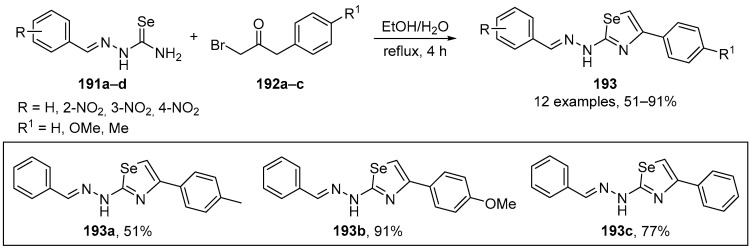
Synthesis of selenazolyl-hydrazones 193.
Scheme 53
Scheme 53
Synthesis of 2-phenyl-3-(arylselanyl)benzofurans 195.

References

    1. Steinbrenner H., Speckmann B., Klotz L.-O. Selenoproteins: Antioxidant selenoenzymes and beyond. Arch. Biochem. Biophys. 2016;595:113–119. doi: 10.1016/j.abb.2015.06.024. - DOI - PubMed
    1. Nogueira C.W., Barbosa N.V., Rocha J.B.T. Toxicology and pharmacology of synthetic organoselenium compounds: An update. Arch. Toxicol. 2021;95:1179–1226. doi: 10.1007/s00204-021-03003-5. - DOI - PMC - PubMed
    1. Chuai H., Zhang S.-Q., Bai H., Li J., Wang Y., Sun J., Wen E., Zhang J., Xin M. Small molecule selenium-containing compounds: Recent development and therapeutic applications. Eur. J. Med. Chem. 2021;223:113621. doi: 10.1016/j.ejmech.2021.113621. - DOI - PubMed
    1. Mamgain R., Kostic M., Singh F.V. Synthesis and Antioxidant Properties of Organoselenium Compounds. Curr. Med. Chem. 2023;30:2421–2448. doi: 10.2174/0929867329666220801165849. - DOI - PubMed
    1. Obieziurska-Fabisiak M., Pacuła-Miszewska A.J., Laskowska A., Ścianowski J. Organoselenium compounds as antioxidants. Arkivoc. 2022;5:69–92. doi: 10.24820/ark.5550190.p011.908. - DOI

MeSH terms

LinkOut - more resources