


Cosexuality Reduces Pollen Production and Fitness in Cannabis sativa L
- PMID: 37960087
- PMCID: PMC10648298
- DOI: 10.3390/plants12213731
Cosexuality Reduces Pollen Production and Fitness in Cannabis sativa L
Abstract
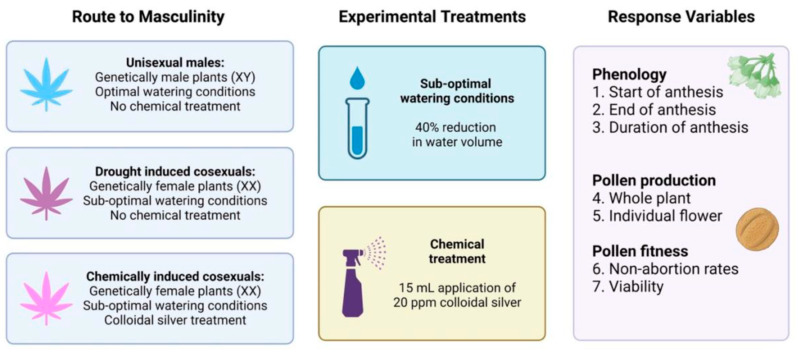
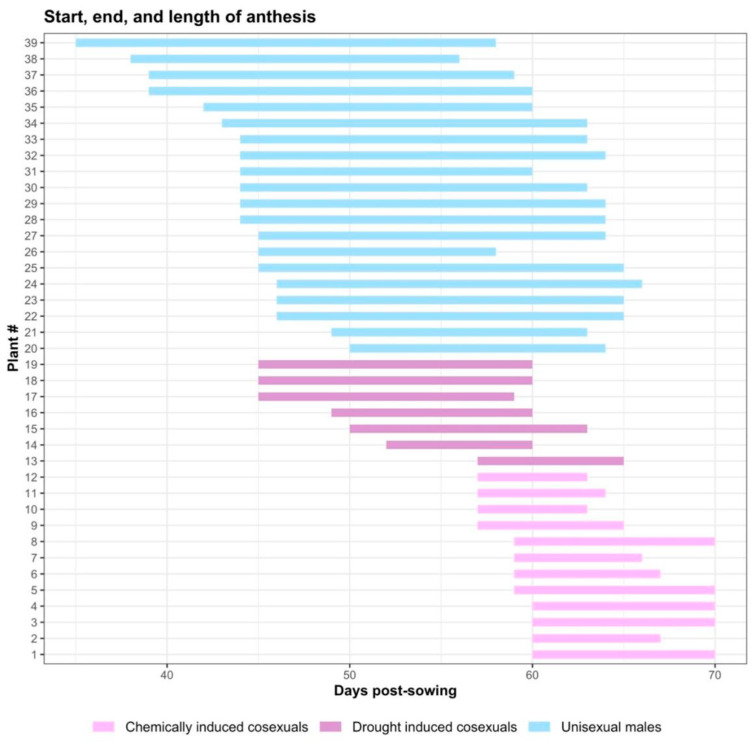
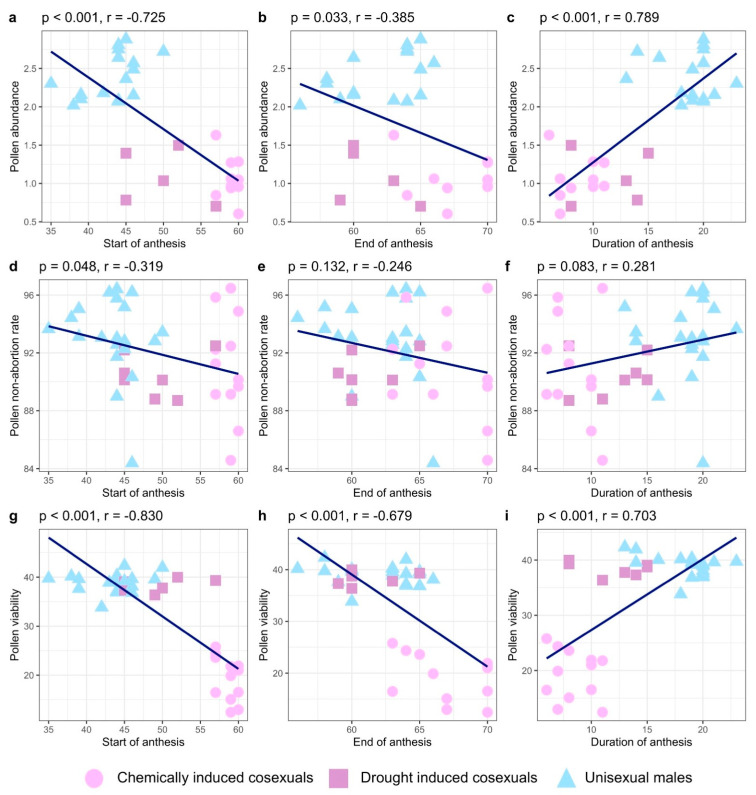
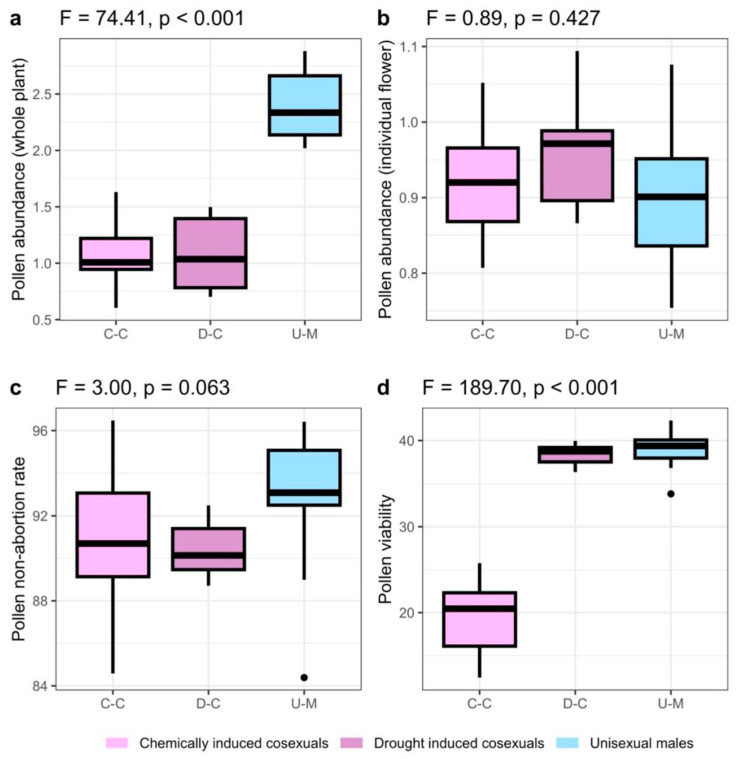
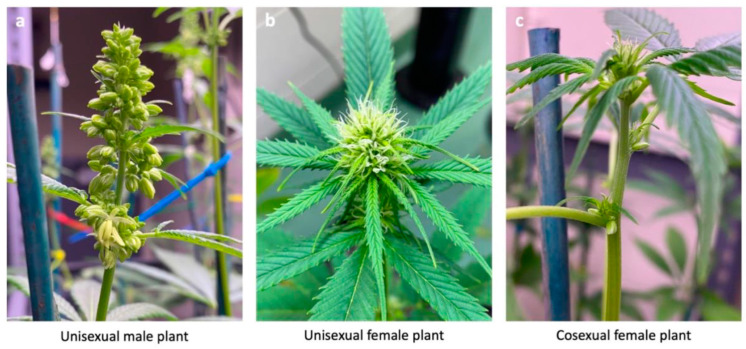
Cannabis sativa L. is cultivated globally for its cannabinoid-dense inflorescences. Commercial preference for sinsemilla has led to the development of methods for producing feminized seeds through cross-pollination of cosexual (masculinized) female plants. Although the induction of cosexuality in Cannabis plants is common, to date, no work has empirically tested how masculinization of female Cannabis plants impacts male flowering, pollen production, pollen fitness, and related life-history trade-offs. Here, we cultivated a population of Cannabis plants (CFX-2) and explored how the route to cosexuality (drought vs. chemical induction) impacted flowering phenology, pollen production, and pollen fitness, relative to unsexual male plants. Unisexual males flowered earlier and longer than cosexual plants and produced 223% more total pollen (F2,28 = 74.41, p < 0.001), but per-flower pollen production did not differ across reproductive phenotypes (F2,21 = 0.887, p = 0.427). Pollen viability was 200% higher in unisexual males and drought-induced cosexuals (F2,36 = 189.70, p < 0.001). Pollen non-abortion rates only differed in a marginally significant way across reproductive phenotypes (F2,36 = 3.00, p = 0.06). Here, we demonstrate that masculinization of female plants impacts whole-plant pollen production and pollen fitness in Cannabis sativa.
Keywords: Cannabis sativa; cosexual; dioecy; phenology; pollen; sexual lability.
Conflict of interest statement
The authors declare no conflict of interest.
Figures
References
-
- Faux A.M., Draye X., Lambert R., d’Andrimont R., Raulier P., Bertin P. The relationship of stem and seed yields to flowering phenology and sex expression in monoecious hemp (Cannabis sativa L.) Eur. J. Agron. 2013;47:11–22. doi: 10.1016/j.eja.2013.01.006. - DOI
-
- Korpelainen H. Labile sex expression in plants. Biol. Rev. 1998;73:157–180. doi: 10.1111/j.1469-185X.1997.tb00028.x. - DOI
Grants and funding
LinkOut - more resources
Full Text Sources
Miscellaneous
