


Efficacy of cupping therapy on pain outcomes: an evidence-mapping study
- PMID: 37965178
- PMCID: PMC10640990
- DOI: 10.3389/fneur.2023.1266712
Efficacy of cupping therapy on pain outcomes: an evidence-mapping study
Abstract
Objective: Cupping therapy is an ancient technique of healing used to treat a variety of ailments. An evidence-mapping study was conducted to summarize the existing evidence of cupping therapy for pain-related outcomes and indicate the effect and the quality of evidence to provide a comprehensive view of what is known.
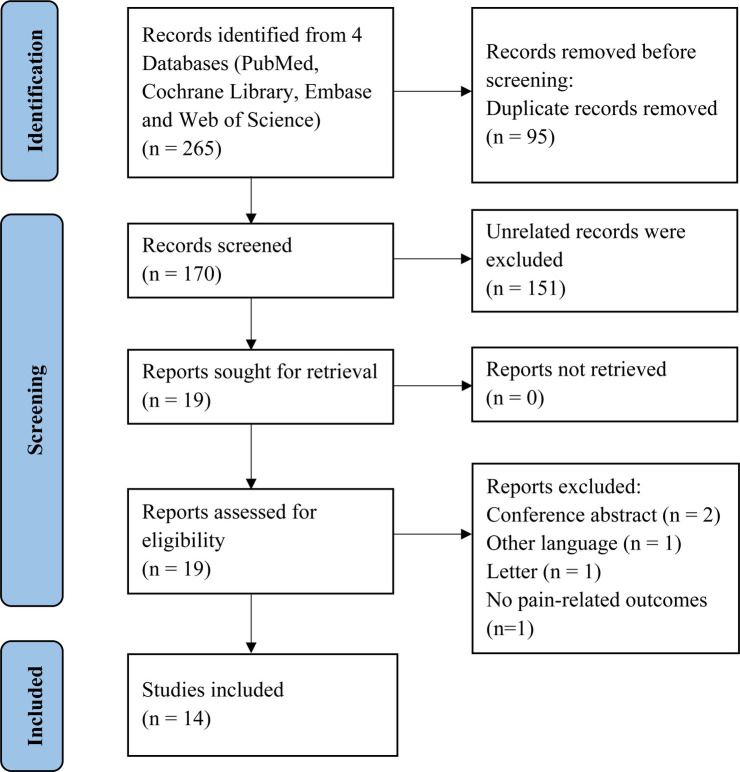
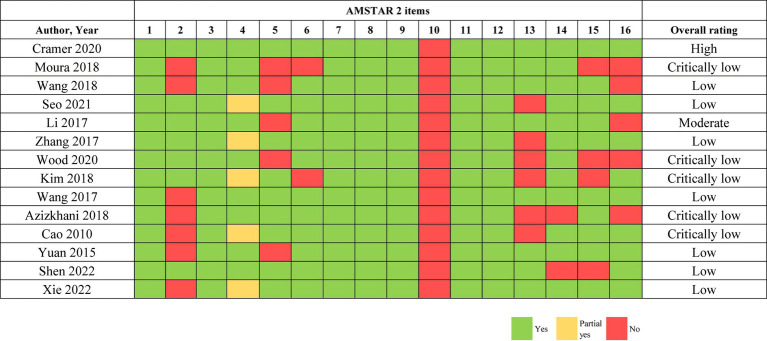
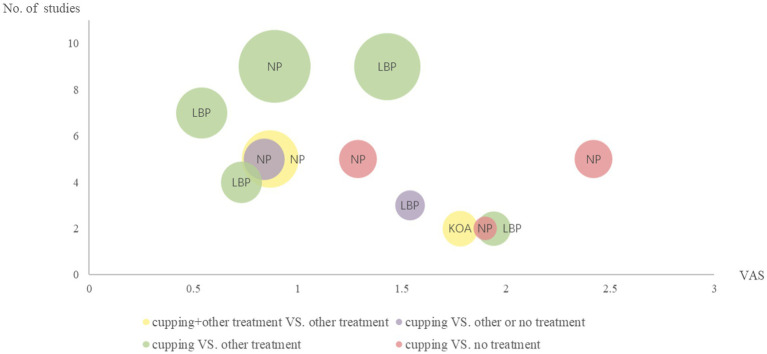
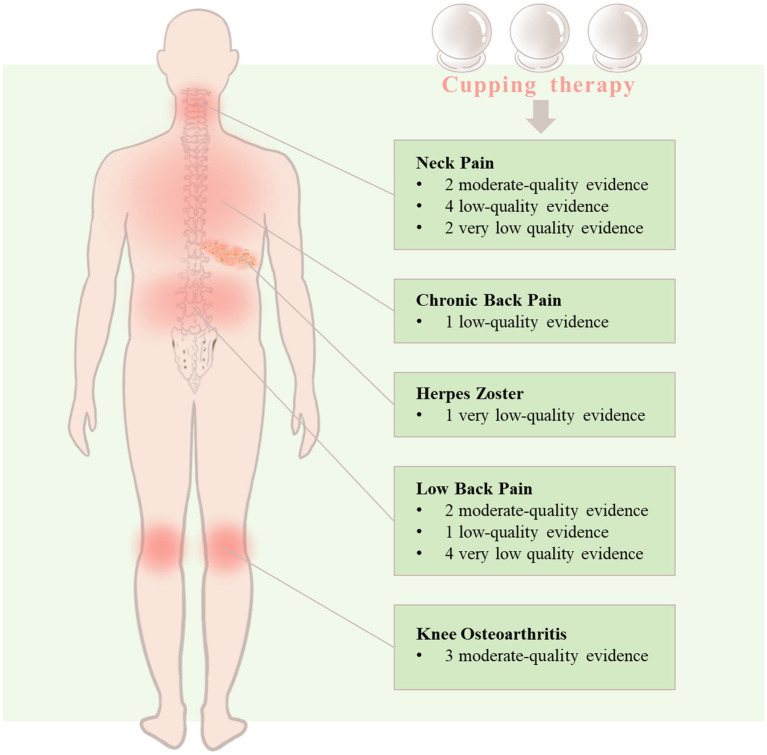
Methods: PubMed, Cochrane Library, Embase, and Web of Science were searched to collect the meta-analyses investigating the association between cupping therapy and pain-related outcomes. The methodological quality was assessed by using the AMSTAR 2 tool. Significant outcomes (p < 0.05) were assessed using the GRADE system. The summary of evidence is presented by bubble plots and human evidence mapping.
Results: Fourteen meta-analyses covering five distinct pain-related conditions were identified and assessed for methodological quality using the AMSTAR 2, which categorized the quality as critically low (36%), low (50.0%), moderate (7%), and high (7%). In accordance with the GRADE system, no high-quality evidence was found that demonstrates the efficacy of cupping therapy for pain-related outcomes. Specifically, for neck pain, there were two moderate-quality, four low-quality, and two very low-quality evidence, while only one very low-quality evidence supports its efficacy in treating herpes zoster and one low-quality evidence for chronic back pain. Additionally, for low back pain, there were two moderate-quality, one low-quality, and four very low-quality evidence, and for knee osteoarthritis, three moderate-quality evidence suggest that cupping therapy may alleviate pain score.
Conclusion: The available evidence of very low-to-moderate quality suggests that cupping therapy is effective in managing chronic pain, knee osteoarthritis, low back pain, neck pain, chronic back pain, and herpes zoster. Moreover, it represents a promising, safe, and effective non-pharmacological therapy that warrants wider application and promotion.Systematic review registration: https://www.crd.york.ac.uk/prospero/display_record.php?ID=CRD42021255879, identifier: CRD42021255879.
Keywords: cupping therapy; evidence mapping; meta-analysis; pain-related conditions; systematic review.
Copyright © 2023 Wang, Cai, Li and Zhu.
Conflict of interest statement
The authors declare that the research was conducted in the absence of any commercial or financial relationships that could be construed as a potential conflict of interest.
Figures
References
-
- GBD 2016 Disease and Injury Incidence and Prevalence Collaborators . Global, regional, and national incidence, prevalence, and years lived with disability for 328 diseases and injuries for 195 countries, 1990-2016: a systematic analysis for the global burden of disease study 2016. Lancet. (2017) 390:1211–59. doi: 10.1016/S0140-6736(17)32154-2, PMID: - DOI - PMC - PubMed
-
- Fan BF. Blue book of pain prevention and health promotion strategy in China: Report on the development of pain medicine in China (2020). Beijing: Tsinghua University Press; (2020).
Publication types
LinkOut - more resources
Full Text Sources
Medical
