Review
. 2024 Dec;162(2-3):459-471.
doi: 10.1007/s11120-023-01056-4. Epub 2023 Nov 15.

Perspectives of cyanobacterial cell factories

Affiliations
Review

Perspectives of cyanobacterial cell factories

Anastasios Melis et al. Photosynth Res. 2024 Dec.

Abstract

Cyanobacteria are prokaryotic photosynthetic microorganisms that can generate, in addition to biomass, useful chemicals and proteins/enzymes, essentially from sunlight, carbon dioxide, and water. Selected aspects of cyanobacterial production (isoprenoids and high-value proteins) and scale-up methods suitable for product generation and downstream processing are addressed in this review. The work focuses on the challenge and promise of specialty chemicals and proteins production, with isoprenoid products and biopharma proteins as study cases, and the challenges encountered in the expression of recombinant proteins/enzymes, which underline the essence of synthetic biology with these microorganisms. Progress and the current state-of-the-art in these targeted topics are emphasized.

Keywords: Synechocystis sp. PCC 6803; Biopharmaceutical proteins; Fusion constructs; Phycocyanin; Plant essential oils; Protein overexpression.


Conflict of interest statement

Declarations. Competing interest: The authors declare no competing interests.

Figures
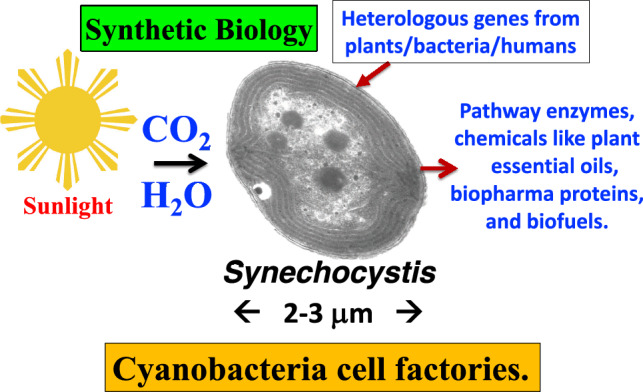
Fig. 1
Fig. 1
Schematic of the cyanobacterial cell factories platform with Synechocystis as the model organism. Sunlight, CO2, and H2O are inputs to the process whereas heterologous pathway enzymes, and chemicals like plant essential oils, biofuels, and recombinant biopharma proteins are target outputs
Fig. 2
Fig. 2
The chemical formula of the hemiterpene isoprene (C5H8), the acyclic β-myrcene, the monocyclic β-phellandrene, and the bicyclic β-pinene monoterpene (C10H16) hydrocarbons
Fig. 3
Fig. 3
The “Bentley bottle,” a lab-designed 1-L sealed bioreactor for diffusion-based delivery of CO2 and O2 gas exchange occurring concomitantly with terpene hydrocarbons production and release/accumulation. A 100% CO2 gas stream was slowly bubbled into the gaseous/aqueous two-phase medium, calibrated to flush the liquid phase and fill the headspace prior to sealing the reactor. Efficient and spontaneous uptake and assimilation of headspace CO2 by the cells occurred in the fully sealed reactor by diffusion and was concomitantly replaced by photosynthetically produced O2 and hydrophobic isoprenoids during cell photoautotrophic growth. The latter (O2 and hydrophobic isoprenoids) accumulated in the reactor headspace. This device was successfully tested with isoprene, β-phellandrene, and geranyllinalool, as the target isoprenoid products. Schematic adapted from Bentley and Melis (2012)
Fig. 4
Fig. 4
A 1,200-L tubular modular pilot photobioreactor layout in the greenhouse was designed to support cell growth and product generation / accumulation. A control box enabled culture manipulations, including addition of nutrients and removal of culture samples from the reactor. a Shown is the gaseous/aqueous two-phase configuration with growth media present but prior to cyanobacterial inoculation. This set-up employed an approximately 50:50 partition between the aqueous and gaseous phases. The latter was filled with a stream of 100% CO2. However, the gaseous/aqueous partition ratio could vary depending on organism and growth conditions. b View of the reactor described above, immediately following inoculation with a starter culture. In a sealed reactor, this configuration permitted spontaneous diffusion-driven CO2 uptake from the gaseous phase and its replacement by O2 and by the isoprenoid products generated from the photosynthesis of the cells in the aqueous phase. c View of the reactor seven days after inoculation. With ambient sunlight and sufficient CO2 substrate, cells grew quickly, resulting in a high-density biomass in the reactor, as evidenced from the high optical density of the culture. Abundance of CO2 (100% provision) and bright sunlight helped the rate of cyanobacterial growth and productivity
Fig. 5
Fig. 5
Comparative growth and biomass accumulation of wild-type and Truncated Light-harvesting Antenna (TLA) strains of Synechocystis 6803 lacking phycocyanin. a 13-L carboys with a 12-inch (30 cm) diameter were inoculated with Synechocystis wild-type and a phycocyanin-deficient (TLA) mutant, followed by growth in BG-11 inorganic nutrients under ambient conditions in the greenhouse. b Early stages of growth for the wild-type and two TLA strains of Synechocystis under artificial illumination in the lab
Fig. 6
Fig. 6
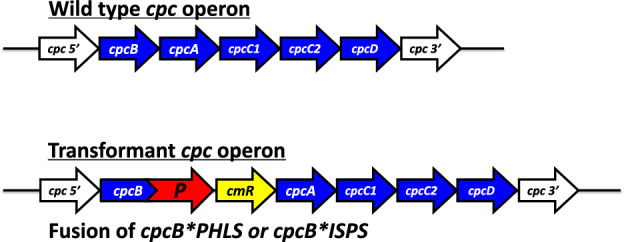
Schematic of DNA maps of the cpc operon in wild-type and Synechocystis fusion construct transformants. (Upper) The native cpc operon, as it occurs in wild-type Synechocystis, comprising the cpcB (phycocyanin β-subunit) and cpcA (phycocyanin α-subunit) DNA, as well as DNA encoding for the phycocyanin rod linker CpcC1, CpcC2, and CpcD proteins. This DNA operon configuration and sequence is referred to as the wild type (WT). (Lower). Replacement of the cpcB gene with fusion DNA construct cpcB*P, where P encodes for a protein of interest. The cpcB*P fusion construct is followed by DNA encoding the chloramphenicol (cmR) resistance cassette in an operon configuration. This transgenic DNA configuration enabled substantial accumulation of the recombinant CpcB*P fusion protein
Fig. 7
Fig. 7
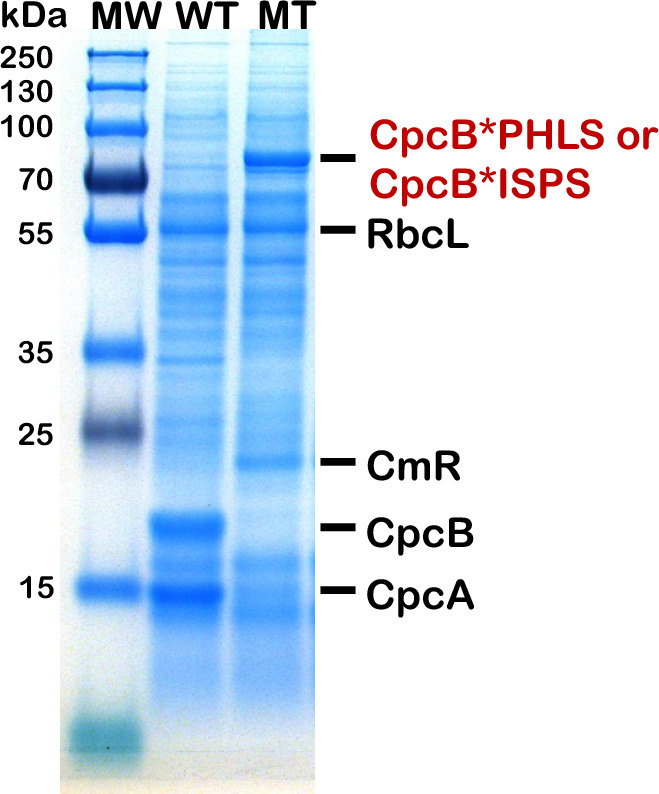
Protein expression analysis of Synechocystis wild-type (WT) and fusion construct transformants (MT) harboring the CpcB*PHLS or CpcB*ISPS encoding recombinant DNA. Total cellular protein extracts were resolved by SDS-PAGE and visualized by Coomassie stain. Two different versions of the fusion construct were used comprising the CpcB*PHLS or CpcB*ISPS, both of which migrate to about 83 kDa, yielding similar results. Note the equivalent amounts of the Rubisco large subunit (RbcL) in wild type and mutant, migrating to about 56 kDa, suggesting about equal loading of WT and MT proteins. Also note the presence of the CmR protein, migrating to about 23 kDa, and the absence of the CpcB protein from the ~ 19 kDa electrophoretic mobility position, as the latter is migrating to ~ 83 kDa in the MT mutants. Sample loading corresponds to 0.25 mg of chlorophyll per lane
Fig. 8
Fig. 8
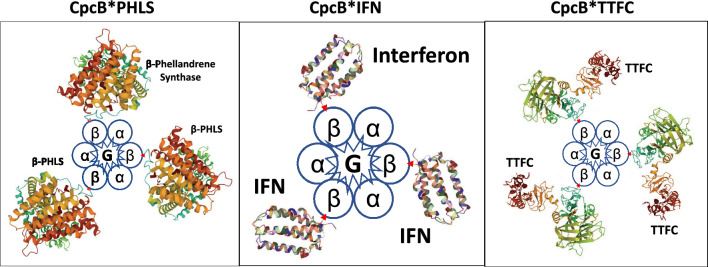
Schematic of the heterohexameric structure of recombinant protein fusions with the CpcB β-subunit of phycocyanin. Shown are the (α,β*PHLS)3CpcG1, (α,β*IFN)3CpcG1, and (α,β*TTFC)3CpcG1 heterohexameric complex configurations with the lavender β-phellandrene synthase, (left panel), the human interferon (middle), and the tetanus toxin fragment C (right panel). A similar configuration resulted when these heterologous proteins were fused to the CpcA α-subunit of phycocyanin. The CpcG1 linker protein (denoted by G) occupies the disk center of the respective complexes and serves to functionally link the modified phycocyanin disk to the allophycocyanin core cylinders in Synechocystis. Assembly of the native α,β heterohexameric complex and its functional association with the allophycocyanin core cylinders suggested that the corresponding heterologous fusion proteins localize away from the disk center and are likely placed at the periphery or emanate radially from the (α,β*PHLS)3, (α,β*IFN)3, and (α,β*TTFC)3 disks, thus being exposed to the medium

References

    1. Albers SC, Gallegos VA, Peebles CAM (2015) Engineering of genetic control tools in Synechocystis sp. PCC 6803 using rational design techniques. J Biotechnol 216:36–46. 10.1016/j.jbiotec.2015.09.042 - PubMed
    1. Bäck J, Aaltonen H, Hellén H, Kajos MJ, Patokoski J, Taipale R, Pumpanen J, Heinonsalo J (2010) Variable emissions of microbial volatile organic compounds (MVOCs) from root-associated fungi isolated from Scots pine. Atmos Environ 44:3651–3659. 10.1016/j.atmosenv.2010.06.042
    1. Baier T, Kros D, Feiner RC, Lauersen KJ, Müller KM, Kruse O (2018) Engineered fusion proteins for efficient protein secretion and purification of a human growth factor from the green microalga Chlamydomonas reinhardtii. ACS Synth Biol 7:2547–2557. 10.1021/acssynbio.8b00226 - PubMed
    1. Barone GD, Cernava T, Ullmann J, Liu J, Lio E, Germann AT, Nakielski A, Russo DA, Chavkin T, Knufmann K, Tripodi F, Coccetti P, Secundo F, Fu P, Pfleger B, Axmann IM, Lindblad P (2023) Recent developments in the production and utilization of photosynthetic microorganisms for food applications. Heliyon 9(4):e14708. 10.1016/j.heliyon.2023.e14708 - PMC - PubMed
    1. Behler J, Vijay D, Hess WR, Akhtar MK (2018) CRISPR-based technologies for metabolic engineering in cyanobacteria. Trends Biotechnol 36(10):996–1010. 10.1016/j.tibtech.2018.05.011 - PubMed

MeSH terms