


Prenatal Exposure to Perfluoroalkyl Substances and Child Behavior at Age 12: A PELAGIE Mother-Child Cohort Study
- PMID: 37971539
- PMCID: PMC10653211
- DOI: 10.1289/EHP12540
Prenatal Exposure to Perfluoroalkyl Substances and Child Behavior at Age 12: A PELAGIE Mother-Child Cohort Study
Abstract
Background: Per- and polyfluoroalkyl substances (PFAS) are chemical substances spread throughout the environment worldwide. Exposure during pregnancy represents a specific window of vulnerability for child health.
Objective: Our objective was to assess the impact of prenatal exposure to multiple PFAS on emotional and behavioral functions in 12-y-old children.
Method: In the PELAGIE mother-child cohort (France), prenatal exposure to nine PFAS was measured from concentrations in cord serum samples. Behavior was assessed at age 12 y using the parent-reported Strengths and Difficulties Questionnaire (SDQ) and the self-reported Dominic Interactive for Adolescents (DIA) for 444 children. Associations were estimated using negative binomial models for each PFAS. Bayesian kernel machine regression (BKMR) models were performed to assess the exposure mixture effect on children's behavior.
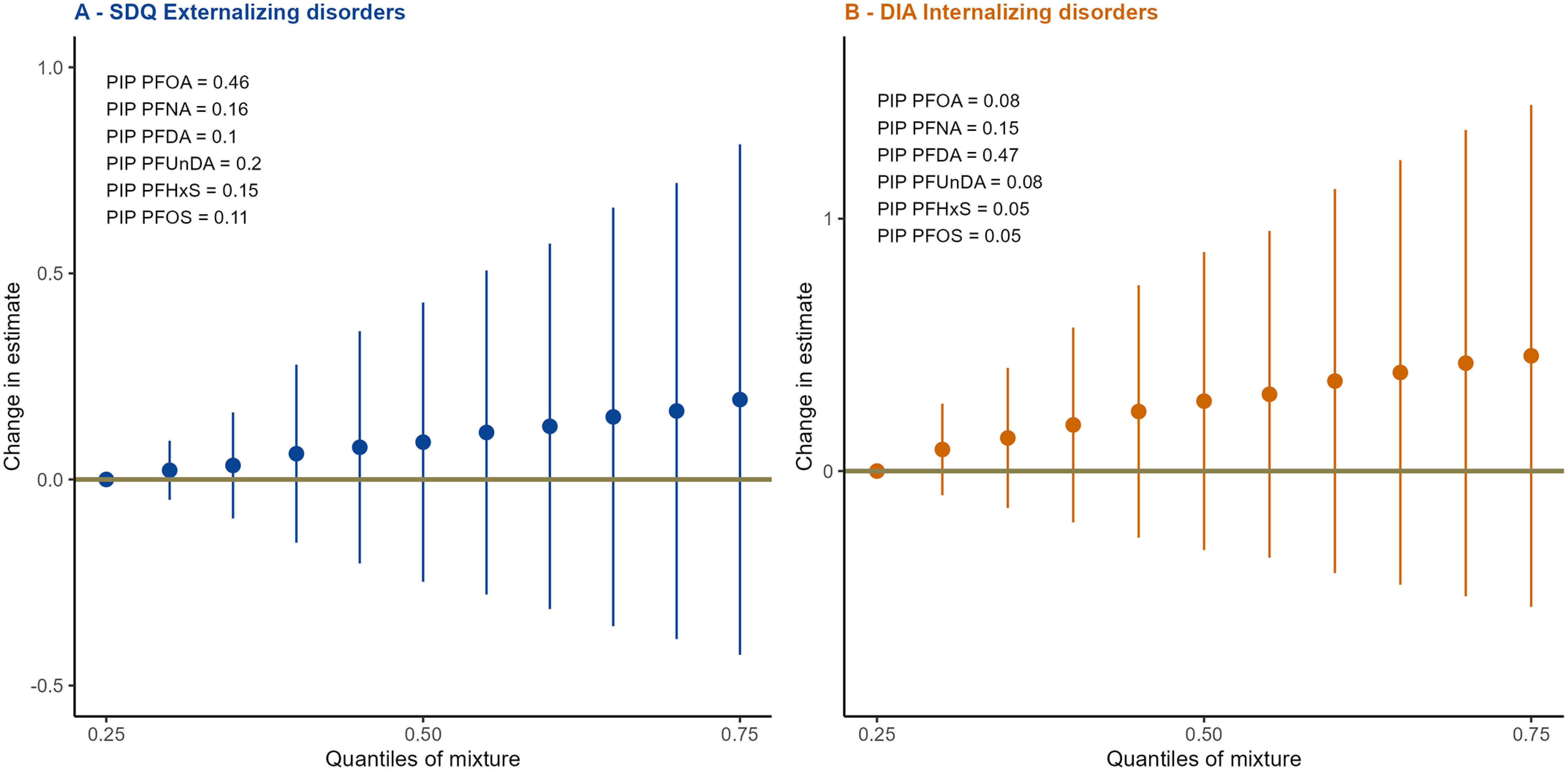
Results: In our study population, 73% of mothers had spent more than 12 y in education. Higher scores on SDQ externalizing subscale were observed with increasing cord-serum concentration of perfluorooctanoic acid (PFOA) and perfluorononanoic acid (PFNA) [adjusted mean ratio , 95% confidence interval (CI): 1.03, 1.34, and (95% CI: 1.00, 1.29) for every doubling of concentration, respectively]. Results for the hyperactivity score were similar [ (95% CI: 1.04, 1.40) and (95% CI: 1.02, 1.36), respectively]. With regard to major depressive disorder and internalizing subscales, perfluorodecanoic acid (PFDA) was associated with higher self-reported DIA scores [ (95% CI: 1.01, 1.27) and (95% CI: 1.02, 1.21), respectively]. In terms of the anxiety subscale, PFDA and PFNA were associated with higher scores [ (95% CI: 1.02, 1.21) and (95% CI: 1.01, 1.19), respectively]. Concurrent increases in the PFAS concentrations included in the BKMR models showed no change in the SDQ externalizing and DIA internalizing subscales scores.
Conclusion: Prenatal exposure to PFNA and PFOA were associated with increasing scores for measures of externalizing behaviors, specifically hyperactivity. We also identified associations between PFNA and PFDA prenatal exposure levels and increasing scores related to internalizing behaviors (general anxiety and major depressive disorder), which adds to the as yet sparse literature examining the links between prenatal exposure to PFAS and internalizing disorders. https://doi.org/10.1289/EHP12540.
Figures
References
-
- Agency for Toxic Substances and Disease Registry. 2021. Toxicological Profile for Perfluoroalkyls. https://stacks.cdc.gov/view/cdc/59198 [accessed 7 July 2022]. - PubMed
-
- Bach CC, Liew Z, Matthiesen NB, Henriksen TB, Bech BH, Nøhr EA, et al. . 2022. In utero exposure to perfluoroalkyl and polyfluoroalkyl substances and attention and executive function in the offspring: a study in the Danish National Birth Cohort. Environ Res 212(pt B):113262, PMID: , 10.1016/j.envres.2022.113262. - DOI - PubMed
Publication types
MeSH terms
Substances
LinkOut - more resources
Full Text Sources