Urinary Bisphenol A and Bis(2-Ethylhexyl) Phthalate Metabolite Concentrations in Children with Obesity: A Case-Control Study
- PMID: 37972573
- PMCID: PMC11309050
- DOI: 10.1159/000535305
Urinary Bisphenol A and Bis(2-Ethylhexyl) Phthalate Metabolite Concentrations in Children with Obesity: A Case-Control Study
Abstract
Introduction: Obesity is a worldwide public health problem. Experimental animal and in vitro studies suggest that the exposure to BPA and phthalates are associated to a higher risk of obesity.
Objective: The objective of the study was to determine urinary excretion of bisphenol A and phthalates in obese and normal weight children.
Methods: A case-control study was conducted in 122 children. Sixty-six obese children, 36 girls (mean age 8.41 ± 1.27 years), and 30 boys (mean age 8.51 ± 1.33 years) and 56 normal weight children, 27 girls (mean age 7.64 ± 1.49 years), and 29 boys (mean age 7.77 ± 1.56 years) were studied. Urinary BPA and bis(2-ethylhexyl) phthalate (DEHP) metabolites (MEHP, MEHHP, and MEOHP) were measured, respectively, by gas chromatography and high-performance liquid chromatography. Individual determinants of exposure were evaluated through "ad hoc" questionnaires.
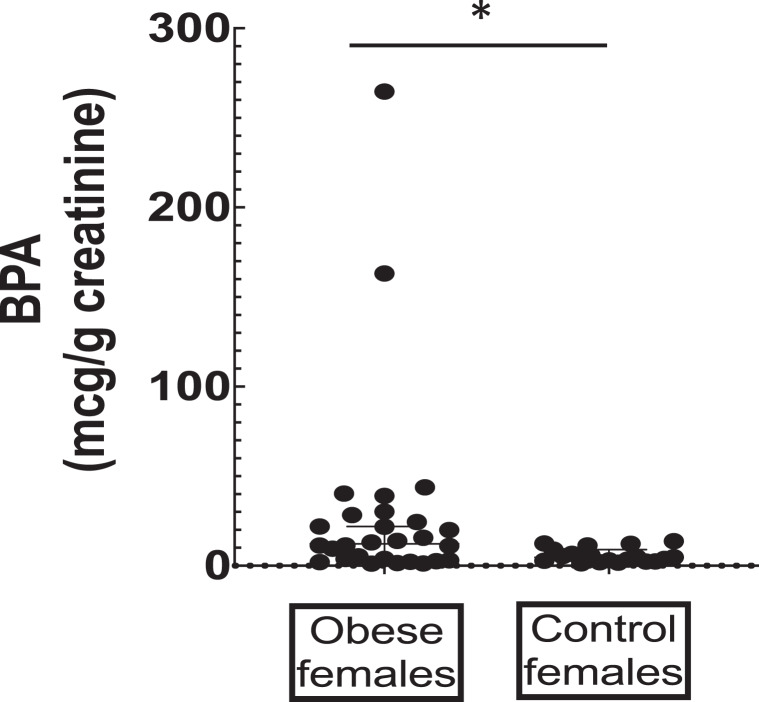
Results: BPA and DEHP metabolites were detectable in obese and normal weight children. Obese girls showed significantly higher BPA concentrations in comparison with normal weight girls (means 10.77, 95% CI = 7.02-16.53 vs. 5.50, 95% CI = 3.93-7.71 μg/g creatinine, respectively, p < 0.02). The first step of DEHP metabolic rate was significantly higher in obese girls compared with controls (p < 0.05). DEHP metabolites correlated significantly with leptin concentrations in obese girls (p < 0.03). A higher risk of obesity was found in children with BPA levels above the median values with the habit to eat food packaged (OR = 11.09, 95% CI = 1.28-95.78).
Conclusions: These findings show that a higher exposure to BPA is associated with the risk of obesity in girls. Further studies are needed to unveil the cause-effect relationship.
Keywords: Bisphenol A; Children; Obesity; Phthalates.
© 2023 The Author(s). Published by S. Karger AG, Basel.
Conflict of interest statement
The authors have no conflicts of interest to declare, except Stefano Cianfarani who is the Editor-in-Chief of Hormone Research in Pediatrics.
Figures
References
-
- Heindel JJ, Newbold R, Schug TT. Endocrine disruptors and obesity. Nat Rev Endocrinol. 2015;11:653–61. - PubMed
MeSH terms
Substances
LinkOut - more resources
Full Text Sources
Miscellaneous