. 2023 Nov 17;10(1):810.
doi: 10.1038/s41597-023-02722-x.

Shotgun metagenomes from productive lakes in an urban region of Sweden

Affiliations

Shotgun metagenomes from productive lakes in an urban region of Sweden

Alejandro Rodríguez-Gijón et al. Sci Data. .

Abstract

Urban lakes provide multiple benefits to society while influencing life quality. Moreover, lakes and their microbiomes are sentinels of anthropogenic impact and can be used for natural resource management and planning. Here, we release original metagenomic data from several well-characterized and anthropogenically impacted eutrophic lakes in the vicinity of Stockholm (Sweden). Our goal was to collect representative microbial community samples and use shotgun sequencing to provide a broad view on microbial diversity of productive urban lakes. Our dataset has an emphasis on Lake Mälaren as a major drinking water reservoir under anthropogenic impact. This dataset includes short-read sequence data and metagenome assemblies from each of 17 samples collected from eutrophic lakes near the greater Stockholm area. We used genome-resolved metagenomics and obtained 2378 metagenome assembled genomes that de-replicated into 514 species representative genomes. This dataset adds new datapoints to previously sequenced lakes and it includes the first sequenced set of metagenomes from Lake Mälaren. Our dataset serves as a baseline for future monitoring of drinking water reservoirs and urban lakes.


Conflict of interest statement

The authors declare no competing interests.

Figures

Fig. 1
Fig. 1
Map of sampling locations. Note that Mälaren was sampled at two nearby but different locations (named Mälaren_B and Mälaren_D in supplementary data files). For coordinates and metadata, see Table S1.
Fig. 2
Fig. 2
Quality of the MAGs. Completeness (A) and contamination (B) across all the 2378 metagenome-assembled genomes (MAGs, in grey). Highlighted in black, the 514 species representative genomes (SRGs). Correlation between completeness and contamination for all 514 SRGs, colored by phyla (C). The legend table indicates the number of MAGs and SRGs classified as high-quality (>90% completeness and <5% contamination), medium-quality (≥50% completeness and <10% contamination), and low-quality (<50% completeness and <10% contamination), following the MIMAG standards for MAG quality completeness and contamination cutoffs.
Fig. 3
Fig. 3
Intersection plot of shared species representative genomes (SRGs) across samples. Intersection size shows the number of SRGs present in each sample. The sum of all intersection sizes equals the 514 SRGs in the dataset. For example, we find that 60 SRGs are exclusively present in Limmaren Sample 101 S75. Set size is the number of SRGs present in total per sample. Samples highlighted in blue are from Lake Mälaren.
Fig. 4
Fig. 4
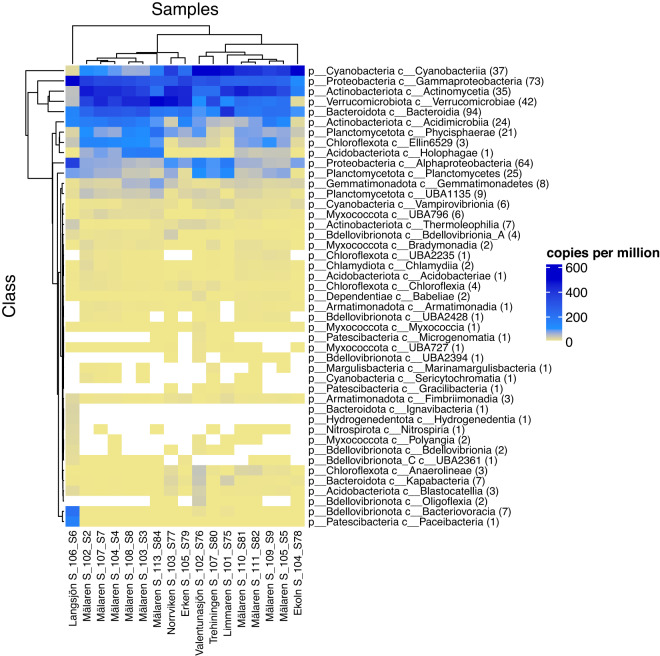
Heatmap indicating the sum of genome copies per million reads per class for each bacterial class represented by the SRGs per sample. White indicates that reads from the given class were not detected in the sample. In the figure, the color yellow/khaki starts at 0.0001 genome copies per million reads. The heatmap is hierarchically clustered.

References

    1. Williamson CE, Saros JE, Vincent WF, Smol JP. Lakes and reservoirs as sentinels, integrators, and regulators of climate change. Limnology and Oceanography. 2009;54:2273–2282. doi: 10.4319/lo.2009.54.6_part_2.2273. - DOI
    1. Cavicchioli R, et al. 2019. Scientists’ warning to humanity: microorganisms and climate change. Nature Reviews Microbiology. 2019;17:569–586. doi: 10.1038/s41579-019-0222-5. - DOI - PMC - PubMed
    1. Linz AM, et al. Bacterial community composition and dynamics spanning five years in freshwater bog lakes. mSphere. 2017;2:e00169–17. doi: 10.1128/mSphere.00169-17. - DOI - PMC - PubMed
    1. Kraemer SA, et al. A large-scale assessment of lakes reveals a pervasive signal of land use on bacterial communities. The ISME Journal. 2020;14:3011–3023. doi: 10.1038/s41396-020-0733-0. - DOI - PMC - PubMed
    1. Garcia S, Hampel JJ. 2023. Metagenomic dataset from Swedish urban lakes. SciLifeLab Data Repository. - DOI