


Reversing frailty in older adults: a scoping review
- PMID: 37978444
- PMCID: PMC10655301
- DOI: 10.1186/s12877-023-04309-y
Reversing frailty in older adults: a scoping review
Abstract
Background: Individuals 65 years or older are presumably more susceptible to becoming frail, which increases their risk of multiple adverse health outcomes. Reversing frailty has received recent attention; however, little is understood about what it means and how to achieve it. Thus, the purpose of this scoping review is to synthesize the evidence regarding the impact of frail-related interventions on older adults living with frailty, identify what interventions resulted in frailty reversal and clarify the concept of reverse frailty.
Methods: We followed Arksey and O'Malley's five-stage scoping review approach and conducted searches in CINAHL, EMBASE, PubMed, and Web of Science. We hand-searched the reference list of included studies and conducted a grey literature search. Two independent reviewers completed the title, abstract screenings, and full-text review using the eligibility criteria, and independently extracted approximately 10% of the studies. We critically appraised studies using Joanna Briggs critical appraisal checklist/tool, and we used a descriptive and narrative method to synthesize and analyze data.
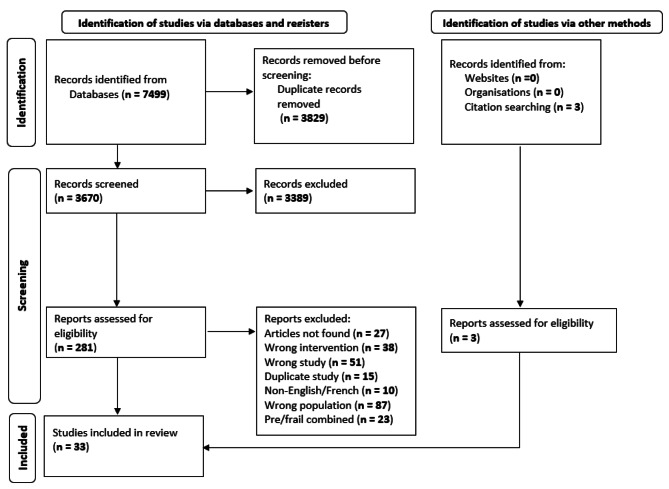
Results: Of 7499 articles, thirty met the criteria and three studies were identified in the references of included studies. Seventeen studies (56.7%) framed frailty as a reversible condition, with 11 studies (36.7%) selecting it as their primary outcome. Reversing frailty varied from either frail to pre-frail, frail to non-frail, and severe to mild frailty. We identified different types of single and multi-component interventions each targeting various domains of frailty. The physical domain was most frequently targeted (n = 32, 97%). Interventions also varied in their frequencies of delivery, intensities, and durations, and targeted participants from different settings, most commonly from community dwellings (n = 23; 69.7%).
Conclusion: Some studies indicated that it is possible to reverse frailty. However, this depended on how the researchers assessed or measured frailty. The current understanding of reverse frailty is a shift from a frail or severely frail state to at least a pre-frail or mildly frail state. To gain further insight into reversing frailty, we recommend a concept analysis. Furthermore, we recommend more primary studies considering the participant's lived experiences to guide intervention delivery.
Keywords: Frailty domains; Multi component interventions; Reverse frailty; Single component interventions.
© 2023. The Author(s).
Conflict of interest statement
The authors declare no competing interests.
Figures


References
-
- United Nations. World Population Ageing 2019. 2019.
Publication types
MeSH terms
LinkOut - more resources
Full Text Sources
Miscellaneous
