


Mindreading beliefs in same- and cross-neurotype interactions
- PMID: 37978869
- PMCID: PMC11191369
- DOI: 10.1177/13623613231211457
Mindreading beliefs in same- and cross-neurotype interactions
Abstract
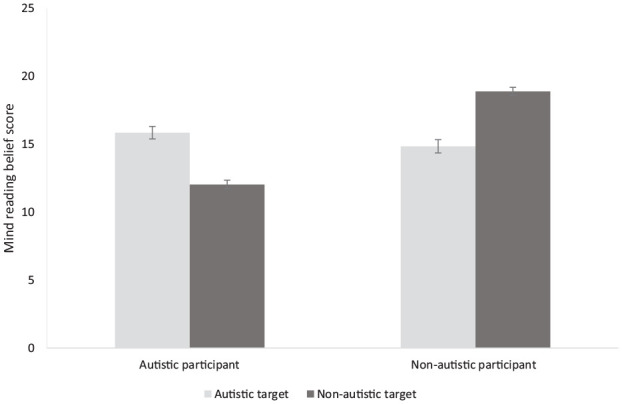
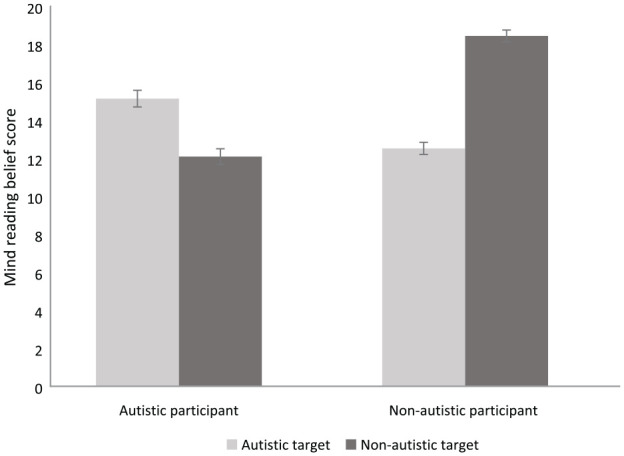
Autistic people are often characterised as having problems with mindreading, which refers to understanding other people's thoughts, beliefs and feelings. However, it has recently been suggested that mindreading difficulties may be a two-way issue between autistic and non-autistic people. This would imply that autistic people may not have difficulty reading the minds of other autistic people, whereas non-autistic people may struggle to read autistic people effectively. In this study, we created a survey in which we asked a relatively large sample of autistic and non-autistic people to rate their own and others' mindreading abilities in relation to autistic and non-autistic others, respectively. Both groups believed that they were better at reading others in their own group than the other group. The autistic respondents reported levels of mindreading skill at least commensurate with the non-autistic respondents when the mind to be read was specified as autistic. Thus, both groups of participants' responses were consistent with the notion that mindreading abilities are relational. Although self-reports are subjective, such beliefs could have important consequences for well-being and intergroup relations.
Keywords: autism; double empathy; mindreading beliefs.
Conflict of interest statement
Declaration of conflicting interestsThe author(s) declared no potential conflicts of interest with respect to the research, authorship, and/or publication of this article.
Figures
References
-
- Allison C., Auyeung B., Baron-Cohen S. (2012). Toward brief ‘red flags’ for autism screening: The short autism spectrum quotient and the short quantitative checklist in 1,000 cases and 3,000 controls. Journal of the American Academy of Child & Adolescent Psychiatry, 51(2), 202–212. 10.1016/j.jaac.2011.11.003 - DOI - PubMed
-
- American Psychiatric Association. (2013). Diagnostic and statistical manual of mental disorders (5th ed.).
MeSH terms
LinkOut - more resources
Full Text Sources
