Meta-Analysis
. 2025 Apr;16(2):484-511.
doi: 10.1007/s12975-023-01205-w. Epub 2023 Nov 20.

Motor Rehabilitation Provides Modest Functional Benefits After Intracerebral Hemorrhage: a Systematic Review and Meta-Analysis of Translational Rehabilitation Studies

Affiliations
Meta-Analysis

Motor Rehabilitation Provides Modest Functional Benefits After Intracerebral Hemorrhage: a Systematic Review and Meta-Analysis of Translational Rehabilitation Studies

Britt A Fedor et al. Transl Stroke Res. 2025 Apr.

Abstract

Few certainties exist regarding the optimal type, timing, or dosage of rehabilitation after stroke. Despite differing injury mechanisms and recovery patterns following ischemic and hemorrhagic stroke, most translational stroke research is conducted after ischemia. As we enter the era of personalized medicine, exploring subtype-specific treatment efficacy is essential to optimizing recovery. Our objective was to characterize common rehabilitation interventions used after in vivo preclinical intracerebral hemorrhage (ICH) and assess the impact of post-ICH rehabilitation (vs. no-rehabilitation) on recovery of motor function. Following PRISMA guidelines, a systematic review (Academic Search Complete, CINAHL, EMBASE, Medline, PubMed Central) identified eligible articles published up to December 2022. Risk of bias (SYRCLE) and study quality (CAMARADES) were evaluated, and random-effects meta-analysis was used to assess treatment efficacy in recovery of forelimb and locomotor functions. Thirty articles met inclusion criteria, and 48 rehabilitation intervention groups were identified. Most used collagenase to model striatal ICH in young, male rodents. Aerobic exercise, enriched rehabilitation, and constraint-induced movement therapy represented ~ 70% of interventions. Study quality was low (median 4/10, range 2-8), and risk of bias was unclear. Rehabilitation provided modest benefits in skilled reaching, spontaneous impaired forelimb use, and locomotor function; however, effects varied substantially by endpoint, treatment type, and study quality. Rehabilitation statistically improves motor function after preclinical ICH, but whether these effects are functionally meaningful is unclear. Incomplete reporting and variable research quality hinder our capacity to analyze and interpret how treatment factors influence rehabilitation efficacy and recovery after ICH.

Keywords: Intracerebral hemorrhage; Meta-analysis; Motor recovery; Rehabilitation; Stroke; Translational research.


Conflict of interest statement

Declarations. Ethical Approval: Not applicable. Conflict of Interest: The authors declare no competing interests.

Figures
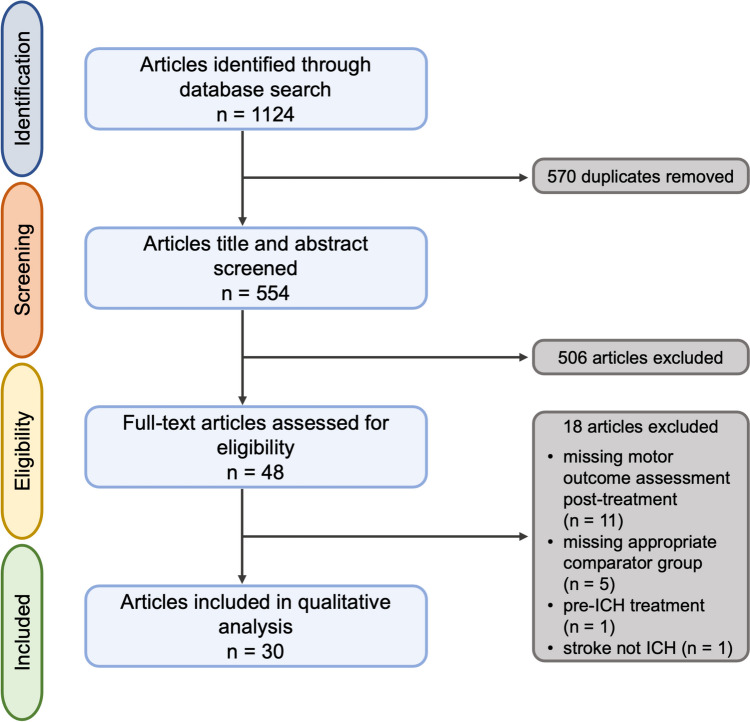
Fig. 1
Fig. 1
PRISMA flowchart of records identified through database searching
Fig. 2
Fig. 2
Summary of experimental characteristics, study quality, and risk of bias in eligible articles (n = 30). a Model population (species and strain); no article reported use of multiple species or strains. b Breakdown of the types of rehabilitation interventions (n = 48) used after preclinical ICH where 48 unique intervention groups were identified across 30 articles. c Summary of article quality assessed by compliance with 10 item CAMARADES checklist (n = 30). Article quality ranged considerably (2–8), with a median score of 4. d Summary of SYRCLE risk of bias tool (n = 30). Risk of bias was predominately unclear, as articles often lacked sufficient detail to determine how/if risk of bias was minimized
Fig. 3
Fig. 3
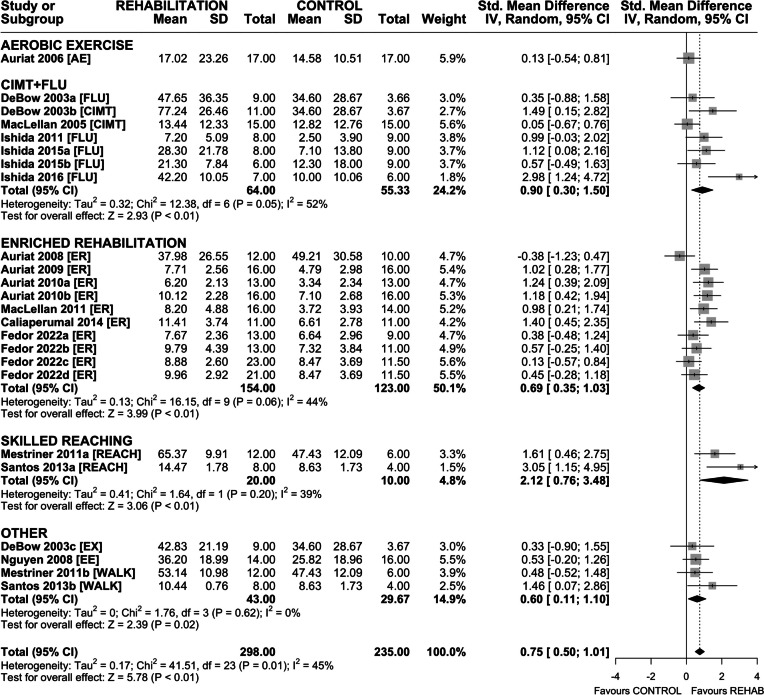
Forest plot of random-effects meta-analysis of post-ICH rehabilitation on performance in skilled reaching tasks (n = 24). Rehabilitation significantly improved skilled reaching (SMD 0.75 (95% CI 0.50–1.01), p < 0.01), with REACH and CIMT + FLU associated with the largest treatment effects. Egger regression indicated the presence of asymmetry in the dataset. Trim-and-fill analysis added 5 data points, all with SMD < 0, suggesting that null or negative data was missing in our original model. Follow-up random-effects meta-analysis of the trim-and-fill model (n = 29) produced a noticeably smaller treatment effect (SMD 0.59 (95% CI 0.32–0.87), p < 0.01). Effect sizes presented as Hedge’s G standardized mean difference (SMD) with 95% CI
Fig. 4
Fig. 4
Forest plot of random-effects meta-analysis of post-ICH rehabilitation on spontaneous impaired forelimb use in the cylinder task. Overall, rehabilitation significantly increased impaired forelimb use (MD 6.36% improvement (95% CI 2.09–10.64), p < 0.01), but only REACH and CIMT + FLU were associated with significant treatment effects. Egger regression did not indicate the presence of asymmetry in the dataset. Effect sizes presented as mean difference (MD), percent change in impaired forelimb use, with 95% CI
Fig. 5
Fig. 5
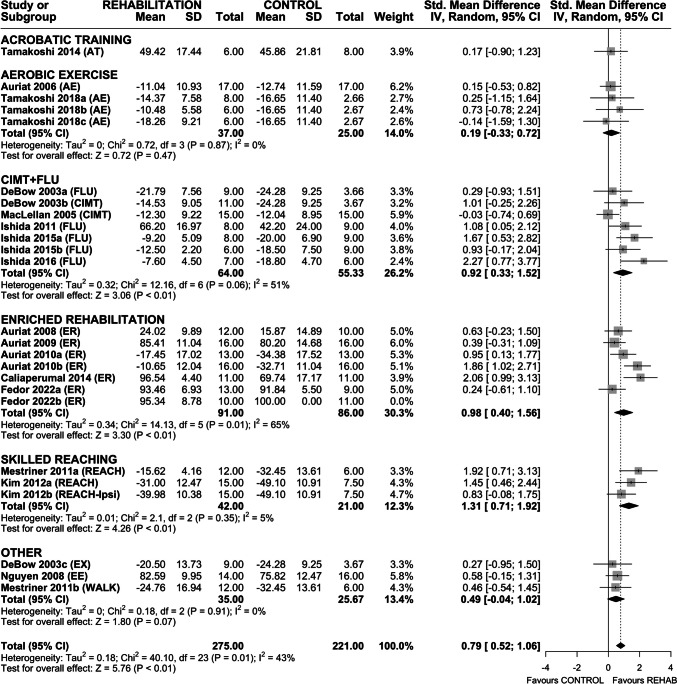
Forest plot of random-effects meta-analysis of post-ICH rehabilitation on locomotor function in the ladder walking task. Rehabilitation significantly improved locomotor function (SMD 0.79 (95% CI 0.52–1.06), p < 0.01). Egger regression did not indicate the presence of asymmetry in the dataset. Effect sizes presented as Hedge’s G standardized mean difference (SMD) with 95% CI
Fig. 6
Fig. 6
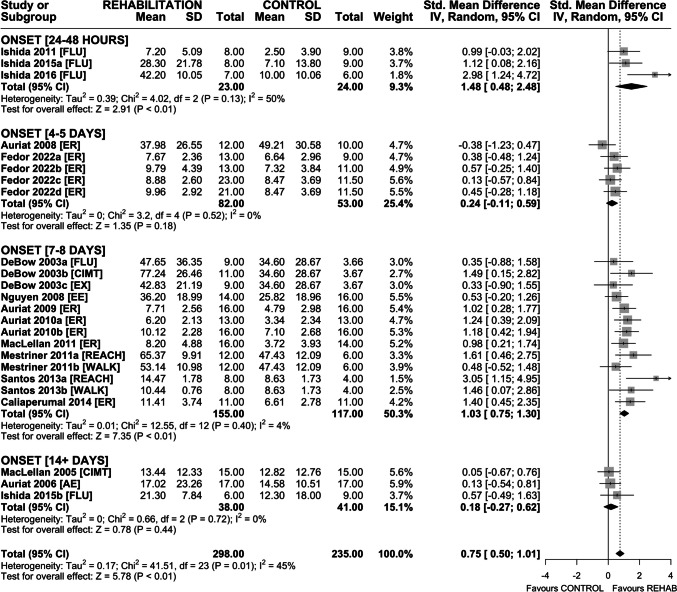
Forest plot of random-effects meta-analysis of skilled reaching performance grouped by timing of rehabilitation onset (days from ICH induction). Rehabilitation improved skilled reaching recovery with treatment onset of 24–48 h (SMD 1.48 (95% CI 0.48–2.48), p < 0.01) and 7–8 days (SMD 1.03 (95% CI 0.75–1.30), p < 0.01) whereas treatment initiated at 4–5 or ≥ 14 days failed to significantly improve skilled reaching. Effect sizes presented as Hedge’s G standardized mean difference (SMD) with 95% CI
Fig. 7
Fig. 7
Forest plot of random effects meta-analysis of spontaneous impaired forelimb use grouped by timing of rehabilitation onset (days from ICH induction). Rehabilitation increased use of the impaired forelimb; however, this effect was predominately driven by two interventions with unclear treatment onset (Kim 2012a, b). Effect sizes presented as mean difference (MD), percent change in impaired forelimb use, with 95% CI
Fig. 8
Fig. 8
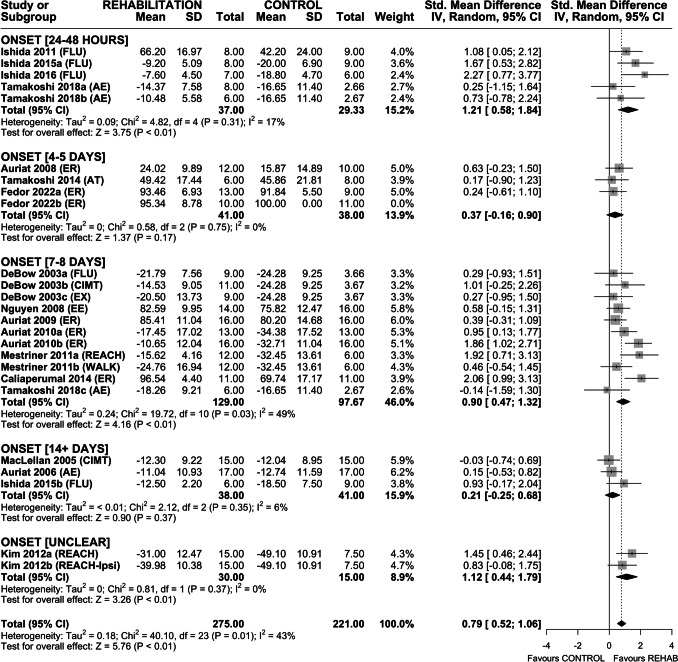
Forest plot of random-effects meta-analysis of recovery of locomotor function grouped by timing of rehabilitation onset (days from ICH induction). Rehabilitation improved locomotor function with treatment onset of 24–48 h (SMD 1.21 (95% CI 0.58–1.84), p < 0.01) and 7–8 days (SMD 0.90 (95% CI 0.47–1.32), p < 0.01); however, treatment initiated at 4–5 or ≥ 14 days failed to significantly improve locomotor function. Effect sizes presented as Hedge’s G standardized mean difference (SMD) with 95% CI

References

    1. Avan A, Digaleh H, Di Napoli M, Stranges S, Behrouz R, Shojaeianbabaei G, et al. Socioeconomic status and stroke incidence, prevalence, mortality, and worldwide burden: an ecological analysis from the Global Burden of Disease Study 2017. BMC Med. 2019;17:191. - PMC - PubMed
    1. Morovatdar N, Avan A, Azarpazhooh MR, Di Napoli M, Stranges S, Kapral MK, et al. Secular trends of ischaemic heart disease, stroke, and dementia in high-income countries from 1990 to 2017: the Global Burden of Disease Study 2017. Neurol Sci. 2022;43:255–64. - PubMed
    1. Feigin VL, Krishnamurthi RV, Parmar P, Norrving B, Mensah GA, Bennett DA, et al. Update on the global burden of ischemic and hemorrhagic stroke in 1990–2013: the GBD 2013 study. Neuroepidemiology. 2015;45:161–76. - PMC - PubMed
    1. An SJ, Kim TJ, Yoon B-W. Epidemiology, risk factors, and clinical features of intracerebral hemorrhage: an update. J Stroke. 2017;19:3–10. - PMC - PubMed
    1. Hong K-S, Saver JL. Years of disability-adjusted life gained as a result of thrombolytic therapy for acute ischemic stroke. Stroke. 2010;41:471–7. - PubMed

MeSH terms

LinkOut - more resources