


Proteomic association with age-dependent sex differences in Wisconsin Card Sorting Test performance in healthy Thai subjects
- PMID: 37981639
- PMCID: PMC10658079
- DOI: 10.1038/s41598-023-46750-4
Proteomic association with age-dependent sex differences in Wisconsin Card Sorting Test performance in healthy Thai subjects
Abstract
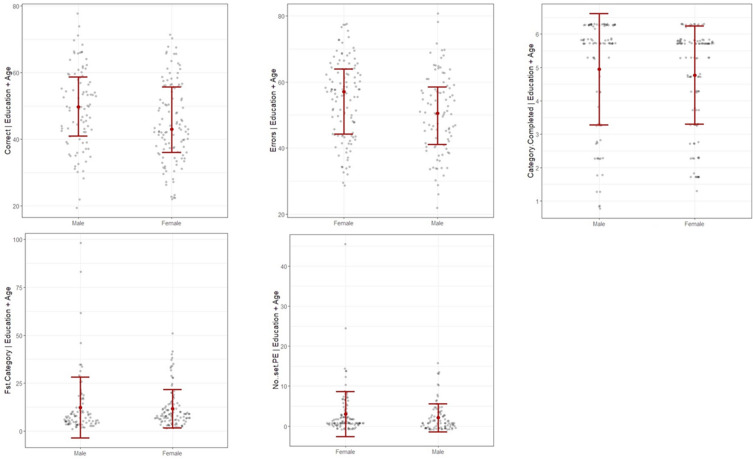
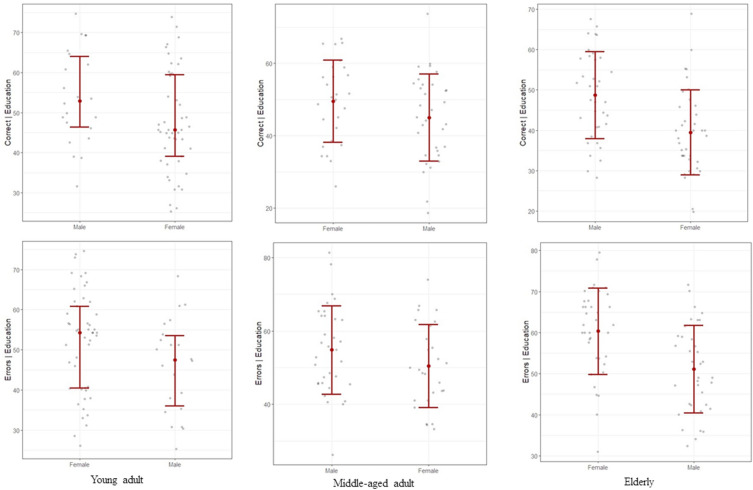
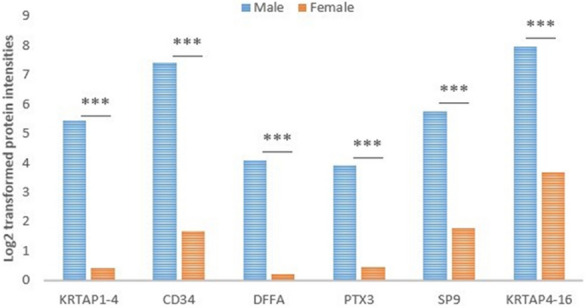
Sex differences in cognitive function exist, but they are not stable and undergo dynamic change during the lifespan. However, our understanding of how sex-related neural information transmission evolves with age is still in its infancy. This study utilized the Wisconsin Card Sorting Test (WCST) and the label-free proteomics method with bioinformatic analysis to investigate the molecular mechanisms underlying age-related sex differences in cognitive performance in 199 healthy Thai subjects (aged 20-70 years), as well as explore the sex-dependent protein complexes for predicting cognitive aging. The results showed that males outperformed females in two of the five WCST sub-scores: %Corrects and %Errors. Sex differences in these scores were related to aging, becoming noticeable in those over 60. At the molecular level, differently expressed individual proteins and protein complexes between both sexes are associated with the potential N-methyl-D-aspartate type glutamate receptor (NMDAR)-mediated excitotoxicity, with the NMDAR complex being enriched exclusively in elderly female samples. These findings provided a preliminary indication that healthy Thai females might be more susceptible to such neurotoxicity, as evidenced by their cognitive performance. NMDAR protein complex enrichment in serum could be proposed as a potential indication for predicting cognitive aging in healthy Thai females.
© 2023. The Author(s).
Conflict of interest statement
The authors declare no competing interests.
Figures
Similar articles
-
Proteomic associations with cognitive variability as measured by the Wisconsin Card Sorting Test in a healthy Thai population: A machine learning approach.PLoS One. 2025 Feb 20;20(2):e0313365. doi: 10.1371/journal.pone.0313365. eCollection 2025. PLoS One. 2025. PMID: 39977438 Free PMC article.
-
Cholinergic-estrogen interaction is associated with the effect of education on attenuating cognitive sex differences in a Thai healthy population.PLoS One. 2023 Jul 20;18(7):e0278080. doi: 10.1371/journal.pone.0278080. eCollection 2023. PLoS One. 2023. PMID: 37471329 Free PMC article.
-
Normative scores of the Wisconsin Card Sorting Test in a sample of the adult Portuguese population.Appl Neuropsychol Adult. 2022 Jul-Aug;29(4):767-774. doi: 10.1080/23279095.2020.1810040. Epub 2020 Sep 8. Appl Neuropsychol Adult. 2022. PMID: 32898451
-
Considerations for using the Wisconsin Card Sorting Test to assess cognitive flexibility.Behav Res Methods. 2021 Oct;53(5):2083-2091. doi: 10.3758/s13428-021-01551-3. Epub 2021 Mar 22. Behav Res Methods. 2021. PMID: 33754321 Review.
-
Executive dysfunction in Parkinson's disease: A meta-analysis on the Wisconsin Card Sorting Test literature.Neurosci Biobehav Rev. 2018 Oct;93:38-56. doi: 10.1016/j.neubiorev.2018.06.014. Epub 2018 Jun 23. Neurosci Biobehav Rev. 2018. PMID: 29944959
Cited by
-
Proteomic associations with cognitive variability as measured by the Wisconsin Card Sorting Test in a healthy Thai population: A machine learning approach.PLoS One. 2025 Feb 20;20(2):e0313365. doi: 10.1371/journal.pone.0313365. eCollection 2025. PLoS One. 2025. PMID: 39977438 Free PMC article.
References
-
- Fisher, G. G., Chacon, M. & Chaffee, D. S. in Work Across the Lifespan (eds Boris B. Baltes, Cort W. Rudolph, & Hannes Zacher) 17–45 (Academic Press, 2019).
MeSH terms
Grants and funding
LinkOut - more resources
Full Text Sources
