


Enhancing care quality and accessibility through digital technology-supported decentralisation of hypertension and diabetes management: a proof-of-concept study in rural Bangladesh
- PMID: 37984955
- PMCID: PMC10660961
- DOI: 10.1136/bmjopen-2023-073743
Enhancing care quality and accessibility through digital technology-supported decentralisation of hypertension and diabetes management: a proof-of-concept study in rural Bangladesh
Abstract
Objective: The critical shortage of healthcare workers, particularly in rural areas, is a major barrier to quality care for non-communicable diseases (NCD) in low-income and middle-income countries. In this proof-of-concept study, we aimed to test a decentralised model for integrated diabetes and hypertension management in rural Bangladesh to improve accessibility and quality of care.
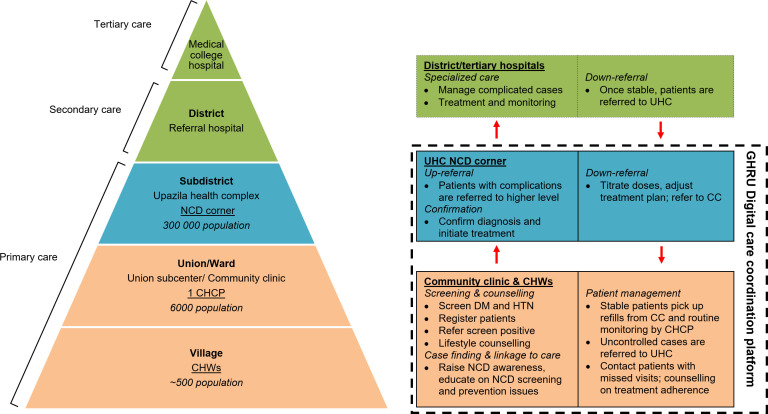
Design and setting: The study is a single-cohort proof-of-concept study. The key interventions comprised shifting screening, routine monitoring and dispensing of medication refills from a doctor-managed subdistrict NCD clinic to non-physician health worker-managed village-level community clinics; a digital care coordination platform was developed for electronic health records, point-of-care support, referral and routine patient follow-up. The study was conducted in the Parbatipur subdistrict, Rangpur Division, Bangladesh.
Participants: A total of 624 participants were enrolled in the study (mean (SD) age, 59.5 (12.0); 65.1% female).
Outcomes: Changes in blood pressure and blood glucose control, patient retention and patient-visit volume at the NCD clinic and community clinics.
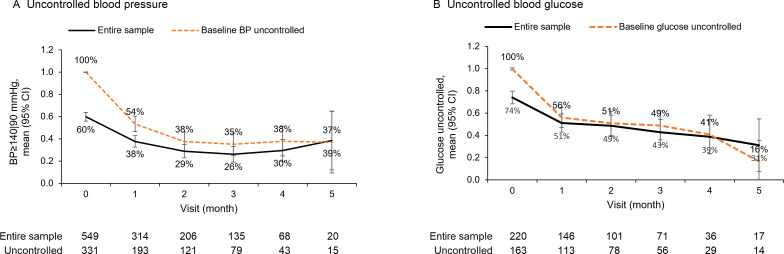
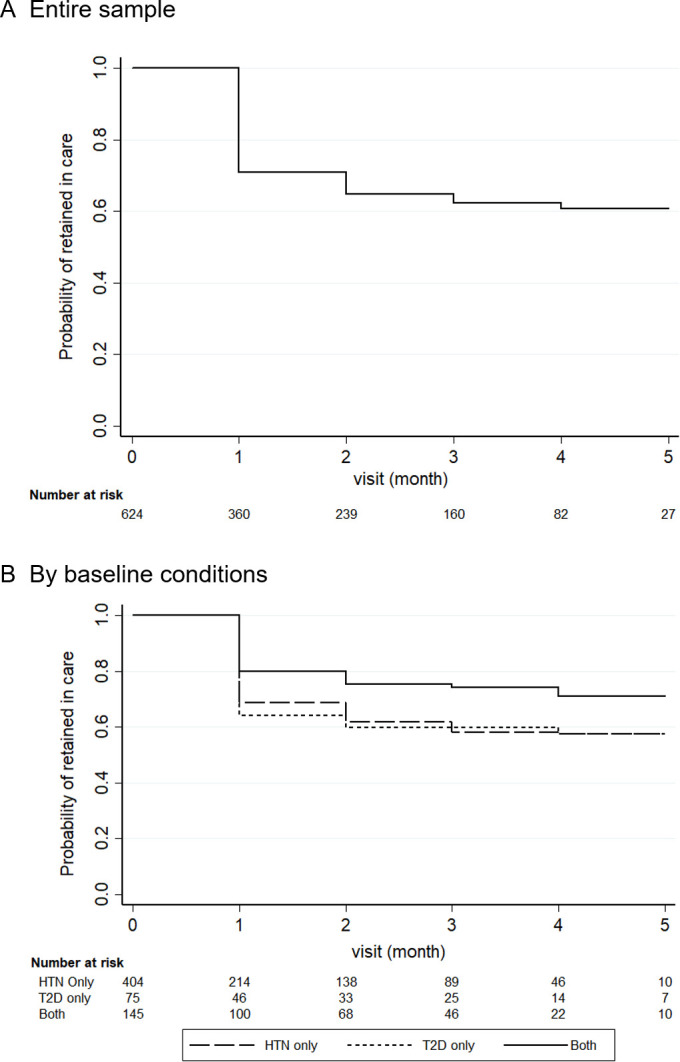
Results: The proportion of patients with uncontrolled blood pressure reduced from 60% at baseline to 26% at the third month of follow-up, a 56% (incidence rate ratio 0.44; 95% CI 0.33 to 0.57) reduction after adjustment for covariates. The proportion of patients with uncontrolled blood glucose decreased from 74% to 43% at the third month of follow-up. Attrition rates immediately after baseline and during the entire study period were 29.1% and 36.2%, respectively.
Conclusion: The proof-of-concept study highlights the potential for involving lower-level primary care facilities and non-physician health workers to rapidly expand much-needed services to patients with hypertension and diabetes in Bangladesh and in similar global settings. Further investigations are needed to evaluate the effectiveness of decentralised hypertension and diabetes care.
Keywords: diabetes & endocrinology; health services accessibility; hypertension.
© Author(s) (or their employer(s)) 2023. Re-use permitted under CC BY. Published by BMJ.
Conflict of interest statement
Competing interests: None declared.
Figures
References
-
- Zhou B, Carrillo-Larco RM, Danaei G, et al. Worldwide trends in hypertension prevalence and progress in treatment and control from 1990 to 2019: a pooled analysis of 1201 population-representative studies with 104 million participants. The Lancet 2021;398:957–80. 10.1016/S0140-6736(21)01330-1 - DOI - PMC - PubMed
-
- World Health Organization . Global action plan for the prevention and control of NCDs 2013–2020. 2013. Geneva: WHO, 2019.
Publication types
MeSH terms
Grants and funding
LinkOut - more resources
Full Text Sources
Medical
