


Drawing as a tool for investigating the nature of imagery representations of blind people: The case of the canonical size phenomenon
- PMID: 37985536
- PMCID: PMC11779753
- DOI: 10.3758/s13421-023-01491-7
Drawing as a tool for investigating the nature of imagery representations of blind people: The case of the canonical size phenomenon
Abstract
Several studies have shown that blind people, including those with congenital blindness, can use raised-line drawings, both for "reading" tactile graphics and for drawing unassisted. However, research on drawings produced by blind people has mainly been qualitative. The current experimental study was designed to investigate the under-researched issue of the size of drawings created by people with blindness. Participants (N = 59) varied in their visual status. Adventitiously blind people had previous visual experience and might use visual representations (e.g., when visualising objects in imagery/working memory). Congenitally blind people did not have any visual experience. The participant's task was to draw from memory common objects that vary in size in the real world. The findings revealed that both groups of participants produced larger drawings of objects that have larger actual sizes. This means that the size of familiar objects is a property of blind people's mental representations, regardless of their visual status. Our research also sheds light on the nature of the phenomenon of canonical size. Since we have found the canonical size effect in a group of people who are blind from birth, the assumption of the visual nature of this phenomenon - caused by the ocular-centric biases present in studies on drawing performance - should be revised.
Keywords: Adventitiously blind people; Canonical size; Congenitally blind people; Drawings; Imagery.
© 2023. The Author(s).
Conflict of interest statement
Declarations. Conflicts of interest/competing interests: The authors declare no competing interests. Ethics approval: The current experiment was conducted in accordance with the 1964 Helsinki declaration and its later amendments or comparable ethical standards and was approved by the ethics committee of the Institute of Psychology of The John Paul II Catholic University of Lublin, Poland. Consent to participate: Written informed consent was obtained from all participants included in the study prior to data collection. Consent for publication: Not applicable.
Figures
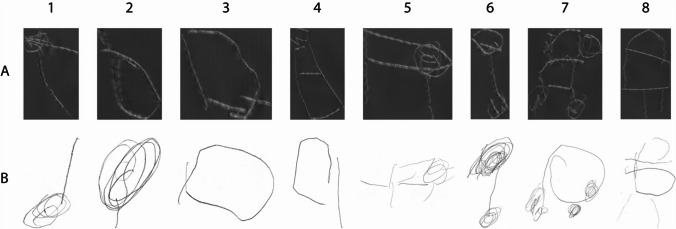
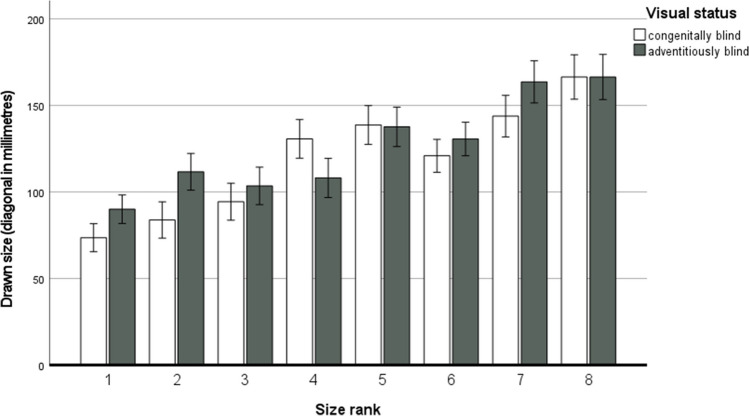
References
-
- Blanco, F., & Travieso, D. (2003). Haptic exploration and mental estimation of distances on a fictitious island: From mind’s eye to mind’s hand. Journal of Visual Impairment & Blindness, 97(5), 298–300. 10.1177/0145482X0309700505 - DOI
-
- Carboni, S., Kennedy, J. M., & Wnuczko, M. (2021). Parallel and sideways inverse perspective drawing of a cube top: By an adult who is blind. British Journal of Visual Impairment. Advance online publication.10.1177/02646196211009934
MeSH terms
LinkOut - more resources
Full Text Sources
