


Life expectancy can increase by up to 10 years following sustained shifts towards healthier diets in the United Kingdom
- PMID: 37985698
- PMCID: PMC10661734
- DOI: 10.1038/s43016-023-00868-w
Life expectancy can increase by up to 10 years following sustained shifts towards healthier diets in the United Kingdom
Abstract
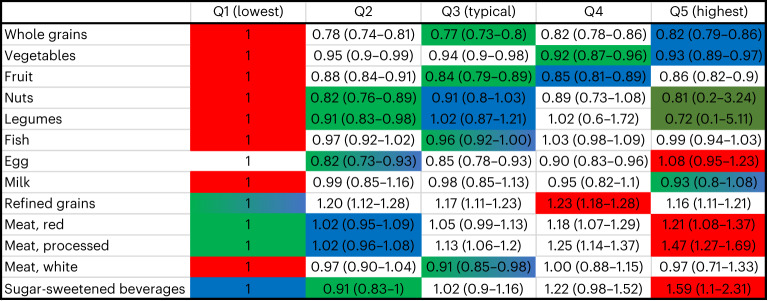
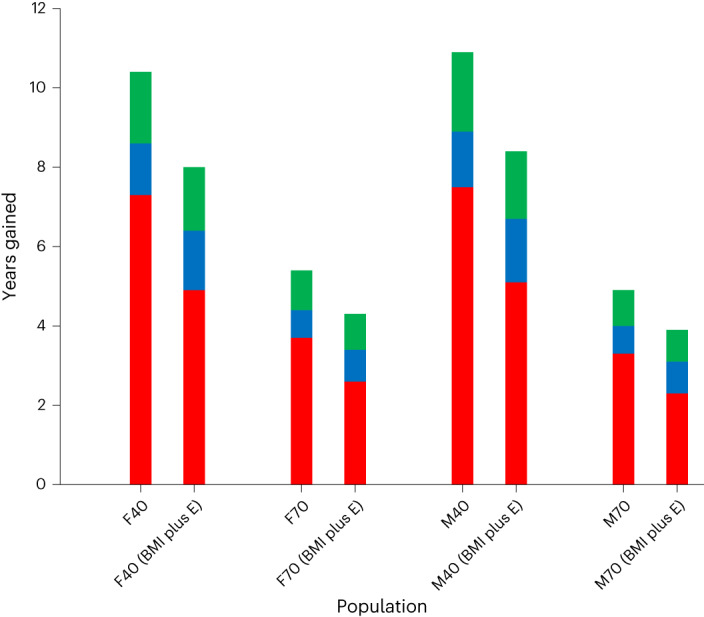
Adherence to healthy dietary patterns can prevent the development of non-communicable diseases and affect life expectancy. Here, using a prospective population-based cohort data from the UK Biobank, we show that sustained dietary change from unhealthy dietary patterns to the Eatwell Guide dietary recommendations is associated with 8.9 and 8.6 years gain in life expectancy for 40-year-old males and females, respectively. In the same population, sustained dietary change from unhealthy to longevity-associated dietary patterns is associated with 10.8 and 10.4 years gain in life expectancy in males and females, respectively. The largest gains are obtained from consuming more whole grains, nuts and fruits and less sugar-sweetened beverages and processed meats. Understanding the contribution of sustained dietary changes to life expectancy can provide guidance for the development of health policies.
© 2023. The Author(s).
Conflict of interest statement
The authors declare no competing interests.
Figures
References
-
- Global Burden of Disease Compare. Institute for Health Metrics and Evaluation http://vizhub.healthdata.org/gbd-compare (2020).
-
- Transforming Our World: The 2030 Agenda for Sustainable Development (United Nations, 2015).
-
- GBD 2017 Diet Collaborators. Health effects of dietary risks in 195 countries, 1990-2017: a systematic analysis for the Global Burden of Disease Study 2017. Lancethttps://www.ncbi.nlm.nih.gov/pubmed/30954305 (2019). - PMC - PubMed
Publication types
MeSH terms
Grants and funding
LinkOut - more resources
Full Text Sources
