. 2023 Nov 20;13(1):20277.
doi: 10.1038/s41598-023-46994-0.

Identifying who adolescents prefer as source of information within their social network

Affiliations

Identifying who adolescents prefer as source of information within their social network

Scarlett K Slagter et al. Sci Rep. .

Abstract

Adolescents are highly influenced by their peers within their social networks. This social influence can stem from both unsolicited peer pressure and the active search for guidance. While extensive research examined the mechanisms of peer pressure, little is known about who adolescents prefer as a source of information. To address this gap, we conducted two independent studies using a novel social search paradigm that allows participants to choose which social sources they wish to observe. In both studies, adolescents demonstrated a preference for their friends over non-friends, as well as for peers who were perceived as trustworthy. Across both studies, we found mixed evidence for the role of perceived popularity as a selection criterion. Notable, study 2 revealed the significance of "cool", "admirable" and "acting mean" as additional characteristics of preferred peers, traits that are often associated with elevated peer status. It also revealed an interest for peers perceived as being smart. These findings highlight the active role adolescents have in choosing social sources and emphasize the importance of multiple peer characteristics. Future research should investigate whether adolescents' interest in these types of peers is contingent upon specific social contexts, age groups, and peer cultures.


Conflict of interest statement

The authors declare no competing interests.

Figures
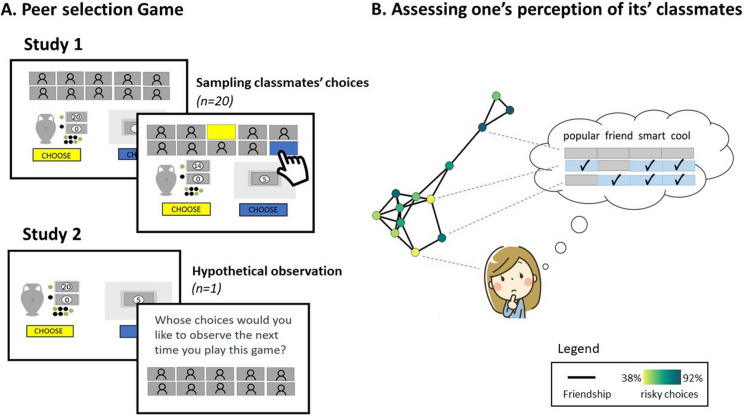
Figure 1
Figure 1
General set-up of study 1 and 2, to examine the peer characteristics of selected peers for choices made under uncertainty. (A) Study 1 consisted of two sessions. During the first session, participants played a decision-making game alone over 20 trials. In all trials participants had to choose between a sure option (blue; worth 5 points) or a risky option (yellow; a random draw from a gambling vase). The risky option resulted in 0 points, if a black ball was drawn, or an amount of either 8, 14, 20, 32 or 50 points (depending on the trial), if a green ball was drawn. In the follow-up session, participants selected the classmates of whom they wanted to see the choices, prior to making their own decision. Classmates’ real-made choices, obtained from the first session, were presented as covered boxes in a matrix (social board). The participant could reveal these choices by clicking on the grey boxes, which were labelled with the classmates’ names to indicate the origin of the choice. In study 2, participants played the same gambling game, but were asked at the end of the game hypothetically which classmates they wanted to observe when they would play the gambling game again. (B) To identify what type of peers participants did (not) select in the game, we used a peer nomination questionnaire. Participants nominated their classmates on various peer characteristics (e.g. smartness, popularity, trustworthiness) in the first session. Friendship nominations were also used to construct the classroom social network. Here, an example social network from one of the participating classrooms shows how participants (i.e. nodes) are connected (i.e. lines) within their classroom based on a mutual nomination of friendship by both parties. Node colour reflects the percentage of risky choices each classmate made in the game.
Figure 2
Figure 2
Predicted selection rate based on the model fit estimates across age for friends and most popular peers. (A) Predicted effect of friend (compared to non-friend). (B) Predicted selection rate for peers nominated as most popular contrasted against peers not attributed with that characteristic. Dots represent the estimated selection rate with 95% confidence intervals (CI) per age category.
Figure 3
Figure 3
Selection rate for peers grouped on network distance. (A) Example of a sampled classroom network based on friendship nominations, visualizing different network distances between nodes (i.e. classmates) based on the number of ties that separate these nodes. (B) Selection rate is highest for friends (network distance = 1), and decreases for peers further away in the classroom network. Black bars and notches indicate the median, the white diamonds the group mean selection rate and the boxes the interquartile range. Grey dots indicate the mean selection rate for an individual classmate for each participant. The number of observations for each network distance is displayed above the box plots.
Figure 4
Figure 4
Predicted selection rate across age for friends and most popular peers for sample 2. (A) Predicted effect of friend (compared to non-friend). (B) Predicted selection rate for peers nominated as most popular contrasted against peers not attributed with that characteristic. Dots represent the estimated selection rate with 95% confidence intervals (CI) per reported age.
Figure 5
Figure 5
Characteristics that described selected peers in study 2 at best. Depicted are the log odds of the most important characteristics, based on the full model with a Lasso regularization for variable selection. The parameter estimates of the other characteristics were set to zero. The error bars indicate the standard error of the parameter estimates.

References

    1. da Pinho AS, Molleman L, Braams BR, van den Bos W. Majority and popularity effects on norm formation in adolescence. Sci. Rep. 2021;11:12884. doi: 10.1038/s41598-021-92482-8. - DOI - PMC - PubMed
    1. Reiter A, et al. Preference uncertainty accounts for developmental effects on susceptibility to peer influence in adolescence. Nat. Commun. 2021 doi: 10.1038/s41467-021-23671-2. - DOI - PMC - PubMed
    1. Choukas-Bradley S, Giletta M, Cohen GL, Prinstein MJ. Peer influence, peer status, and prosocial behavior: An experimental investigation of peer socialization of adolescents’ intentions to volunteer. J. Youth Adolesc. 2015;44:2197–2210. doi: 10.1007/s10964-015-0373-2. - DOI - PMC - PubMed
    1. van Hoorn J, van Dijk E, Meuwese R, Rieffe C, Crone EA. Peer influence on prosocial behavior in adolescence. J. Res. Adolesc. 2016;26:90–100. doi: 10.1111/jora.12173. - DOI
    1. Leung RK, Toumbourou JW, Hemphill SA. The effect of peer influence and selection processes on adolescent alcohol use: A systematic review of longitudinal studies. Health Psychol. Rev. 2014;8:426–457. doi: 10.1080/17437199.2011.587961. - DOI - PubMed
