


Bipolar ionization rapidly inactivates real-world, airborne concentrations of infective respiratory viruses
- PMID: 37992037
- PMCID: PMC10664916
- DOI: 10.1371/journal.pone.0293504
Bipolar ionization rapidly inactivates real-world, airborne concentrations of infective respiratory viruses
Abstract
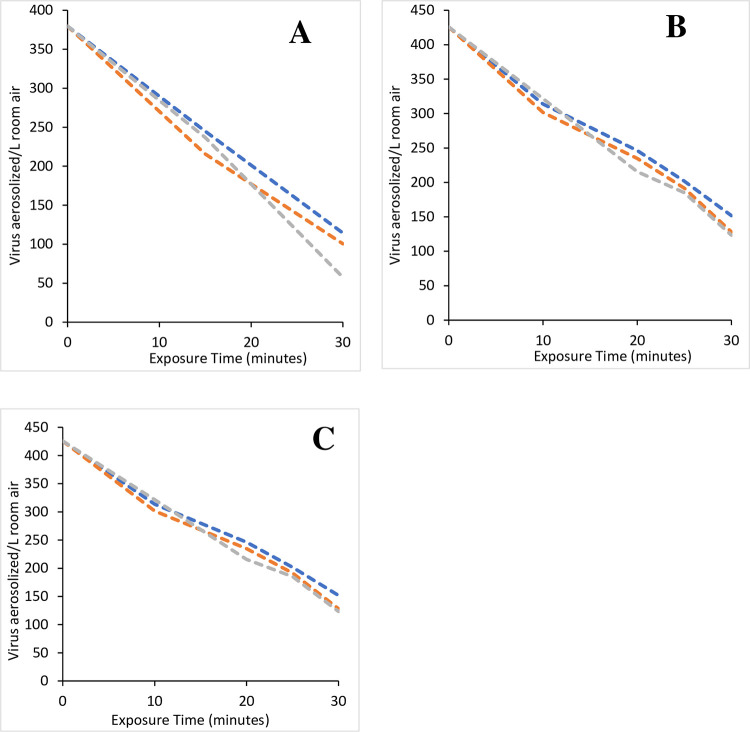
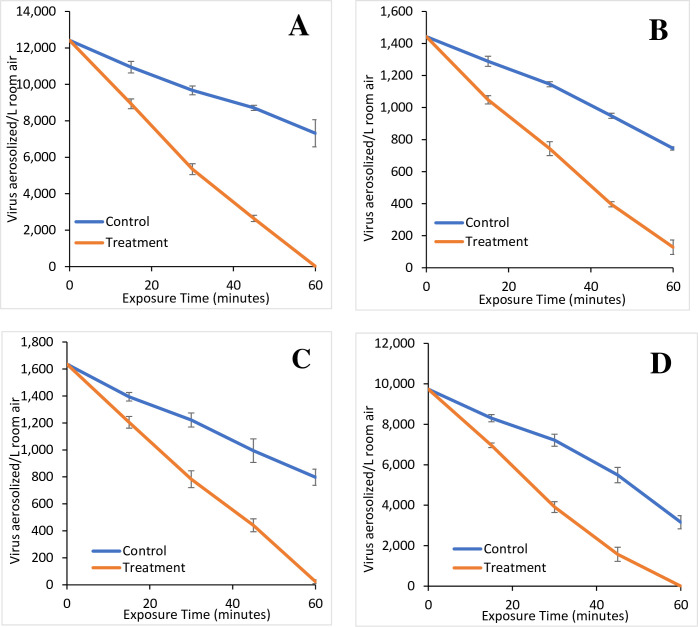
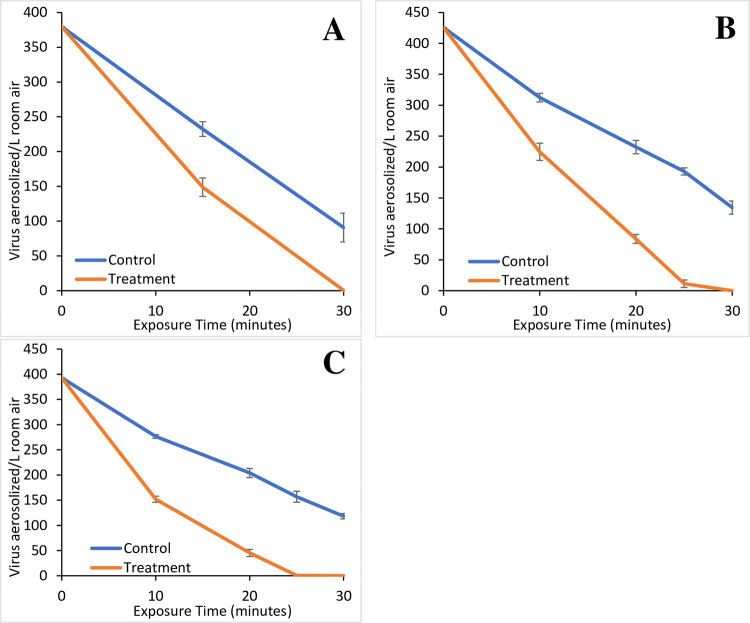
The SARS-CoV-2 (COVID-19) pandemic has highlighted the urgent need for strategies that rapidly inactivate airborne respiratory viruses and break the transmission cycle of indoor spaces. Air ions can reduce viable bacteria, mold, and virus counts, however, most studies use small test enclosures with target microbes and ion sources in close vicinity. To evaluate ion performance in real-world spaces, experiments were conducted in a large, room-size BSL-3 Chamber. Negative and positive ions were delivered simultaneously using a commercially available bipolar air ion device. The device housed Needle Point Bipolar ionization (NPBI) technology. Large chamber studies often use unrealistically high virus concentrations to ensure measurable virus is present at the trial end. However, excessively high viral concentrations bias air cleaning devices towards underperformance. Hence, devices that provide a substantial impact for protecting occupants in real-world spaces with real-world virus concentrations are often dismissed as poor performers. Herein, both real-world and excessive virus concentrations were studied using Influenza A and B, Human Respiratory Syncytial Virus (RSV), and the SARS-CoV-2 Alpha and Delta strains. The average ion concentrations ranged from 4,100 to 24,000 per polarity over 60-minute and 30-minute time trials. The reduction rate was considerably greater for trials that used real-world virus concentrations, reducing infectivity for Influenza A and B, RSV, and SARS-CoV-2 Delta by 88.3-99.98% in 30 minutes, whereas trials using in-excess concentrations showed 49.5-61.2% in 30 minutes. These findings strongly support the addition of NPBI ion technology to building management strategies aimed to protect occupants from contracting and spreading infective respiratory viruses indoors.
Copyright: © 2023 Sobek, Elias. This is an open access article distributed under the terms of the Creative Commons Attribution License, which permits unrestricted use, distribution, and reproduction in any medium, provided the original author and source are credited.
Conflict of interest statement
The authors have declared that no competing interests exist.
Figures
References
-
- Castaño N, Cordts SC, Kurosu Jalil M, Zhang KS, Koppaka S, Bick AD, et al. Fomite Transmission, Physicochemical Origin of Virus–Surface Interactions, and Disinfection Strategies for Enveloped Viruses with Applications to SARS-CoV-2. ACS Omega. 2021;6(10):6509–27. doi: 10.1021/acsomega.0c06335 - DOI - PMC - PubMed
-
- Cheng P, Luo K, Xiao S, Yang H, Hang J, Ou C, et al. Predominant airborne transmission and insignificant fomite transmission of SARS-CoV-2 in a two-bus COVID-19 outbreak originating from the same pre-symptomatic index case. Journal of Hazardous Materials. 2022;425:128051. doi: 10.1016/j.jhazmat.2021.128051 - DOI - PMC - PubMed
MeSH terms
Substances
LinkOut - more resources
Full Text Sources
Medical
Miscellaneous
