Covid-19 vaccine effectiveness against post-covid-19 condition among 589 722 individuals in Sweden: population based cohort study
- PMID: 37993131
- PMCID: PMC10666099
- DOI: 10.1136/bmj-2023-076990
Covid-19 vaccine effectiveness against post-covid-19 condition among 589 722 individuals in Sweden: population based cohort study
Erratum in
-
Covid-19 vaccine effectiveness against post-covid-19 condition among 589 722 individuals in Sweden: population based cohort study.BMJ. 2024 Feb 20;384:q434. doi: 10.1136/bmj.q434. BMJ. 2024. PMID: 38378193 Free PMC article. No abstract available.
Abstract
Objective: To investigate the effectiveness of primary covid-19 vaccination (first two doses and first booster dose within the recommended schedule) against post-covid-19 condition (PCC).
Design: Population based cohort study.
Setting: Swedish Covid-19 Investigation for Future Insights-a Population Epidemiology Approach using Register Linkage (SCIFI-PEARL) project, a register based cohort study in Sweden.
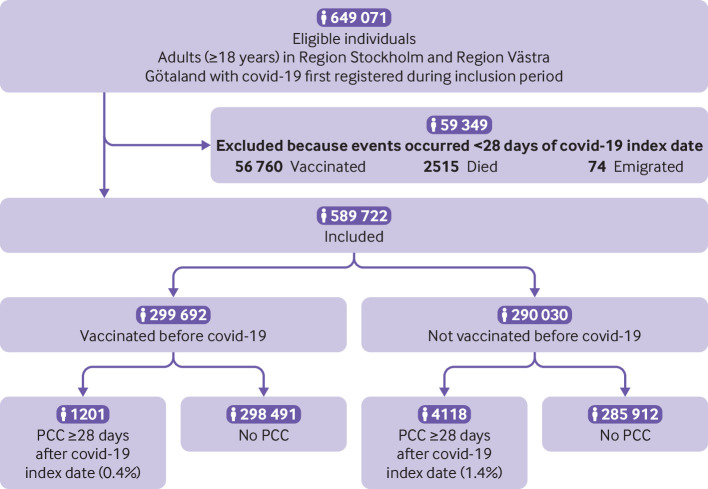
Participants: All adults (≥18 years) with covid-19 first registered between 27 December 2020 and 9 February 2022 (n=589 722) in the two largest regions of Sweden. Individuals were followed from a first infection until death, emigration, vaccination, reinfection, a PCC diagnosis (ICD-10 diagnosis code U09.9), or end of follow-up (30 November 2022), whichever came first. Individuals who had received at least one dose of a covid-19 vaccine before infection were considered vaccinated.
Main outcome measure: The primary outcome was a clinical diagnosis of PCC. Vaccine effectiveness against PCC was estimated using Cox regressions adjusted for age, sex, comorbidities (diabetes and cardiovascular, respiratory, and psychiatric disease), number of healthcare contacts during 2019, socioeconomic factors, and dominant virus variant at time of infection.
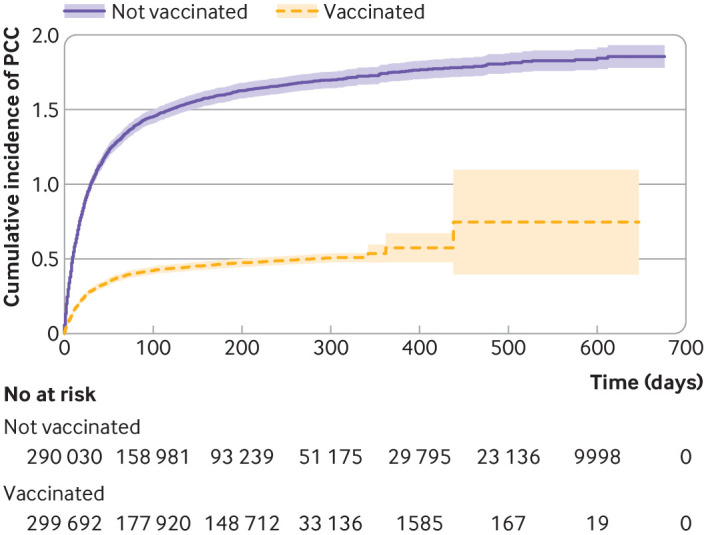
Results: Of 299 692 vaccinated individuals with covid-19, 1201 (0.4%) had a diagnosis of PCC during follow-up, compared with 4118 (1.4%) of 290 030 unvaccinated individuals. Covid-19 vaccination with any number of doses before infection was associated with a reduced risk of PCC (adjusted hazard ratio 0.42, 95% confidence interval 0.38 to 0.46), with a vaccine effectiveness of 58%. Of the vaccinated individuals, 21 111 received one dose only, 205 650 received two doses, and 72 931 received three or more doses. Vaccine effectiveness against PCC for one dose, two doses, and three or more doses was 21%, 59%, and 73%, respectively.
Conclusions: The results of this study suggest a strong association between covid-19 vaccination before infection and reduced risk of receiving a diagnosis of PCC. The findings highlight the importance of primary vaccination against covid-19 to reduce the population burden of PCC.
© Author(s) (or their employer(s)) 2019. Re-use permitted under CC BY. No commercial re-use. See rights and permissions. Published by BMJ.
Conflict of interest statement
Competing interests: All authors have completed the ICMJE uniform disclosure form at www.icmje.org/disclosure-of-interest/ and declare: support from the Swedish Society for Medical Research, the Swedish Research Council for Health, Working life, and Welfare (FORTE), and the Swedish Research Council for the submitted work; MB is funded through research grants from the Swedish Society for Medical Research, the Swedish Research Council for Health, Working Life, and Welfare (FORTE), and the Swedish Research Council; SL was funded by a Swedish government research grant through the ALF-agreement; SL has been employed by AstraZeneca since January 2023; MG receives funding through a Swedish government research grant through the ALF-agreement, Swedish Research Council, King Gustaf V:s and Queen Victoria’s Foundation, and from the Swedish Research Council for Sustainable Development (FORMAS); MG has received research grants from Gilead Sciences and honorariums as speaker, member of the data safety and monitoring board and scientific advisor for Amgen, AstraZeneca, Biogen, Bristol-Myers Squibb, Gilead Sciences, GlaxoSmithKline/ViiV Healthcare, Janssen-Cilag, MSD, Novocure, Novo Nordic, Pfizer, and Sanofi; FN was funded for the submitted work by a Swedish government research grant through the ALF-agreement and by a previous joint grant from the Swedish Research Council for Health, Working Life, and Welfare (FORTE) and the Swedish Research Council for Sustainable Development (FORMAS); FN is funded through research grants from the Swedish Research Council, Swedish Heart Lung Foundation, SciLifeLab/Knut and Alice Wallenberg Foundation, and Swedish Social Insurance Agency; FN was employed by AstraZeneca until 2019 and owns some AstraZeneca shares; no other relationships or activities that could appear to have influenced the submitted work.
Figures
Comment in
-
Does timely vaccination help prevent post-viral conditions?BMJ. 2023 Nov 22;383:2633. doi: 10.1136/bmj.p2633. BMJ. 2023. PMID: 37993122 No abstract available.
References
-
- Coronavirus WHO. (COVID-19) Dashboard. World Health Organization 2023. https://covid19.who.int
-
- Regionernas planering avseende vaccinering mot covid-19, delrapport 6. [The planning regarding vaccination against Covid-19 for regions, report 6]. Stockholm, Sweden: Sveriges Kommuner och Regioner, SKR; 2021. https://skr.se/download/18.5bb54e0c179a302981232fd/1621980314035/Regione...
MeSH terms
Substances
LinkOut - more resources
Full Text Sources
Medical