Review
. 2023 Nov 22;11(11):e007798.
doi: 10.1136/jitc-2023-007798.

Neuroblastoma: an ongoing cold front for cancer immunotherapy

Affiliations
Review

Neuroblastoma: an ongoing cold front for cancer immunotherapy

Paul T Kennedy et al. J Immunother Cancer. .

Abstract

Neuroblastoma is the most frequent extracranial childhood tumour but effective treatment with current immunotherapies is challenging due to its immunosuppressive microenvironment. Efforts to date have focused on using immunotherapy to increase tumour immunogenicity and enhance anticancer immune responses, including anti-GD2 antibodies; immune checkpoint inhibitors; drugs which enhance macrophage and natural killer T (NKT) cell function; modulation of the cyclic GMP-AMP synthase-stimulator of interferon genes pathway; and engineering neuroblastoma-targeting chimeric-antigen receptor-T cells. Some of these strategies have strong preclinical foundation and are being tested clinically, although none have demonstrated notable success in treating paediatric neuroblastoma to date. Recently, approaches to overcome heterogeneity of neuroblastoma tumours and treatment resistance are being explored. These include rational combination strategies with the aim of achieving synergy, such as dual targeting of GD2 and tumour-associated macrophages or natural killer cells; GD2 and the B7-H3 immune checkpoint; GD2 and enhancer of zeste-2 methyltransferase inhibitors. Such combination strategies provide opportunities to overcome primary resistance to and maximize the benefits of immunotherapy in neuroblastoma.

Keywords: Immunotherapy; Neuroblastoma; Tumor Microenvironment.


Conflict of interest statement

Competing interests: None declared.

Figures
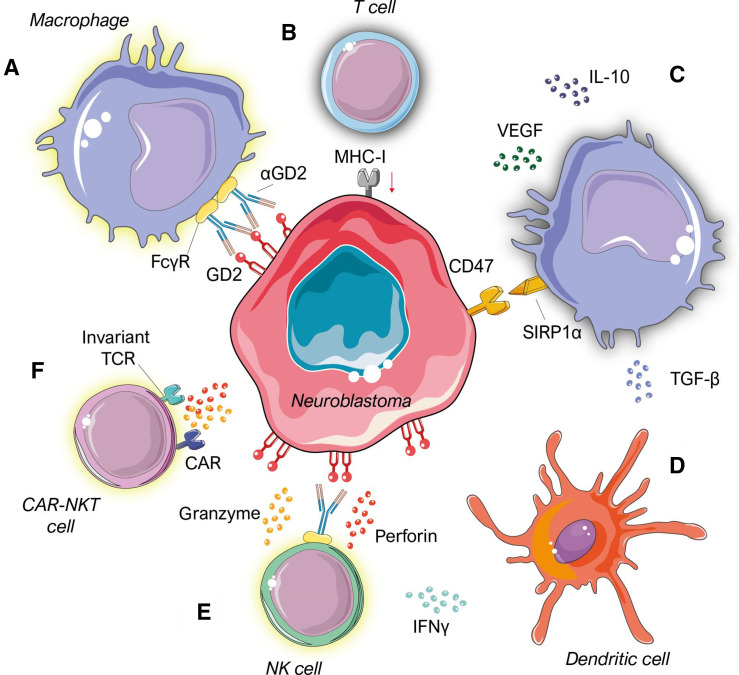
Figure 1
Figure 1
Targets for immunotherapy within the neuroblastoma tumour microenvironment. (A) GD2 expression represents an attractive therapeutic target due to ubiquitous and abundant expression in neuroblastoma regardless of disease stage, in addition to limited expression in other cell types. (B) Targeting neuroblastoma specific GD2 expression with monoclonal antibodies promotes tumour cell phagocytosis by macrophages via antibody dependent cellular cytotoxicity. The neuroblastoma tumour microenvironment often lacks significant infiltration and activation of T cells and is instead dominated by tumour-promoting stromal cells such as tumour-associated macrophages. Amplification of the MYCN oncogene is often associated with reduced major histocompatibility complex class I (MHC-I) expression, which reduces presentation of tumour-associated antigens and compromises T-cell recognition and elimination of neuroblastomas. (C) Neuroblastoma overexpression of “don’t eat me” signal CD47 inhibits effective phagocytosis by macrophages through signal regulatory protein alpha (SIRP1α) interaction. TAMs also secrete cocktails of chemokines and cytokines, such as VEGF and the potently immunosuppressive IL-10, which promote immune evasion and tumour growth. (D) Dendritic cells secrete pro-inflammatory cytokines which activate NK cells in the neuroblastoma TME. (E) NK cells also facilitate antibody-dependent cellular cytotoxicity and can target neuroblastoma via MHC-I-independent cytotoxic mechanisms. Secretion of cytolytic granules granzyme-B and perforin induces tumour cell lysis.(F) Adoptive transfer of molecularly engineered CAR-NKT cells enhances NK-cell mediated targeting and clearance of neuroblastoma cells. CAR, chimeric-antigen receptor; IFN, interferon; IL, interleukin; NK, natural killer; NKT, natural killer T cell; TCR, T cell receptor; TGF, transforming growth factor; VEGF, vascular endothelial growth factors.
Figure 2
Figure 2
tumour associated macrophages as therapeutic targets in neuroblastoma. (A) tumour associated macrophages (TAMs) secrete stroma-regulating mediators such as matrix metalloproteinases, vascular endothelial growth factors (VEGF), endothelial growth factors (EGF) and chemokines (CCL2) which promote cancer cell growth and proliferation, angiogenesis, and tumour metastasis. (B) TAM-derived interleukins (IL-9 and IL-10), growth factors (TGF-β) and chemokines (CXCL9 and CXCL10) attenuate T-cell effector responses. T-cell effector responses may be promoted using monoclonal antibodies for immune checkpoint blockade (ICB), such as the anti-PD-1 antibody pembrolizumab. (C) CD47 expression masks neuroblastoma cells from surveillance and targeting by phagocytes. Anti-CD47 antibodies reduce tumour immune evasion and enhance cancer cell phagocytosis by macrophages. (D) Neuroblastoma cells secrete colony stimulating factor 1 (CSF-1) to promote TAM recruitment to the tumour microenvironment. Since macrophage infiltration is a poor prognostic indicator in neuroblastoma, anti-CSF antibodies may inhibit CSF-1R activation and cell trafficking. Immunotherapy strategies are indicated in red. PD-1, programmed cell death protein-1; PD-L1, programmed death-ligand 1; SIRP1α, signal regulatory protein alpha.
Figure 3
Figure 3
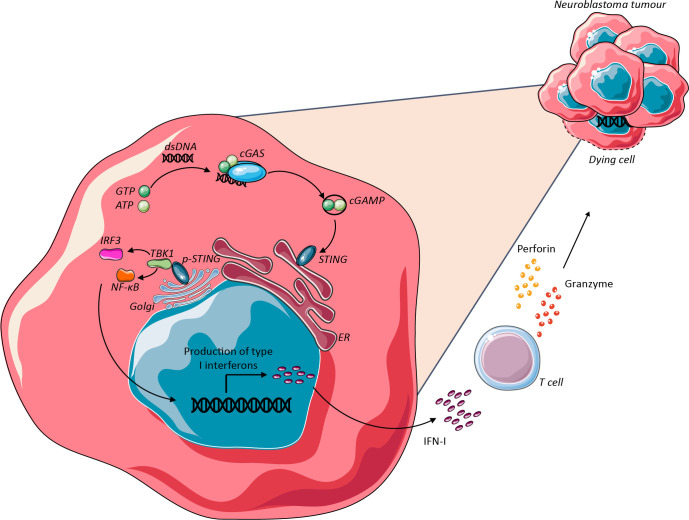
The STING pathway activation against neuroblastoma. Radiation therapy causes damage to cancer cells leading to cell death and release of double stranded DNA (dsDNA). Tumour cell-derived dsDNA binds to cyclic GMP-AMP synthase (cGAS) leading to the production of cyclic GMP-AMP (cGAMP) and subsequent activation of the stimulator of interferon genes (STING). Activated STING undergoes ER to Golgi translocation and activates tank binding kinase (TBK1), interferon regulatory factor (IRF3) and the transcription regulator NF-κB. These trigger pro-inflammatory gene expression, recruitment of CD8+ T cells and promote anti-tumour cytotoxic activity. (Adapted from Garland et al, Saulters et al112). dsDNA, double-stranded deoxyribonucleic acid; ER, endoplasmic reticulum; IFN, interferon; NF-κB, nuclear factor kappa-light-chain-enhancer of activated B cells; pSTING, phosphorylated stimulator of interferon genes .

References

    1. London WB, Castleberry RP, Matthay KK, et al. . Evidence for an age cutoff greater than 365 days for neuroblastoma risk group stratification in the children's oncology group. J Clin Oncol 2005;23:6459–65. 10.1200/JCO.2005.05.571 - DOI - PubMed
    1. Matthay KK, Maris JM, Schleiermacher G, et al. . Neuroblastoma. Nat Rev Dis Primers 2016;2:16078. 10.1038/nrdp.2016.78 - DOI - PubMed
    1. Pinto NR, Applebaum MA, Volchenboum SL, et al. . Advances in risk classification and treatment strategies for neuroblastoma. J Clin Oncol 2015;33:3008–17. 10.1200/JCO.2014.59.4648 - DOI - PMC - PubMed
    1. Wienke J, Dierselhuis MP, Tytgat GAM, et al. . The immune landscape of neuroblastoma: challenges and opportunities for novel therapeutic strategies in pediatric oncology. Eur J Cancer 2021;144:123–50. 10.1016/j.ejca.2020.11.014 - DOI - PubMed
    1. Blavier L, Yang R-M, DeClerck YA. The tumor microenvironment in neuroblastoma: new players, new mechanisms of interaction and new perspectives. Cancers (Basel) 2020;12:2912. 10.3390/cancers12102912 - DOI - PMC - PubMed

Publication types