. 2023 Nov 22;13(1):20524.
doi: 10.1038/s41598-023-47726-0.

Interplay between stress, sleep, and BDNF in a high-risk sample of young adults

Affiliations

Interplay between stress, sleep, and BDNF in a high-risk sample of young adults

Nimmy Varghese et al. Sci Rep. .

Abstract

Children in institutional care have a high risk to experience childhood adversities (CAs), with consequences for physical and mental well-being. The long-term effects of CAs on the brain, including consequences for neuronal plasticity and sleep, are poorly understood. This study examined the interplay between stress (including CAs), sleep, and brain-derived neurotrophic factor (BDNF), a prominent marker for neuronal plasticity. Participants (N = 131, mean age = 26.3±3.4 years, 40 females) with residential youth-care history completed questionnaires measuring CAs (Childhood Trauma Questionnaire, CTQ), psychological well-being (World Health Organization-Five Well-Being Index, WHO-5), and sleep disturbances (Pittsburgh Sleep Quality Inventory, PSQI). Hair cortisol and serum BDNF concentration were measured using enzyme-linked immunosorbent assays. The analyses were conducted by using bootstrap regression models. There was no association of stress parameters or sleep with BDNF concentration. However, we found a significant association of CAs and well-being with sleep disturbances. Last, we found an association between CAs and BDNF in sleep-healthy but not sleep-disturbed participants. Our findings indicated a role of sleep disturbance in the association between stress and BDNF. Still, further studies are warranted using vulnerable groups at-risk to understand long-term effects on mental health and sleep.


Conflict of interest statement

The authors declare no competing interests.

Figures

Figure 1
Figure 1
Linear associations of serum BDNF with with (a) CTQ Total Score (H1a); (b) Hair Cortisol Concentration (H1b); and (c) WHO-5 Total Score (H1c). The dots represent the individual subjects, with the darker dots representing overlapping dots. Abbreviations: sBDNF = serum Brain-derived neurotrophic factor; CTQ = Childhood Trauma Questionnaire; WHO-5: World Health Organization Questionnaire.
Figure 2
Figure 2
Linear associations of PSQI Sleep Disturbance Score with (a) BDNF concentration (H2a); (b) CTQ Total Score (H2b); (c) hair cortisol concentration (H2c); and d) WHO-5 Total Score (H2d). The dots represent the individual subjects, with the darker dots representing overlapping dots. Abbreviations: BDNF = Brain-derived neurotrophic factor; CTQ = Childhood Trauma Questionnaire; PSQI: Pittsburgh Sleep Quality Inventory; WHO-5: World Health Organization Questionnaire.
Figure 3
Figure 3
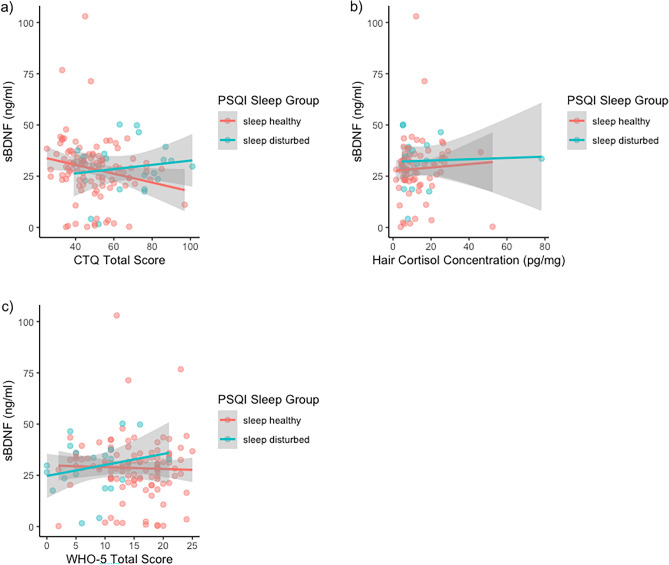
Linear associations by PSQI Sleep Disturbance group between BDNF concentration and (a) CTQ total score; (b) hair cortisol concentration; and (c) WHO-5 score. Abbreviations: BDNF = Brain-derived neurotrophic factor; CTQ = Childhood Trauma Questionnaire; PSQI: Pittsburgh Sleep Quality Inventory; WHO-5: World Health Organization Questionnaire.

References

    1. McEwen BS. Physiology and neurobiology of stress and adaptation: central role of the brain. Physiol. Rev. 2007;87(3):873–904. doi: 10.1152/physrev.00041.2006. - DOI - PubMed
    1. Humphreys KL, et al. Evidence for a sensitive period in the effects of early life stress on hippocampal volume. Dev. Sci. 2019;22(3):e12775. doi: 10.1111/desc.12775. - DOI - PMC - PubMed
    1. Heim C, Binder EB. Current research trends in early life stress and depression: review of human studies on sensitive periods, gene-environment interactions, and epigenetics. Exp. Neurol. 2012;233(1):102–111. doi: 10.1016/j.expneurol.2011.10.032. - DOI - PubMed
    1. Gander T, et al. Predictive factors for changes in quality of life among children and adolescents in youth welfare institutions. Soc. Psychiatry Psychiatr. Epidemiol. 2019;54(12):1575–1586. doi: 10.1007/s00127-019-01724-8. - DOI - PubMed
    1. Garcia AR, et al. Adverse childhood experiences among youth reported to child welfare: Results from the national survey of child & adolescent wellbeing. Child Abuse Negl. 2017;70:292–302. doi: 10.1016/j.chiabu.2017.06.019. - DOI - PubMed

Substances