


Understanding factors associated with the trajectory of subjective cognitive complaints in groups with similar objective cognitive trajectories
- PMID: 37993894
- PMCID: PMC10666380
- DOI: 10.1186/s13195-023-01348-w
Understanding factors associated with the trajectory of subjective cognitive complaints in groups with similar objective cognitive trajectories
Abstract
Background: Cognitive complaints are often regarded as an early sign of Alzheimer's disease (AD) but may also occur in several other conditions and contexts. This study examines the correlates of cognitive complaint trajectories over a 5-year period in individuals who shared similar objective cognitive trajectories.
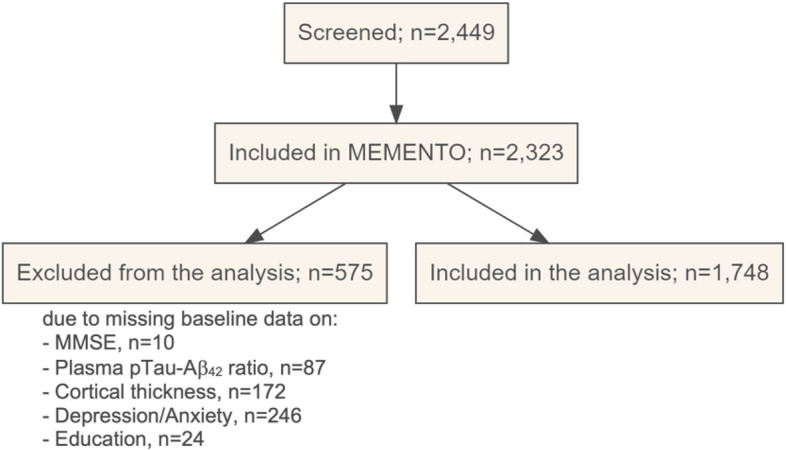
Methods: We analyzed a subsample (n = 1748) of the MEMENTO cohort, consisting of individuals with subjective cognitive decline or mild cognitive impairment at baseline. Participants were stratified based on their latent MMSE trajectory over a 5-year period: "high and increasing," "subtle decline," and "steep decline." Within each of the three strata, we used a latent-class longitudinal approach to identify distinct trajectories of cognitive complaints. We then used multiple logistic regressions to examine the association between these complaint trajectories and several factors, including AD biomarkers (blood pTau/Aβ42 ratio, cortical thickness, APOE genotype), anxiety, depression, social relationships, a comorbidity-polypharmacy score, and demographic characteristics.
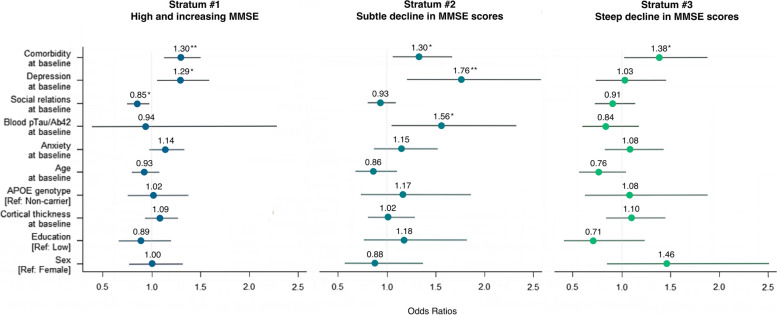
Results: Among participants with high and increasing MMSE scores, greater baseline comorbidity-polypharmacy scores (odds ratio (OR) = 1.30, adjusted p = 0.03) were associated with higher odds of moderate and increasing cognitive complaints (as opposed to mild and decreasing complaints). Baseline depression and social relationships also showed significant associations with the complaint pattern but did not survive correction for multiple comparisons. Among participants with subtle decline in MMSE scores, greater baseline depression (OR = 1.76, adjusted p = 0.02) was associated with higher odds of moderate and increasing cognitive complaints (versus mild and decreasing). Similarly, baseline comorbidity-polypharmacy scores and pTau/Aβ42 ratio exhibited significant associations, but they did not survive correction. Among participants with a steep decline in MMSE scores, greater baseline comorbidity-polypharmacy scores increased the odds of moderate complaints (versus mild, OR = 1.38, unadjusted p = 0.03, adjusted p = 0.32), but this effect did not survive correction for multiple comparisons.
Conclusions: Despite similar objective cognitive trajectory, there is heterogeneity in the subjective perception of these cognitive changes. This perception was explained by both AD-related and, more robustly, non-AD-related factors. These findings deepen our understanding of the multifaceted nature of subjective cognitive complaints in individuals at risk for dementia and underscore the importance of considering a range of factors when interpreting cognitive complaints.
Keywords: Alzheimer’s disease; Blood-based AD biomarkers; Cognitive complaints; Cohort study; Comorbidity-polypharmacy; Dementia risk; Depression; Latent class mixed model; Loneliness; Longitudinal study; Objective cognitive trajectories.
© 2023. The Author(s).
Conflict of interest statement
The authors declare no competing interests.
Figures


References
-
- Jessen F, Amariglio RE, Van Boxtel M, Breteler M, Ceccaldi M, Chételat G, Dubois B, Dufouil C, Ellis KA, Van Der Flier WM. A conceptual framework for research on subjective cognitive decline in preclinical Alzheimer’s disease. Alzheimers Dement. 2014;10:844–852. doi: 10.1016/j.jalz.2014.01.001. - DOI - PMC - PubMed
Publication types
MeSH terms
LinkOut - more resources
Full Text Sources
Medical
Miscellaneous
